More than one regular reader and contributor offered to write a tribute to Gustav Büsing – Chevrolet Europe PR Serge Vanbockryck provided these words in remembrance of a dearly departed friend and colleague.
I met Gustav Büsing for the first time in the second half of the 1980s, when I had just started as a freelance journalist covering the World Sports-Prototype Championship, or Group C as it was more commonly known. In those days, in small-town Belgium, if you were passionate about your sportscar racing you had to get your informative kicks from foreign magazines and books, as the Belgian motorsports media landscape was, well, small-town.
 Thus, names like Gustav’s, and those of Michael Cotton in England, Jean-Marc Teissèdre in France, Peter Wyss in Switzerland and Jonathan Ingram in the USA, sounded very familiar to me years before I started writing myself, though only from reading them under the articles they wrote for the top-class publications in their respective countries.
In those pre-digital days of arguably the best era ever in sportscar racing, print media coverage was still important, elaborate and very detailed, with more room for words than for pictures, and those who still had more to say did so by writing books. The gentlemen mentioned above all did and most still do, for their opinions were and always are well-founded, constructive and respected by all.
Gustav was one of those names which were a guarantee for thoroughly researched and well-written books on sportscar racing. The first – of many – of his books I bought was “Der Porsche 956/962” in 1986, a standard work he co-wrote with the late Lothar Boschen and which covered in minute detail the development and history of the Porsches 956 and 962 from 1982 till 1986. Thirty years on it is still a work of reference and it is the one book which triggered my own obsession with the chassis histories of specific Group C cars. Many more reference works by Büsing’s hand, on Porsches (often co-written with Porsche’s own Jürgen Barth), the WS-PC, the DRM, etc. would follow and today surely sit on most sportscar professionals shelves.
As luck would have it, over the course of my journalistic years I would get to befriend all of authors mentioned earlier, and I would shamelessly pick their brains and learn from their experiences stretching back decades in time. To me, and many others, they truly are sportscars racing’s “League of Gentlemen”, of which now one member has sadly passed away. Though Gustav was 72 years old, he still made it to most WEC and other classic endurance races, more often than not accompanied by Rainer Braun, another of those German motorsport writer monuments. “Because I’m still having fun, mein Lieber” he would say when asked why he still worked as hard as he did at the races.
This past Le Mans, as every year, I bumped into Gustav at scrutineering and handed him his access pass to Corvette Racing’s media hospitality suite, reminding him of our “Meet The Team” over lunch on the Wednesday and Thursday. As every year he promised he would try to make it, but – as every year – he didn’t quite make it, for Gustav knew at least half the working paddock and was never able to take more than a dozen paces before being held up by someone for a “remember when?”-conversation. That, and the fact he was always working on the next project, meant he would rather spend his time working his paddock sources than chit-chatting in a hospitality suite.
This year, in Spa, he told me Peter Sauber had asked him to find out whether he (Sauber) had really sold the 1986 Nürburgring 1000km winning car (pictured below – Mercedes’ first sportscar win since 1955) to French privateer Noël del Bello and whether I could shed some light on the subject.
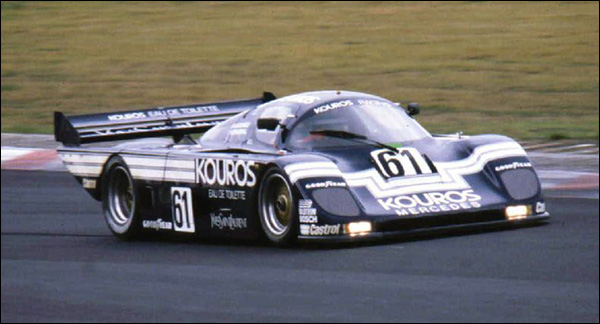
I looked through all my data at home, and told Gustav in Le Mans, that, yes, Sauber had indeed sold this very historic car to a privateer (the only Sauber-Mercedes to ever be sold) and not one of the other two cars the team had used that year in testing and/or racing. He thanked me, apologized for not having made the “Meet the Team” and promised to try and make it to our hospitality at some point during the race if at all he could, for he was again commentating the race for host broadcaster Eurosport. As fate would have it, it was the last time we spoke.
With Gustav Büsing the first of those household names of the Group C era disappears, at a time when sportscar racing is again all about saving energy and outsmarting the competition when using it. In more than one way, with Porsche again winning Le Mans overall in an energy-driven formula, sportscar racing has come full-circle, and had he lived a little longer, Gustav Büsing would surely have written another reference work about it.
Serge Vanbockryck