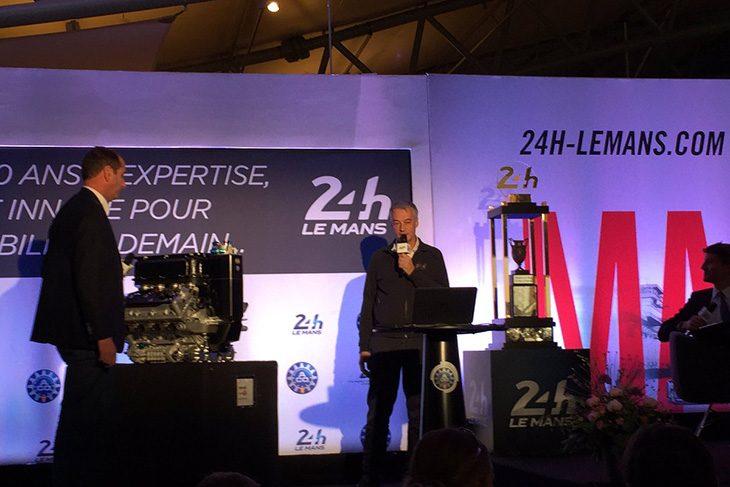

The ACO’s traditional press conference ahead of the Le Mans 24 Hours focused on the future of prototype racing at the world-famous race.
LMP1
The LMP1 Hybrid cars will see a variety of changes as of 2017. In a an attempt to reduce the aero advantage over the private entries, the ACO has opted to increase the height of the front splitter by 15mm and adjust the size of the rear diffuser.
The ACO is also attempting to make the cars safer in 2018, including a survival cell similar to the current crop of GTE cars, as well as an increased height of the cockpit to improve access to the driver and free up space around the drivers helmet. By making the height increase it will increase frontal shock risk.
Driving position is affected by the height change, the driver’s seat angle has been altered to a minimum of 55 degrees, to achieve a less reclined position, reducing the risk of vertebral damage in an impact. The hybrid components will also be isolated from the drivers.

Also in 2018, there’s an increase to 10 megajoule maximum power from eight, an increase to the three potential ERS’ (Energy Recovery Systems) in each car from two, and a reduction in fuel consumption by a further eight percent.
P1 privateer
In a bid to attract further entries in the diminishing sub-class, the ACO has committed to further changes to close the performance gap between privateer P1 cars and hybrid manufacturer entries.
To do this, the minimum weight has been reduced to 830kg from 855kg. The width of the cars and rear wings has also increased, to attract more aerodynamic developments.
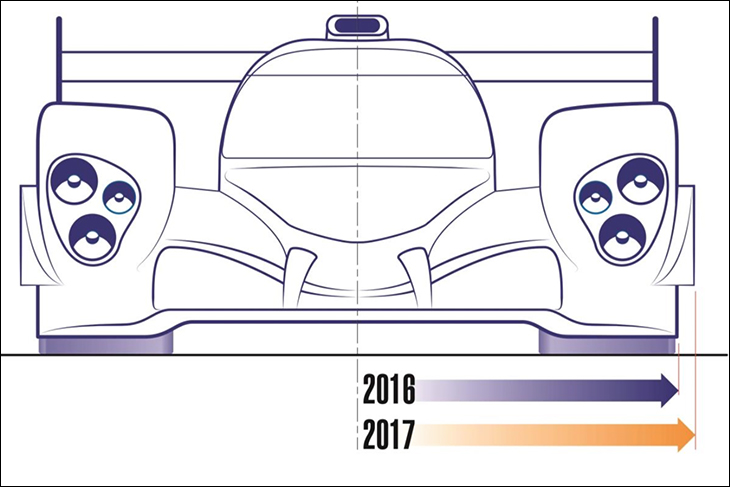
As was hinted earlier in the year by DSC, a DRS (Drag Reduction System) is also being considered for the rear wings in 2018, but any specific details were not given.
LMP2
Next year is of course the first year of the new regulations for the secondary prototype division. The biggest news was the first sighting of the new spec Gibson GK428 power plant, which is a normally aspirated V8, producing 600hp (an increase from 500) and 4169cc.

The new Gibson engine claims to lessen the cost per hour from €1300 to €1250. Technical support is also now included in the engine leasing agreement.
The distant future
The ACO is continuing to explore further technological advancements for P1 cars, which we could see implemented down the line.
ACO sporting director Vincent Beaumesnil stated that there is a movement to consider all-electric, solar, bio-methane and hydrogen fuel cell solutions, and combinations thereof, utilising Equivalence of Technology regulations.
The storage of energy is a development target, as frequent recharging of recovered energy is currently a barrier for several hours of continuous running. Hydrogen technology is a viable solution to this, the ACO suggested.
Working groups have been set up with manufactures to work towards a zero-emissions future at the Le Mans 24 Hours.