Marcos tops the billing at St Saturnin's annual Classic Festival
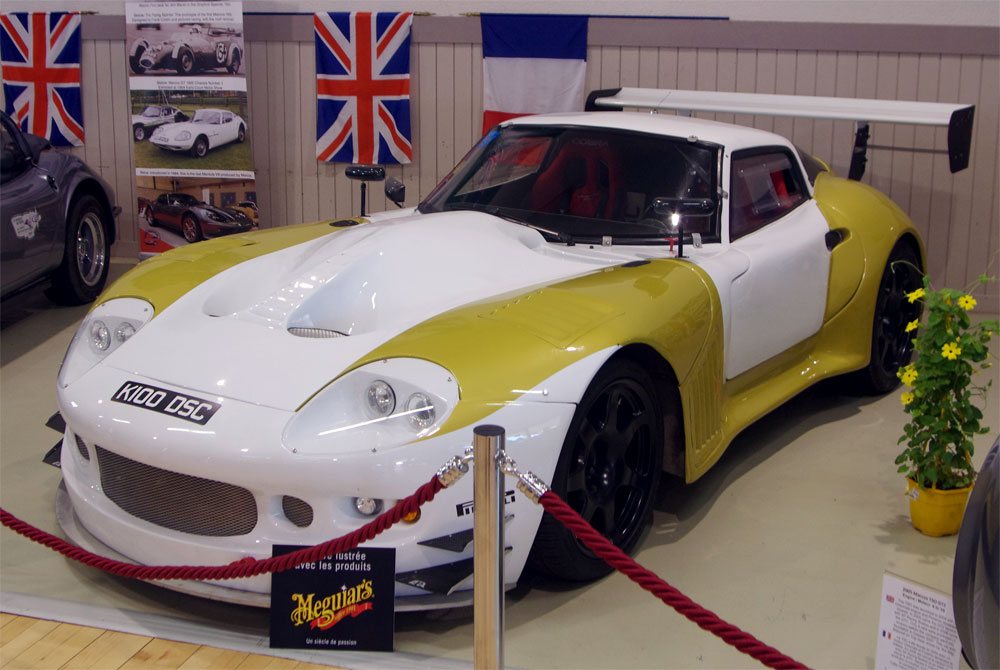
Star of the show was the #71 Marcos LM600, one of a pair of Team Marcos factory-entered GT2 contenders that captured the hearts of British racegoers back in 1995. Fantastic noise, slick livery and the epitome of gritty British determination.
The #71 was shared between BTCC and Scottish sportscar star David Leslie, Le Mans-born F1 veteran François Migault, and Chris Marsh, the son of Marcos founder Jem. The car hit electrical problems two hours in that were resolved with the help of a radio ….
The #71 eventually crossed the line 22nd, narrowly missing out on classification through a marginal lack of laps – but with Chris Marsh waving the Union flag as he crossed the line, Marcos had cemented its position in Le Mans history.
The Classic British Welcome has become a hugely popular feature of the annual pilgrimage to Le Mans for the thousands of British car enthusiasts who make the journey. Over 300 modern and classic cars attend across seven display parks, and it gets bigger every year.
Also on display was a 1996 Mantis from Cor Euser’s personal collection – this being the last race car built at the Westbury factory and displaying Marcos Racing International’s iconic multicoloured livery.
Production moved to Holland, and this Marcos Mantis was built in 2000. Upgraded to what were then the current GT regulations it remained competitive through to 2006, taking 19 podiums in its final season. Great registration …
The early versions of the Marcos GT had an elegance and beauty that make them among the most beautiful of mid-Sixties classics … although the first version of the Mantis, launched in 1970, lacked the svelte lines and visual appeal of the Adams-designed 1800 GT.
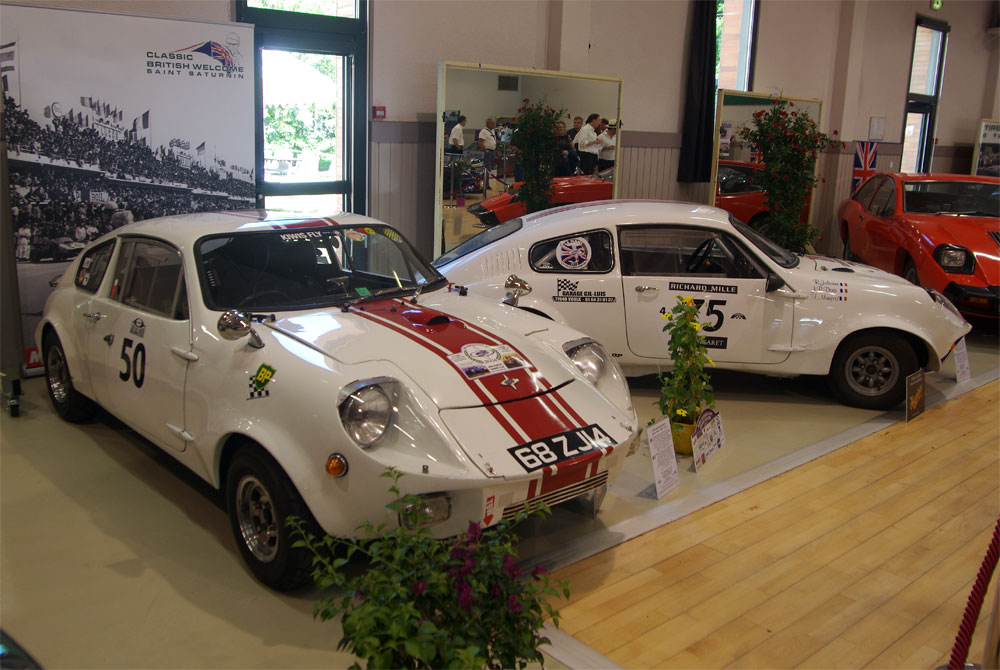
The marque’s first appearance at Le Mans came in 1966, with a French entered Mini Marcos. It was the only British car to finish that year. Jem Marsh entered his own car in 1967, co-driving with Chris Lawrence, and recorded a top speed along the Mulsanne of 141 mph.
Around 80 Marcos cars of various vintages were displayed proudly by their owners out in the sunshine, including a prototype aluminium-bodied GT and a pristine ivory-white 1800 GT. Also here another Mini Marcos.
Over the years the shape of the Marcos mainstay changed considerably, as cars grew wider, aerodynamic understanding changed, and homologation requirements impacted on the designer’s pen. That early nose is still the prettiest …
One of the final incarnations of the Marcos to emerge from the Nissen Huts in Westbury was the Mantis. Just over 50 of these were built, some with supercharged V8s that generated over 500 bhp and had a 0-60 of well under 4 seconds.
The early Marcos GT was fitted with the Volvo 1800, and subsequent cars used the Ford V6, but in the later years nearly every Marcos LM, Mantara and Mantis was powered by the ubiquitous Rover V8, typically of around 4 litres.
The Classic Welcome is not restricted to British cars, or even classics, and the display included modern sportscars and foreigners, including American musclecars and some teutonic heavy metal.
When he first saw the E-Type in 1961, Enzo Ferrari described it as “the most beautiful car ever made.” Some suggest there have been a few choice alternatives to that claim since then, including a few Ferraris, but there’s no denying the purity of those lines. Stunning.
Without doubt, the loudest car at St Saturnin on Friday! The bellow from this replica Ford GT40 could be heard from five miles away … or so I was assured. The ground shook, heads turned, and gravel sprayed in all directions.
St Saturnin is a chance for classic car owners to get together, and show off. Some do it with restrained style, others get a bit brash, but it’s all good fun.
If Enzo loved the E-Type, he was less complimentary of the XJ120 and its succeedents; the XK140 and XK150. Not only were they beautifully elegant, fast and well-built, but they cost (new) a fraction of the price of one of his Italian stallions.
When Marcos returned to mainline motorsport in the 1990s, one of its major rivals was the Venturi GTR. Paul Belmondo ran a Venturi 600 SLM at Le Mans in 1995, and the car remains a favourite with Stéphane Ratel.
The Yorkshire Volunteers Band with Corps of Drums made various appearances around Le Mans this year, including marching through the town in support of the Grande Parade des Pilotes and at St Saturnin.
You can have your Cobra replica, or your GT40, but there’s something special about the Lola T70. We assume this is another replica, but what a beauty. American V8 power again encased by the purposeful lines of the late, great Eric Broadley.
Sometimes an owner can get a little too carried away with badges and mascots … and especially on the simplistic purity of a Bugatti. One Buddha would suffice.
Art Deco was interrupted by WW2, and survived well into the 1950s. This stylish bonnet mascot graced the front-end of a French-owned Studebaker Champion at St Saturnin.
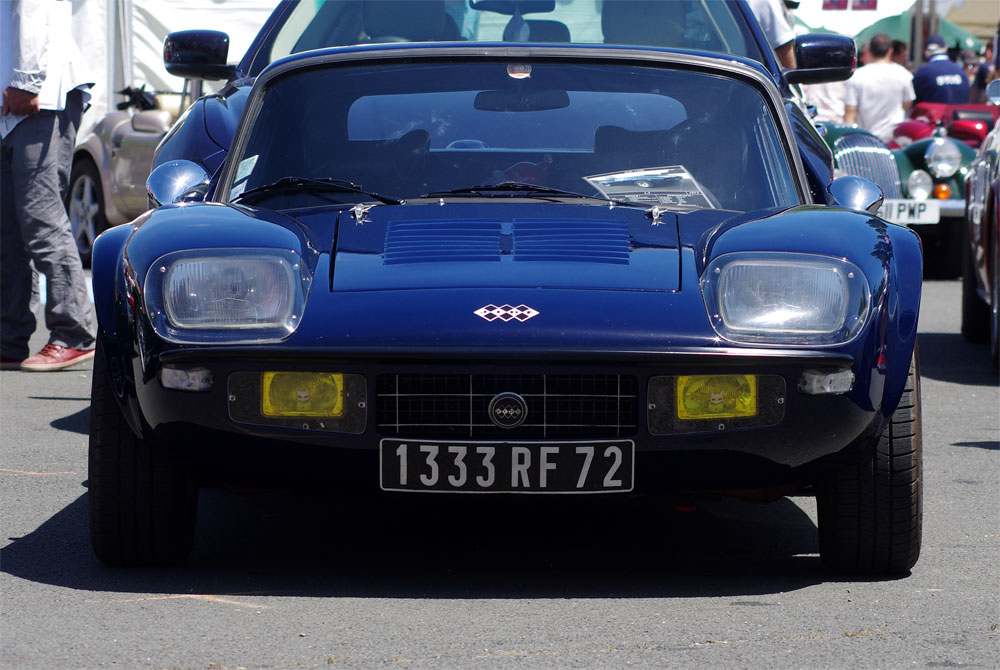
Here’s one to stump you! This diminutive sportscar is a Jidé, designed and built in the 1960s by Frenchman Jacques Durand. Ladder frame chassis, cheeky fibreglass bodywork, and various engine configurations gave the Jidé great performance and a successful competition pedigree.
The Yorkshire Volunteers Band can be traced back to 1860 when it was formed as the Band of the 7th Yorkshire West Riding Rifle Volunteer Corps. The style of the current uniform is based upon the traditional red tunic of the Rifle Brigade and dates from 1891.
The side panel and badging from a 1967 Ford Mustang in two-tone cherry red and cerise with red-piped ivory interior. Class.
Even the latest cars are welcome at St Saturnin. Launched in March this year, the 720S is the only McLaren in the current range – so far – without a track-only model. Prices for the McLaren 720S start from £208,600.
A beautifully presented MG T-Type Midget with an unusual radiator mascot in the form of a dragonfly. Just about every MG model was present at St Saturnin, all the way through to an example of the MG XPower SV.
In 2009 Jem published his definitive Marcos book; Making my Marque. The middle section focuses on the Le Mans 24 Hours of 1995, and includes much of this author’s PR output from the race, as well as his now-iconic photo of car 71 crossing the line. Proud to have been associated.