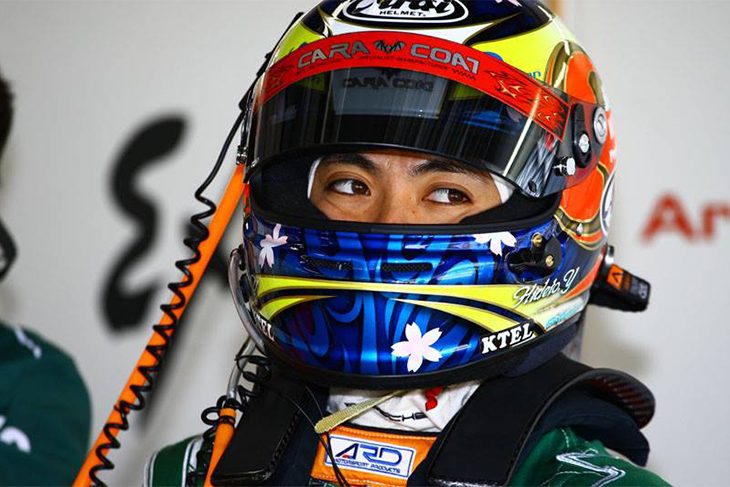
34-year-old Hideto Yasuoka is a driver who embodies the spirit of the independent racer, through a career that’s spanned the better part of 15 years in single-seaters, touring cars, and sports cars.
Yasuoka is returning to the Autobacs Super GT Series in 2018 with Arnage Racing, the team for whom he’s driven for the majority of his six-plus seasons in Super GT, after spending most of 2017 out of the racing cockpit.
And on the eve of his first test back in the #50 Arnage Racing Mercedes-AMG GT3, which he’ll drive alongside Masaki Kano and newly-appointed third driver Yuya Sakamoto throughout the 2018 season, DSC’s RJ O’Connell spoke to Yasuoka. Needless to say, he’s very happy to be back, full-time, in Super GT.
Here’s Part 1:
“Last year, I only did one race, which was a surprise, because I didn’t think I would be racing at all last year,” he says in reference to his one-off drive at last year’s Fuji 500km, where he substituted for a suspended Hisashi Wada at R’Qs Motor Sports.
2017 saw Yasuoka drive only that race, plus a round of the Blancpain GT Series Asia at Shanghai International Circuit, but by no means was Yasuoka out of racing. In fact, he was still working with Arnage Racing as the team manager for their Porsche Carrera Cup Japan team, working as the mentor to Taiwanese gentleman racer Brian Lee.
But there was always the hope that Yasuoka could return to Super GT, and as early as the middle of last season, the plans came into place for a comeback, even as Arnage Racing were fielding an entirely different car and two entirely different drivers in a partnership with INGING Motorsport which ended after the season.
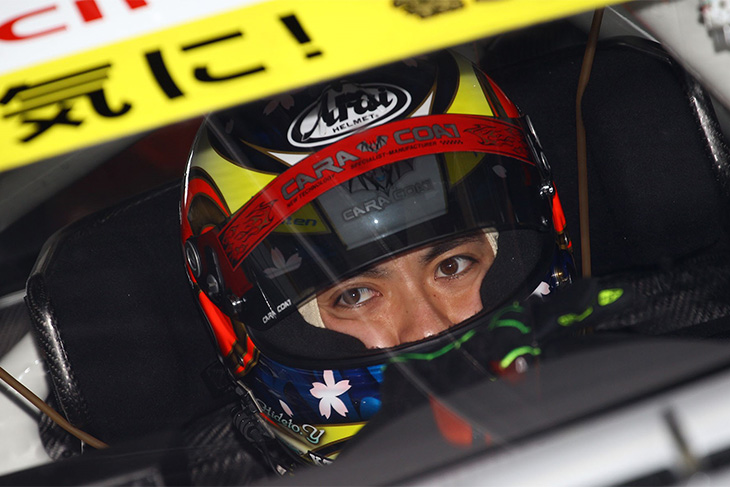
“I was hoping that we could be back, and I was hoping I could come back alongside (Masaki) Kano, who was my very first-co driver in Super GT in 2013. We were pushing for this opportunity pretty early on last year, say, at the end of summer, and we decided to purchase the new AMG around the same time, late summer or early autumn. It never really felt like I was away from the team at all,” Yasuoka says.
Yasuoka’s career started in Japan driving go-karts, but his graduation to single-seaters came an entire continent away in Europe, where he finished his karting career. It lines up perfectly for the son of an airline executive who also lived in Bahrain and the UK very early on in his childhood.
I was a big fan of Jenson Button, and I wanted to follow in his footsteps
“I was a big fan of Jenson Button, and I wanted to follow in his footsteps, and it was just my luck that I worked with his engine tuner when I was racing in the European karting championships.” Yasuoka later lamented that R’Qs did not bring him back to run in last year’s Suzuka 1000km, the race where his F1 hero Button made his Super GT debut. “So I wanted to start my single-seater career in England, and I enrolled in the Silverstone racing school, where I got a lot of praise from the coaches there.”
“And I decided to stay there, so I enrolled in the racing series run by the school (the BRDC Single Seater Championship) which had the prize of a scholarship to race in British Formula Ford. I won the championship, and won the scholarship that came with it – so I moved up to Formula Ford. But was a very competitive championship, and we couldn’t get a great result in our first year.” Third place in the Scholarship Class and a weekend sweep at Brands Hatch were solid, but ultimately not enough for Yasuoka to move up to British Formula 3.

“By that time, I was already 20 years old, and I knew that if I wanted to reach Formula 1, I had to move up the ladder into Formula 3. It wasn’t looking like I could do that by staying in England, so I decided to come back to Japan, where both Honda and Toyota were offering scholarships to Formula 3 through their single-seater championships: Formula Toyota, and Honda’s Formula Dream.”
“My uncle, who was Honda’s F1 project leader when (Ayrton) Senna and (Gerhard) Berger were driving for McLaren, I asked him for advice, and surprisingly, he recommended Toyota! I won the Formula Toyota championship in 2004, and won the scholarship to move up to Formula 3 in 2005.”
As a Toyota-backed young driver, Yasuoka was on the right track to potentially reach F1, but his time in Formula 3 was littered with setbacks along the way.
“In 2005, I was racing in Japan, but I was still trying to get a drive in Europe with Toyota backing! To make matters worse, in my first season, I was driving for the only team using Dome chassis – while everyone else was driving Dallaras. It was a tough first year, but I was a rookie, and I had great teammates, like Roberto Streit, and Jonny Reid, and I learned a lot from them.”
As João Paulo de Oliveira romped to the title in 2005, Yasuoka finished a distant 10th, with a best finish of 4th coming at Central Park Miné Circuit. “The results were alright for the Dome chassis, although I got involved in a number of unnecessary accidents,” Yasuoka reflects, “and while it was expected from a rookie driver, I still wasn’t happy about it.”
In 2005, I was racing in Japan, but I was still trying to get a drive in Europe with Toyota backing
Yasuoka got a major break in 2006 when he joined TOM’s, a powerhouse in Japanese F3. But he soon found himself overshadowed by fellow newcomers Adrian Sutil, who eventually won the championship, and 19-year-old rookie Kazuya Oshima, Yasuoka’s successor as Formula Toyota champion and runner-up that year. After just five race meetings, Yasuoka was released from the team, but even he’ll admit it was the right decision.
“I then spent the next year out of racing, but I still had the goal of reaching Formula 1.” So Yasuoka returned in 2008, this time in the National Class, and with privateer Le Beausset Motorsports. In a season littered with mechanical failures, including three straight retirements to open the season, Yasuoka’s two wins and six podiums weren’t enough to contend for the championship.
“And at the same time, Lewis Hamilton had become the youngest Formula 1 champion, and Sebastien Vettel had just become the youngest race winner. So I thought to myself, ‘this wasn’t going to happen,’ with these two younger guys already winning races and championships. Honestly, I thought I would quit racing. Mentally, I thought I was finished.” Yasuoka didn’t race at all in 2009, and at 25-years-old, he was not sure he’d be able to continue, his ultimate goal now well out of reach.
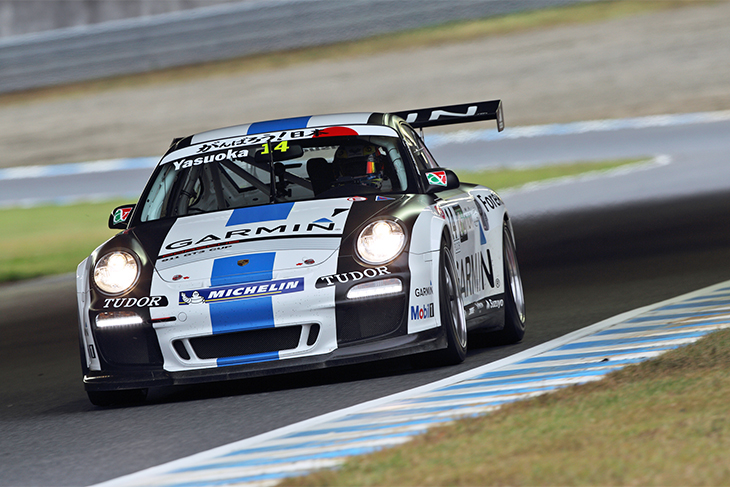
But Porsche Japan gave him the opportunity to audition for a full-season scholarship in the Japanese Carrera Cup series, which he won in 2010. It was a new lease on Yasuoka’s racing life, and the launching pad to a 2011 campaign that will undoubtedly go down in the record books as the greatest individual season in Porsche Carrera Cup history.
And as Yasuoka explains, the pressure was on from the beginning of that 2011 season. “That year, we had to be perfect. I dominated the second half of the PCCJ in 2010, winning the last four races in a row and losing the championship by just six points. Porsche gave me another shot in 2011, and it was like, ‘I had to keep doing what I was doing at the end of 2010.’”
“There was a lot of pressure on my mechanics, because as we kept winning but there was always the chance that something would go wrong with the car. They told me after the season that about all the pressure they were under. But I just had to keep doing what I was doing at the end of last season.”
Yasuoka entered 11 races in the 2011 Porsche Carrera Cup Japan. He took 11 pole positions, set 11 fastest laps, and won all 11 races. It was the first time in the 25 year history of Porsche Carrera Cup that anyone had ever completed a perfect season.
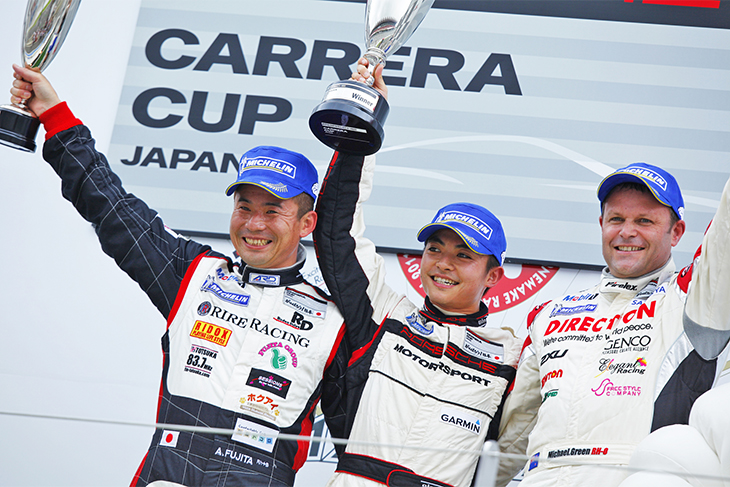
“When I went to Germany, and everyone had told me that I was the first driver to complete a perfect season in Carrera Cup history, it was then that I realized I had achieved something special,” said Yasuoka.
Finally, in 2012, Hitotsuyama Racing gave Yasuoka his first chance to race in Super GT, driving an Audi R8 LMS. Yasuoka was making his debut at a time when FIA GT3 cars were about to become the dominant presence in the GT300 class, as a cost-effective alternative to the traditional JAF-GT platform.
“The R8 was…well, we had setup issues, and it took us a couple of races to get it dialed in. We did fix the setup issues, but I was driving very aggressively, and yet we still weren’t able to match the pace of cars like the Aston Martin (V12 Vantage) that we were competing against at that time.”
That Aston Martin was run by Team A Speed, who at that year’s Suzuka 1000km, put on one of the most dominant performances in the history of the Suzuka Summer Endurance race, when they came back from starting 25th after a post-qualifying penalty, through the field to the lead in less than 13 laps, and dominated en route to a GT300 class victory. Such was their pace that the car literally caught fire on the way back to the pits. “I remember being in my R8 and shortly after the race started, thinking, ‘Wow, here they are already!’” Yasuoka says with a laugh.
When the people at A Speed withdrew, Arnage Racing, who handled the vehicle maintenance for the team, took over the operation, and gave Yasuoka his first full-time drive in Super GT, in what was, pound-for-pound, the fastest car in the class the year before.
“I got a call from (Muneharu) Ito of Arnage Racing, who said they were going to run the Aston Martin on their own that year. We knew how great the car was, it was a balanced car that performed well throughout a race stint, compared to other GT3 cars like the (Mercedes-Benz) SLS and the R8, which had great one-lap pace, but quickly fell off on a long run.”
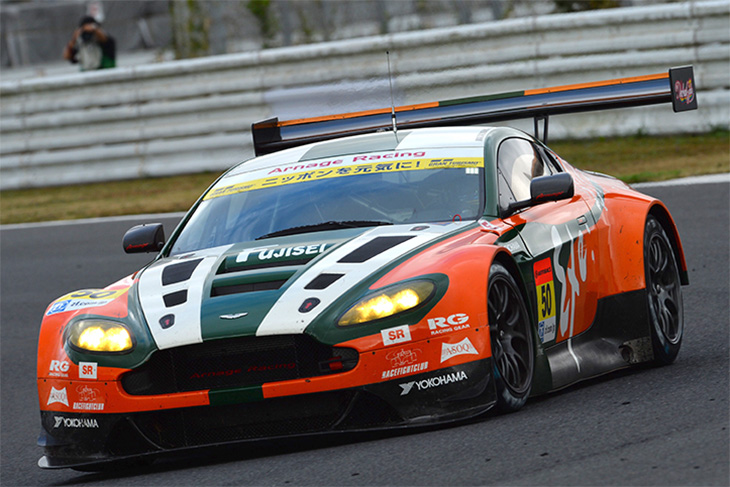
Yasuoka and new co-driver Masaki Kano formed a formidable pro-am combination in what was increasingly becoming an “all-pro” class, especially at the wheel of their new Aston Martin Vantage. “Kano-san had just come off a difficult season with JLOC in 2012 – he had joked that the Lamborghini Gallardo that year was a ‘GT200’ car! Now all of a sudden, we were both in a winning car together.”
“It took a while for the team to gel, to work together without any problems. We did well at Okayama at the start of the year, getting into Q2 and starting from 13th, but we got involved in an unfortunate incident during the race. Our goal was always going to be the Suzuka 1000km, since it is Arnage Racing’s home race. So we said that by Round 5, we have to be able to complete a race without any mistakes or mechanical issues.”
Round 5, the Suzuka 1000km, yielded Arnage Racing’s first points of the season, but by no means was it an easy drive for Yasuoka, Kano, and third driver Ryohei Sakaguchi!
Our goal was always going to be the Suzuka 1000km, since it is Arnage Racing’s home race. So we said that by Round 5, we have to be able to complete a race without any mistakes or mechanical issues
“We started P3, and we finished P8, but we were actually running a ‘V11’, one cylinder had died by lap 15, I believe… so we had to drive the hell out of the car the rest of the race, which we did! So we were confident after that race that, if everything went well, we could have a good result…”
Enter the penultimate round of the championship at Autopolis circuit, an event where qualifying was slashed to one session on the morning of the race due to a typhoon. Once again, Yasuoka was able to qualify the Aston Martin in P3 in the single session, at one of his favorite tracks.
“Ito-san was very good at setting up the car for the dry conditions, and I had a good race. By lap 8 I was leading the race, and I’d gotten up to about a 15 second lead, and then handed it to Kano-san, who did very well to finish 2nd.”
With a pro-am driver lineup, Arnage Racing had scored their first podium finish, and as Yasuoka said, “we were pretty pumped going into 2014.”
Check back on DSC for Part 2 tomorrow
Images courtesy of Arnage Racing, Hideto Yasuoka Supporters’ Club, Porsche Japan K.K., Motorsport Department (MS-Boo.com), and the GT Association
Formula Toyota photo credit to Tadashi Iida