With the 2018 Super GT season almost here, it’s time to take a look at the entire field before the season opener, starting here, with the first part of DSC’s extensive season preview, covering the Lexus teams in GT500. Expect a lot more to come over the next 24 hours, as we count down to the opener on Sunday.
A historic start carried the Lexus LC500 to a championship in its debut season, and a reloaded driver roster could see them repeat in 2018.
2017 was a history-making dream season for Toyota and Lexus Gazoo Racing, in the premier GT500 class of the Autobacs Super GT Series.
Entering the season with overwhelming pace in pre-season testing, many people had expected the new Lexus LC500 to be a great car, the best of the refreshed GT500 machines under a modified rules package. They validated that pre-season pace with authority, by becoming the first Super GT manufacturer to sweep the top six places in GT500 at the first round at Okayama.
Then they went on to dominate the Fuji 500km, and with subsequent victories at Autopolis and Sugo, Lexus were able to match the record for the most consecutive wins to open a season at four. Just as the Cadillac DPi-V.R did on the other side of the pacific in IMSA, the Lexus LC500 dominated the early stretches of the 2018 GT500 championship so thoroughly that, even though their rivals at Honda and Nissan had caught up to them by seasons’ end, they still had built up enough of a cushion to take the ninth GT500 championship for the Toyota Motor Corporation. Lexus’ top five teams finished in the top six of the final GT500 championship results. They won five of the eight races last season.

But motorsport is a game of constant development, of evolution that can progress so swiftly that if left unattended, it can overwhelm even the brightest and best organisations. So like any good team, they made big moves in the off-season in a bid to stay on top.
Much as Toyota did with their WEC programme by signing two-time Formula 1 World Champion Fernando Alonso, Lexus added two internationally-renowned drivers, and one of their brightest young drivers in recent memory, to what was already an outstanding group of drivers in GT500, a crew where every other driver has a Super GT, Formula 3, or Super Formula championship to their name.
Pre-season testing wasn’t the dominant showcase that Lexus enjoyed last year, but they still enter the season with a slight edge at Okayama. Their six teams are still well-prepared to win the GT500 championship once again in 2018.
#1 | Lexus Team KeePer TOM’s | KeePer TOM’s LC500 | Bridgestone | Ryo Hirakawa & Nick Cassidy
Lexus Team KeePer TOM’s enter the 2018 season as defending champions of GT500, with two of the most exciting young drivers to ever share a single car in the series, and a high-profile associate sponsor in Red Bull. And the frightening thing for the rest of the GT500 grid is that they’re only going to improve from here.

By all accounts, 2017 was the year that this team and their young drivers should have put it all together for a title run. For the third time in four years, the KeePer TOM’s Lexus won at Okayama to open the season, leading Lexus’ historic 1-2-3-4-5-6 finish. But unlike the years past, when mid-season inconsistencies took them out of the title picture by the time Motegi rolled around, the KeePer TOM’s team showed incredible resilience.
Adding a second win in October at Chang International Circuit in Thailand, two more podiums, and finishing in the top six in seven out of the eight races, Ryo Hirakawa and Nick Cassidy only had to finish second at Twin Ring Motegi to capture the 2017 GT500 championships. The fourth in total for TOM’s, this one twenty years after their first championship in GT500. Hirakawa and Cassidy, both 23 years of age, now the youngest champions in the history of the class.
This one was different than the championships won in 1997, 2006, and 2009. Those had all been won by TOM’s flagship car, the number 36, and not the 37, which has been TOM’s traditional “B-team”, going back to the late ‘90s and early 2000s. There is no separation in that regard any more. There is no “B-team” stigma.
Only a desire to win back-to-back titles in the fastest GT racing category on earth. For all the change that Lexus made to their teams in the off-season, this and one other crew are the only ones that changed nothing from 2017. Toyota racing legend Masanori Sekiya still calls the shots on strategy, along with chief engineer Masaki Saeda. The Bridgestone tyres they use are still the class of the GT500 field in terms of pure performance. And of course, the drivers didn’t change from 2018. Ryo Hirakawa is no longer a “young driver”.
At 24 years of age, Hirakawa is now a young man about to hit the peak of his power as an established professional racer. That is a foreboding statement of a person who debuted in GT500 as a 20-year-old, who was driving a Super Formula car and testing an IndyCar as a teenager, who at 18 was a rookie champion of Formula 3 and Porsche Carrera Cup and being hailed as Japan’s next great Grand Prix star of the future.

Things are a little different this year for Hirakawa. He’s not running in the European Le Mans Series this year. His plans for Toyota in the WEC appear to be on the backburner for now, with his return to Super Formula also coming this year. And oh, yes, he is the defending co-champion of GT500.
Hirakawa is a driver who represents the perfect balance of blinding race pace, qualifying speed, consistency, poise, composure, and the maturity of a driver in their late 30s. The experience he’s gained across two continents in the last two years alone has made Hirakawa a much more well-rounded driver than he was as the ludicrously quick rookie sensation of the 2015 season.
The only thing that could hinder Hirakawa’s rocket-like ascent up the all-time Super GT record books is his desire to one day become a champion on a bigger stage, be it in the WEC with Toyota, be it in Formula 1 as a Red Bull athlete. Across Japan and Europe, Ryo Hirakawa has already proven that he can go wheel-to-wheel with some of the world’s best sports car racers on the planet.
His co-driver Nick Cassidy, is every bit as good, and only five months the junior of Hirakawa.

A fateful decision to switch to the All-Japan Formula 3 Championship with TOM’s in 2015 changed the trajectory of Cassidy’s young racing career, from a promising single-seater prospect who could never get the funding to advance in Europe, to a full-fledged factory racing driver and champion for Toyota and Lexus.
Just from his rookie year in 2016 to his championship season in 2017, Cassidy improved on everything that he needed to, in order to develop into a more mature, well-rounded driver that can blitz the start of a race. Not only has Cassidy become an instant success in Japan, but his success there, as the first driver from New Zealand to win a race, and subsequently a championship, has opened up the eyes of their ravenous motorsport culture to something different, and created a new emerging market for Super GT where there wasn’t one before.
He can be placed firmly on the same top shelf of young Kiwi racers from his generation, names like Hartley, McLaughlin, Van Gisbergen, Evans and Stanaway, as one of the most versatile young racers there is.
On the Super Formula circuit this year, Hirakawa and Cassidy will be championship rivals. Aboard the KeePer TOM’s Lexus LC500 they share in Super GT, they will be one of the most balanced, fast-paced, cohesive tandems in GT500. Already they showed to be quick in testing, picking up exactly where they were this time last year.
It was only a matter of time until they won their first races and their first championship, and now the question is, for Hirakawa and Cassidy: How many more can they win?
#6 | Lexus Team LeMans Wako’s | Wako’s 4CR LC500 | Bridgestone | Kazuya Oshima & Felix Rosenqvist
In 2015 Juichi Wakisaka, after 18 seasons as a driver, retired from Super GT to take on the role of team director at Lexus Team LeMans. That decision subsequently breathed new life into a team which had been to the top of the mountain in GT500 back in 2002, when he was their ace driver, but had struggled to compete for championships on a consistent basis in between.

With a new director, a new title sponsor, and a new approach, Lexus Team LeMans Wako’s have come close to the GT500 championships, very close, as close as the final round of the season, in both 2016 and 2017. They are always incredibly consistent in terms of points-scoring and finishing on the podium, but arguably, a lack of wins in that time has been what’s kept them back.
To make matters all the more complicated, in the offseason, they lost Andrea Caldarelli, who left Super GT after six strong seasons to commit full-on with Lamborghini’s efforts in Europe and North America.
Amazingly enough, that change of personnel didn’t rattle the team. In fact, it may have emboldened them, when they signed one of the biggest free agents in Super GT history. But first, let’s examine the young man who’s already been helping to build Lexus Team Wako’s LeMans back into a title contender.
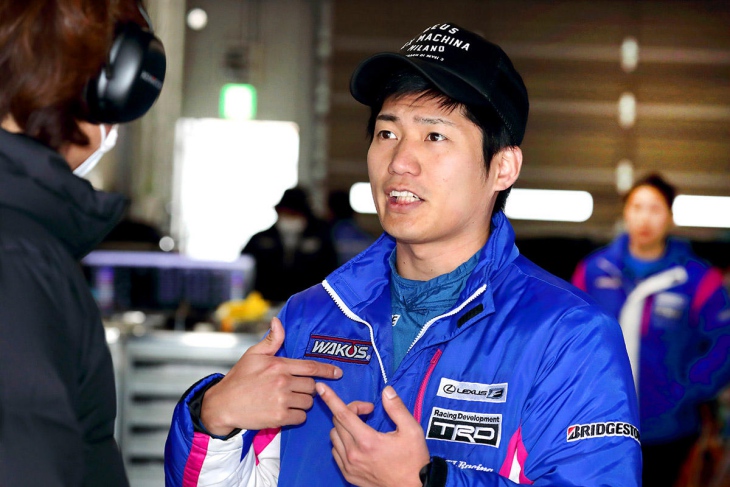
Kazuya Oshima was an 18-year-old rookie in GT300 when he made his debut in 2006. He’s about to eclipse 100 career races this year, and start his tenth season as a GT500 driver. Oshima won’t even turn 31 until the end of April, and he’s already a tenured veteran of the sport.
He still has an abundance of speed in hand. That much was made clear when Oshima set the fastest time in the first day of pre-season testing at Okayama. He’s always been fast in both qualifying and race trim.
In a career that saw him win the GT300 championship at 20, and the Suzuka 1000km at 22, Oshima is still missing from his resumé a GT500 championship. One that he’s missed out on, and only just so, in each of the last two seasons, finishing 2nd in 2016, and 3rd in 2017. This could very well be the best chance that Kazuya Oshima has had of capturing an elusive career milestone and winning his first GT500 championship title. And a large part has to do with the driver he’ll race with this season.
While Jenson Button’s arrival as a full-time Super GT driver was a landmark announcement, the signing of Felix Rosenqvist at Lexus Team LeMans Wako’s is perhaps just as big, maybe even a bigger deal, because of what Rosenqvist brings right now as a young driver.
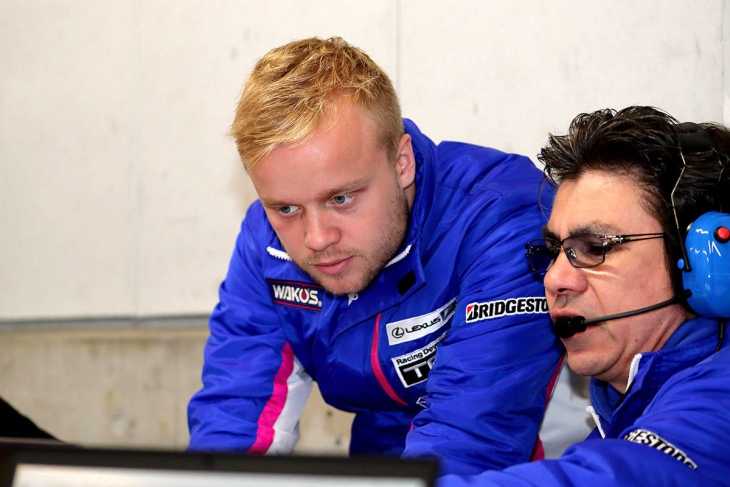
By now, it’s well-established what Rosenqvist can do in the wheel of any car on any given week. Since winning the European Formula 3 Championship in 2015, Felix Rosenqvist has become a perennial title contender and regular race winner in Formula E, and a winner in everything from GT3 cars, to Indy Lights, to Porsche Cup. He made an unexpected Japanese debut in last year’s Super Formula championship. That was, of course, the year of Pierre Gasly as the big-ticket item amongst a stacked rookie class, but Rosenqvist was putting on a championship challenge of his own, and could have won the title from underneath Gasly and Hiroaki Ishiura.
Rosenqvist was not only fast, but consistently so, in his first laps in a GT500 car. While he missed the Okayama test due to his Formula E commitments, he quickly got back up to speed at Fuji the following week. He loves the car. He’s enjoying the rapport with his new teammate.
Though Rosenqvist will miss one race, at Suzuka, because of his prior commitments in Formula E, his addition to what was already a perennial contender not only adds one of the best all-around young drivers in all of motorsport to Super GT’s premier class, it could give Oshima and Team LeMans the extra push they needed to win their first GT500 championship in sixteen years.
#19 | Lexus Team WedsSport Bandoh | WedsSport Advan LC500 | Yokohama | Yuji Kunimoto & Kenta Yamashita
What is lost in the elation of the year that Lexus enjoyed in 2017 is the fact that one of their teams genuinely struggled at the same time: Lexus Team WedsSport Bandoh, the only team in the fleet on Yokohama tyres.

When they won their first GT500 race in 2016, it was looking like the start of a rise to prominence. Instead, Lexus Team WedsSport Bandoh plummeted, finishing 12th in the Teams’ Championship with no wins, no podiums, and a two-race scoreless drought to end the season. Compared to what TOM’s, Cerumo, SARD, and Team LeMans did with the same car on a different brand of rubber, it was hard to watch the blue and gold Lexus struggle so much in relation to their peers.
No driver felt the brunt of the disappointment more than Yuji Kunimoto, who now becomes the senior driver of the team with the departure of Yuhi Sekiguchi. 2017 was a challenging year following a breakthrough 2016 campaign. His Super Formula championship victory and breakthrough in GT500 got him a Le Mans drive with Toyota, but Kunimoto simply wasn’t able to replicate that same magic back home in Japan, or in Europe at Spa or Le Mans.
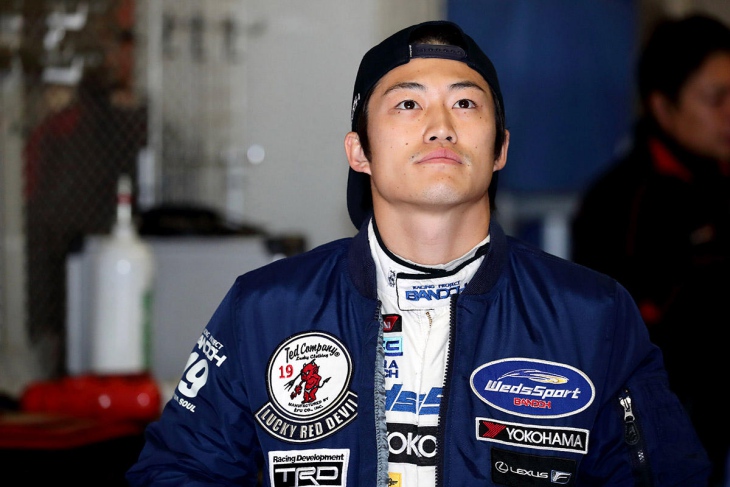
Some were quick to point to his surprise LMP1 appointment as a grave mistake on Toyota’s part, especially when the young man originally tipped for that seat went on to win the GT500 title later in the year, one Ryo Hirakawa. But something seems to have unlocked Kunimoto’s extra gear, as he set the fastest time on the final day of testing at Fuji Speedway.
Kunimoto has always been a consistently pacey driver when he’s at the top of his game, and now it looks like the WedsSport LC500 is a properly quick car once again.
A number of factors are involved, like the development work that Yokohama have put into their GT500 tyres, like the appointment of Manabu Orido, a Racing Project Bandoh legacy, to an executive advisory role with the team to guide two of the best young drivers in GT500.
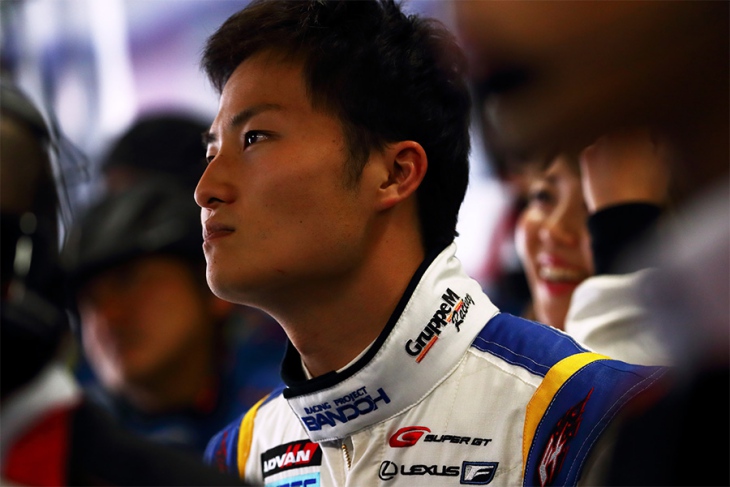
That leads us to the new addition: 22-year-old Kenta Yamashita, and his much-anticipated step up to GT500, the top prospect of the Toyota Young Driver Programme (TDP). Though his rookie year with Tsuchiya Engineering didn’t end on the brightest of notes as they slid out of title contention at the end of the year, he was still one of the best drivers on the GT300 grid. He demonstrated that with a commanding opening stint at Autopolis for his first career victory. He showed it again when he took pole position at Suzuka saddled with 82 kilos of ballast.
And keep in mind, Yamashita was already making waves in single-seaters: Winning the Japanese F3 title in 2016, then stealing the show at Macau that same year, en route to a promotion to Super Formula.
Kenta Yamashita didn’t have to set the world alight in his one-off debut in last year’s Fuji 500km. But it’s very likely that he will this year, as this young combination of drivers aims to get the blue and gold WedsSport LC500 back on the top step of the podium and continue where they left off in 2016.
#36 | Lexus Team au TOM’s | au TOM’s LC500 | Bridgestone | Kazuki Nakajima & Yuhi Sekiguchi
Sponsors have come and gone, and colours have changed with the seasons past, but the number 36 car of Lexus Team TOM’s – now in its third year with the orange and white of title sponsor au KDDI, is a car with a legacy to uphold in Super GT.

The two teams at TOM’s are renowned for their consistent and strategic approach towards attacking the championship. Last time out though, it was the other TOM’s car, the #37, that won the title as the #36 broke down during the deciding race in the championship.
The team retain a few key components from last year, such as upstart team director Daisuke Ito, who’s adjusting to life after GT500 driving after over 17 seasons racing in the top flight. They also have Tsutomu Tojo, the most respected chief engineer in the paddock, returning for yet another season with the number 36 crew. But after five seasons, James Rossiter is taking a sabbatical from full-time Super GT racing, focusing on his second chance in Super Formula with TOM’s, as well as the pursuit of a WEC drive.
But they still have Kazuki Nakajima, the top star of the Toyota Gazoo Racing programme. Many never would have expected Nakajima to make a comeback to Super GT after the WEC and Super Formula had taken up top priority in his busy, busy schedule, but his return to the series in 2017 after two years’ absence was a welcome sight.

It’s hard to imagine Toyota racing without Nakajima, a top-class driver in everything from single-seaters, to GT500 cars, to LMP1 hybrids. He followed in his father’s footsteps into Formula 1, of course, but it was when he came back home to Japan in 2011 that he really began to rediscover himself as a racing driver. Just in 2017 alone, Nakajima won at least one race in all three of his major championships by the end of May – winner in Autopolis in GT500, Suzuka in Super Formula, and a whopping five wins in the WEC including landmark victories in Silverstone, Spa-Francorchamps, and his third win in the 6 Hours of Fuji.
Nakajima has also won both the Fuji 500km and the Suzuka 1000km, though he is still searching for his first GT500 title, though these days, his commitments in the WEC and the scheduling of the Fuji 500km on May 4 make that a virtual impossibility. That’s not to say, however, that Nakajima will not give his all, he is an incredibly competitive and lightning-fast driver who can take over a race on command.
And of course, in the midst of his triple-enrolled programme with Toyota and Lexus, there is still the big prize in France that awaits his challenge once again this June, hopeful that this will finally be the year for Kazuki Nakajima and Toyota, but that’s another saga for another time and another series.
With Rossiter stepping away from GT500, Lexus Team au TOM’s picked up a new driver: Yuhi Sekiguchi, formerly of Lexus Team WedsSport Bandoh, who led that team to their first career victory. This is Sekiguchi’s first GT500 campaign on Bridgestone tyres, and his first in the most well-known car in the Lexus fleet.

But as anyone who knows Sekiguchi can tell you, and especially those who have followed his career in recent years, he is a tough and determined young man who has overcome a mountain of professional adversities, worked tirelessly to reach the apex of motorsport in Japan, and has made the most of a second chance with Toyota, taking nothing for granted after falling out with them a decade ago.
And when he is at his best, there isn’t a driver who is more entertaining in a wheel-to-wheel battle for the lead than Yuhi Sekiguchi. He’s no longer the “Bad Boy” of Super GT as he was as a teenage upstart, but even as he’s matured and refined, he hasn’t lost any ounce of his ruthless aggression at the wheel, it’s just now done in smaller doses these days. Last year we didn’t get to see as much of that relentless approach at the sharp end of the grid, certainly not as much as he demonstrated in his breakout 2016 campaign.
A change of scenery might just be what Sekiguchi needs to get back to where he was two years ago, if not a step or two beyond.
Together, they contrast as drivers, both in the way they carry themselves in the car, and in the paths they’ve taken to get here. What makes them alike is their desire to win – and we can expect to see this team score at least one victory during the season, with the people that are in place.
#38 | Lexus Team ZENT Cerumo | ZENT Cerumo LC500 | Bridgestone | Yuji Tachikawa & Hiroaki Ishiura
Along with TOM’s and SARD, Cerumo are one of the houses of speed that have been around since the start of Toyota’s journey in GT500.

And through it all, one man has been the leader of Team Cerumo for two decades: Yuji Tachikawa, who begins his 22nd season as a Super GT driver, and the 20th consecutive season, a record by a whopping margin, with Cerumo and their ZENT LC500.
Tachikawa’s exploits at the wheel of a Super GT car are the stuff of legend: 3 GT500 class championships. 18 career victories. A record 22 pole positions. One of only two drivers in GT500 history to rack up 1,000 career championship points. And all of these milestones in a Cerumo-entered Toyota or Lexus, all since he got his first drive with the team in 1999.
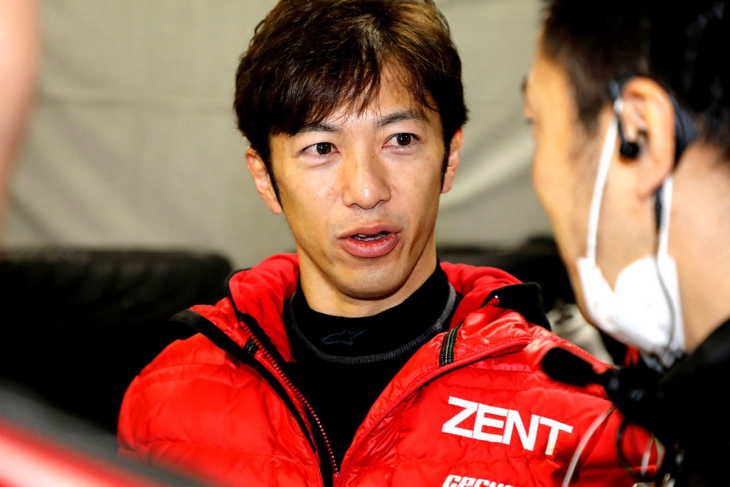
It’s longevity that defies the logic of Super GT, where drivers are known to stay with one manufacturer almost for life, but tend to shuffle about between different teams in GT500. No one has stayed with one team as long as Tachikawa has. And it’s likely nobody else ever will. It’s special. And so is Tachikawa’s prowess at Fuji Speedway, home court for Toyota – where last May, he drove to his eighth career victory at Fuji in the 500km race on Golden Week.
As Tachikawa’s driving career starts to draw to a close, he’s even extending his legacy, and that of Team Cerumo itself, out into other categories – he’s now overseen three consecutive Super Formula championships as the team principal of Cerumo’s open-wheel programme. And the lead man who won two of those three championships just happens to be Tachikawa’s GT500 co-driver, Hiroaki Ishiura. Together, they form the most experienced driver duo in Lexus’ six-car stable.
It’s pretty amazing how Ishiura has started to grow stronger as a driver in his mid-30s, where others will start to plateau or even depreciate. This is Ishiura’s 11th GT500 campaign, a run that began in 2008 as reward for winning the GT300 title the year before. In that time, he’s never finished better than third in the championship (2012). But in that same time, he’s won five races, and they’ve all been the crown jewel events on the calendar: The Suzuka 1000km twice, the Fuji 500km three times.
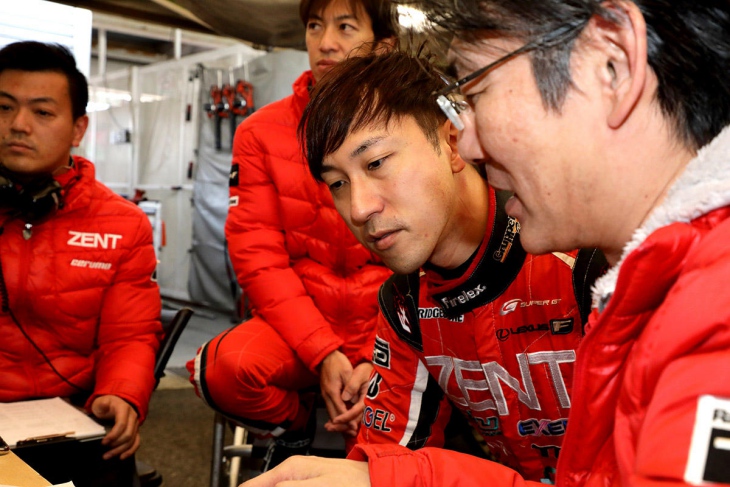
Ishiura’s tale is the one seldom told these days in motor racing, where the landscape shifts towards youth, he is the late-blooming star of the circuit, who is finding himself as a driver under Tachikawa’s guidance and leadership.
This is the other team that remains intact from 2017, which after winning the Fuji 500km, followed the season up with another Fuji podium in the 300km, and a third podium finish in the season finale at Motegi. Good enough for Tachikawa and Ishiura to finish 4th in the championship, following a 6th place result in 2016, and another 4th place in 2015.
At stake is not only Ishiura’s first GT500 championship, but also a fourth for Tachikawa, one to equal Ronnie Quintarelli, which would be his fourth title with as many different co-drivers, to span eighteen seasons. But don’t get it twisted: Just because Tachikawa is 42, doesn’t mean he’s slowing down. In fact, he may be just as good as he was 10 or 15 years ago.
While TOM’s are Toyota and Lexus’ most celebrated GT500 crew, the accomplishments of Lexus Team ZENT Cerumo have been just as great. With the experienced and rapid duo of Tachikawa and Ishiura to captain them, the ZENT Cerumo crew will always have a chance at the championship.
#39 | Lexus Team SARD | Denso Kobelco SARD LC500 | Bridgestone | Heikki Kovalainen & Kamui Kobayashi
In late 1994, the Toyota Gazoo Racing GT500 programme as we know it today began with a wildcard entry from Team SARD, and the first Toyota Supra GT. It took them 22 years to finally win their first championship, but there were signs of a hangover in 2017.

The season started reasonably well enough, but over the course of the season, they got involved in too many incidents that cost them points, and any hope of repeating as GT500 champions.
Kohei Hirate gained the admiration of Super GT fans when he won at Sugo. But the two-time GT500 champion also got tangled up in a number of other awkward and uncharacteristic incidents – including back-to-back clashes with the au TOM’s LC500 at the Fuji 500km and at Autopolis. Slipping off the podium at the Suzuka 1000km, then crashing in the final 10 minutes, may have been the tipping point for Lexus.
They had to effectively demote one of their most successful GT500 drivers just two years after he’d helped Lexus Team SARD win the championship – Hirate’s fall from the pinnacle of GT500 demonstrating just how cutthroat the racing business can be sometimes. But the team still retains the “other” former Formula 1 Grand Prix winner on the grid, now in his fourth year as a GT500 regular, Heikki Kovalainen.
The switch from running out the string at the back of the Formula 1 grid, to a new lease on his racing life in Super GT, has redefined the career of Kovalainen in his late 30s. And it’s proven, then, that GT500 wasn’t just a stop-gap for something else down the road like WRC or LMP1, this has become Kovalainen’s calling card.
In contrast to the haphazard season endured by his former co-driver, Kovalainen never put a wheel wrong all season long in 2017, befitting his metronomically consistent racing style that manifests in race stints where he’ll consistently lap within the same tenth of a second for long stretches of a race. He had his team in contention for a win at Autopolis, and a podium at Suzuka, before things went pear-shaped at the end of both rounds.
And now with two other marquee Formula 1 alumnus joining him on the grid this year, the pressure is off of Kovalainen. He’s comfortable in his current role as a GT500 stalwart, and if he drives as he did last year, Lexus Team SARD will still be able to compete for a GT500 championship.
Now, the ¥100,000,000 question: How can a team drop a two-time GT500 Drivers’ Champion and project to improve by leaps and bounds?
By bringing in another F1 folk hero, WEC superstar Kamui Kobayashi, who like Jenson Button at Honda, will make his full-time Super GT debut in 2018, driving a different car than the one he raced at last year’s Suzuka 1000km.
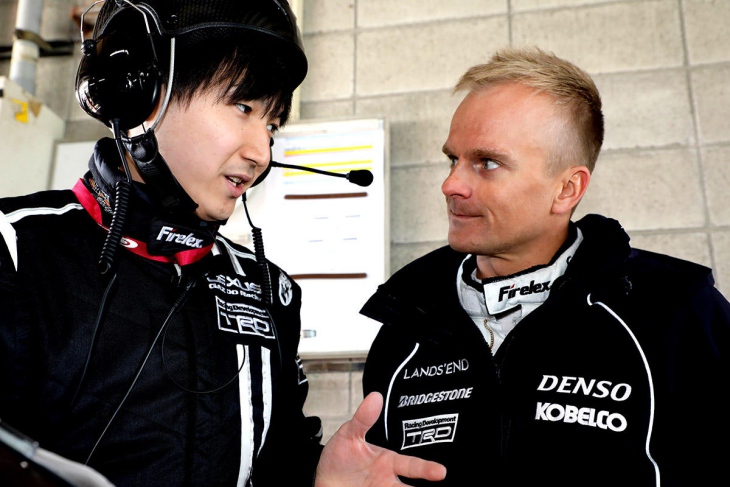
DSC readers and Toyota racing supporters now know of Kobayashi not just as one of only three Japanese drivers to score an F1 podium, at times the most brazen and fearless driver on the grid, but as the man who, as of today, still holds the fastest lap ever recorded around the fabled Circuit de la Sarthe. But he was also rejuvenated as a Super Formula driver back in Japan, coming very close to his first victory with former perennial backmarkers KCMG, and three podiums in LMP1 last year don’t tell the story of how any of them could have been victories with a little better luck.
Of the three newcomers to Super GT that are debuting in GT500 straight away, him, Button, and Rosenqvist, it would seem as if Kobayashi has far less of a learning curve. Yet, in pre-season testing, Kobayashi reportedly struggled to adapt to the different characteristics of driving a GT500 car as opposed to his previous LMP1 ride. Things didn’t get better when his car caught fire in the final weekend of testing at Fuji Speedway.
Like Nakajima, Kobayashi will also have to miss the Fuji 500km, giving Sho Tsuboi his first competitive drive in a GT500 car in May.

The preamble to their 2018 campaign may not have been the dream start for the “dream team” of former F1 heroes, but if they drive to the level of their reputations, it will be hard to catch Kovalainen and Kobayashi in the Denso SARD LC500.
All images courtesy of Toyota Motor Corporation