Allan McNish is next on the call list for DSC’s GT1 Week, to find out some background on his introduction to GT1 racing in the late 1990s amidst the astonishing period of development that saw the front of the grids in international GT racing switch from a short tail Mclaren to a Toyota GT One in just three years!
So Allan, how did you first get involved?
“It was Jost Capito, who ran Porsche Supercup at the time and asked if I could do a race at the Nurburgring in, I think it was 1995 in the VIP car now and I couldn’t because it was a week before, if I remember correctly, something else that I was already committed to. But he kept in touch and I did the race in ’96 supporting the British Grand Prix.
“The car was, I have to be honest, definitely one of the hardest cars to drive I’ve ever had in my life. Kevin Schwantz, and I did the two VIP cars, and it was a lot of fun and I just kept in touch with them because my focus was definitely not on sportscar racing at the time, I was looking to single-seaters.
“But I kept in touch and at the end of the year, I had some conversations through Jost with Herbert Ampferer (then head of Porsche’s motorsport division) who was looking to sort of realigning, I think, their driver lineup as well as part of the way that they were developing the car.
“At the time there was nothing in F1 and a potential Indy drive had gone to Mark Blundell which left me a little bit out the cold because of the timeline. So I went to Ricard and did a test – Alex Wurz and I were there.
“The car was actually a lot better than I expected because I fully expected it to be a little bit like a Supercup car. A bit heavy, tail-happy, not a lot of downforce, not a lot of power and full conservation mode just to try and make the car last 24 hours.
“This was the original 911 GT1 in early 1997. Then we went to another circuit, Alex and I, and then they invited me back to Jerez. Alex went off to do something with Mercedes and they asked me to come back to Jerez and that was with the 1997 911 GT1 Evo and it was with Thierry (Boutsen), Hans Stuck and all the race drivers were there.
“And that went very well and they asked if I would sign up to be a spare driver and to do some testing with the vision to going forward, which I agreed to do.
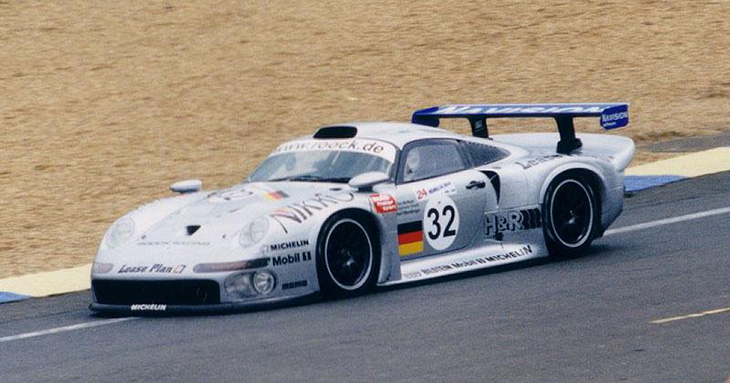
“They sent me off to drive with Roock and they sent me off to America, which was with Rohr.

“I did a lot of the development and testing with the Evo leading into a lot of the parts which went into the ’98 car from there.
“The ’97 to the ’98 car was clearly a very, very big change because it was the first-ever carbon car that they had done. And it was a big step forward in that but it was also a very big step forward aerodynamically.

“It went from the concept of being a supercar on the road that was sort of tuned for racing to be a racing car tuned to drive on the road if it had to. And that’s where I think the concept came from. That was partly because of Toyota with the way that they came into it because everybody else came from a supercar into racing whereas Toyota looked at it very differently and came from basically a racing car to drive for the road if it could, and everybody had to follow suit. There was no question, you couldn’t compete otherwise.
“But also as well the depth of competition for 1999 was huge.
“And so, therefore, you had to take a step up because it wasn’t as if you’re going to finish you’d finish third, in 1999 if you didn’t step up you were going to finish 9th or 10th!
“We did a lot of testing. I got a lot of miles very, very quickly. So I would say that probably sped up my development in a sports car relative to a single-seater extremely quickly.
“It was with a group and organisation that was very different in the way that they worked from what I was used to.
“The Porsche way is quite similar in a lot of ways to the Audi way, but it was different to certainly anything I had been used to even including McLaren or Benetton from the F1 side of things. But it was one that I felt I fitted in very, very well. And thankfully they felt I fitted in well as well.
“The rate of development was constant because it wasn’t just car development. It was also tyre development too. It was constantly testing and constantly racing. And that was without a shadow of a doubt, a huge thing for me.
“And the car development just got quicker and quicker. Everything we did was quicker and quicker.”
Was it a surprise when we got into ’98 that the step by Mercedes was as big as it was?
We were very, very quick at the beginning of the year with our car. We should have won the first two races but didn’t do to different things with a reliability problem in Silverstone and I got hit by Zonta at Oschersleben.
“But we had the speed, and we had the speed all the way up to Le Mans. It was post Le Mans where we struggled a little bit with the pure performance.
qualifying”We were better in race pace than we were in qualifying pace. Remember we had qualifying tires. And so there was definitely a discrepancy in the way that the Michelin worked in qualifying to race in comparison to the Bridgestone.
“Plus as well, the issue that we also had was with it being a turbo and where the restrictor was placed then if it was hairpins, and we struggled in initial torque which as we know as well-meant in racing, you did struggle a wee bit with overtaking and traffic in these situations.
“But that was a political argument as opposed to anything else. But were we surprised? I think there was there were certainly circuits like Hockenheim where it was a bit of a shock, the speed they could take of it, but I think on the other side of it there was also points like Suzuka where we should have won the race as well.
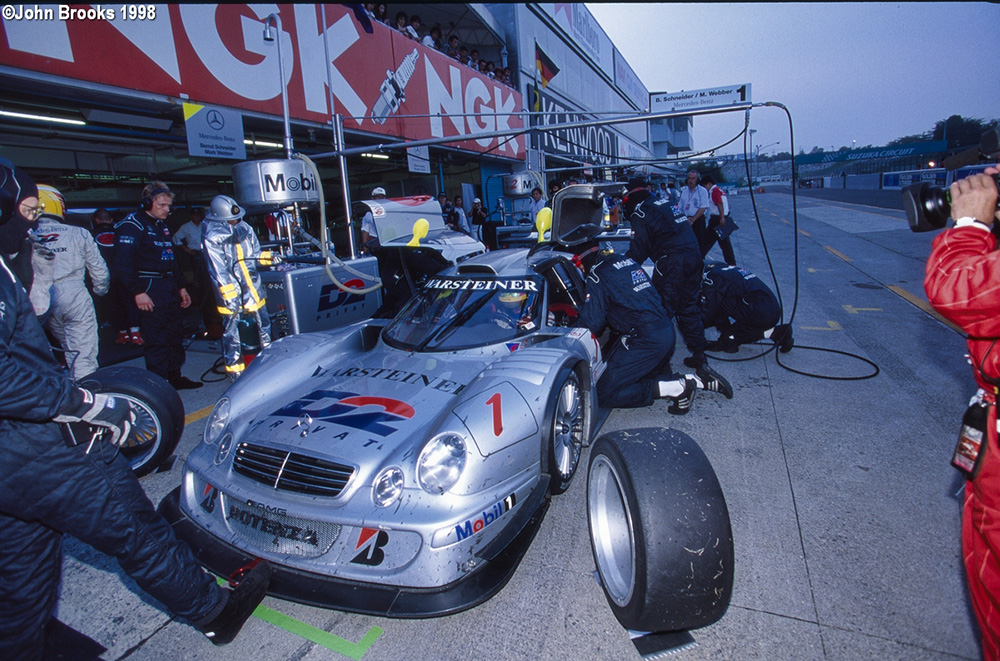
“The stats don’t necessarily tell the full story as everybody that doesn’t win the Championship says! But, you come back and say that the one race that they wanted to win was the one they did win.

Tell us about that. that one panned out a very different way to the rest of the season?
“There was one thing about that car in its inherent characteristic that you could qualify and race it at roughly the same sort of performance. Taking out the qualifying tire because clearly a race tyre and a qualifying tyre have a different level of lap time performance.
“But in general, you could push it to the limit in qualifying, and you could push it to the limit in the race.

“It was good in that respect. So, therefore, it was a very consistent car. It was a very consistent car through Le Mans in terms of the grip level changes. It was a bit damp and drizzly in the night, it was good in those conditions. It maybe didn’t have the peak performance. It had a high peak, but not necessarily the pure peak performance. But it had a higher peak performance offered a wider range of racing conditions and that meant that it was one that you could lean on all of the time, which is exactly what you need for Le Mans.
Would you classify the 98 car as closer to a prototype than a GT car?
“I would say that the Toyota drove the next year was, it had more of a characteristic of a single-seater or an LMP1 as we know it now? The picture below, the Toyota team pic at Le Mans in 1998 complete with the ‘road car’

“It was only at Christmas, the Christmas party when we knew we weren’t going racing in ’99 with Porsche as well because they were going to look at the LMP900 car.
“If you go back, it wasn’t as if they closed the doors on the programme directly after Le Mans. It was at the end of the year.
“It was Toyota press officer Gwyn Dolphin that first contacted me and we spoke to Ove (Andersson), who was the head of what was then known as TTE (Toyota Team Europe).
“We also looked at the other options as well with Mercedes and BMW who were the main protagonists. But I have to say I went to see Ove and sat down with him. Andre de Cortanze was there too and they sold it, they sold the programme to me in the clarity of where they were, what they were doing, where I fitted into it, how we were they were going to do it if I fitted in if I joined, whereas the others, there was always a little bit less well defined.
“For me, they were just very clear. They knew what they wanted to do. That was their plan. That was their mission. They were doing this, or that because of what happened last year. I came away from it thinking Actually, yeah, and being very honest about it. I still had to go and speak to Porsche to Herbert Ampferer to ask him for permission. He had to go to the board because it was another manufacturer.
“I was still under contract, but they allowed me to do that and I went off and did that one race with Toyota.
“It was very clear I was going to be in with Thierry and Ralf Kelleners. Ralf, I knew from karting in 1985 in Gothenberg at the European Championships moment and I knew Thierry anyway.
“But I was always playing second fiddle to some extent in that car because Thierry was the lead on that car. He was the one doing qualifying. He was the one starting the race. And Ralf and I were there to make sure we kept it in position.
“All in all, it was a very good strategy, maybe not quite as adaptable and as agile as what Porsche had been.
“Because the year before they were looking at a lot of different options in terms of drivers just for starters.
“Aiello, for instance, I think he was only sorted out in our car a week before the pre-test and didn’t do that test. In that respect, it was all very flexible, where this was done and dusted at the beginning of the year, in December or January.
“And we knew what every test was, every time we would be in the car all the way up to the actual race itself.
“And that was, I think, in so many ways, was actually one of their clear strengths because they had a very, very clear goal.
“I jumped in the car at Ricard for the first test and I have to say it took me a test to get up to speed with it.
“It wasn’t as if I jumped in and was quick straight away. Martin Brundle was the King of the Hill and they had Sospiri and Manu Collard in the other car and then the three Japanese drivers in the third car who were fantastic. They were lovely, really lovely.
“But in reality, the two main cars were the two European crewed cars, but at the same time, I would say the main one was Martin because of Martin’s profile and position. And Martin was very, very fast. I jumped in the car at Ricard and did three days.”
That Ricard test, by pure coincidence, was the first test too for the Audi R8R!
“I saw the Audi at the far end of the pit lane.”
“The Toyota was very much ‘on the nose’ in comparison to the Porsche.
“The Porsche, you sort of rolled it into the corners, and it was all smooth, and it was comfort. And it was, it was nice and it was consistent. This was on the nose of the car. This was one where there was definitely a bark from the engine.
“It was aerodynamically very, very efficient, which meant a bloody good top speed.
“But it worked in a narrow window. But it when it was in the window by god it was alive, and it was jumping around and you had to hang on and work with this car. And that took me a wee bit by surprise at the beginning.
“By the next test, I was up to speed and then because I didn’t do the performance tests, I basically was stuck in to do the endurance tests and the long runs. So for me, that was perfect because you know, it gave me a time to understand what made that car tick. And it was one where you had to commit to it. You had to kind of take control of the car or it took control of you.

“That suited my driving style because at the end of the day I’d only just really come out of single-seaters. So I was quite used to a car that was right on the nose and you sort of drove it right into the corners threw it around and got it back out again. And that was something that fitted quite well for me.
“But it was, I would say, about the last endurance test we did before Le Mans, because I think we did three of them before going to the pre-test at Le Mans where I felt at home with it. And then I felt, right, I’m in the game here in terms of inter-team performance, and understood how the aero worked, understood how the tire degradation worked, understood how the traction control worked, for example, and understood just all the little nuances of it, and what it meant for me and how I could translate it towards Le Mans.”
Where were you when Thierry had his accident?
“I was in my cabin. Because I got out, I’d done a sprint until about 2 am if I remember correctly, and it was about 3:30 or something and heard he’d had an accident.
“So I went down to the garage. But it was only due to the time that it took to take him out of the car that we realised that was much, much more serious than what we initially anticipated. Because when you go off there, clearly, you’re going off at a rate of knots.
“Any accident is a big one at Le Mans. But to have that sort of level of impact, there was a lot of worry and fear that it was going to be than what it actually turned out to be. But it did still turn out to be a very long road to recovery. It wasn’t six months. It was many, many years before I think it was all tidied up.
“After that, it was back to Porsche – and the LMP900 car. That tale though is for another day!”