


The first examples of what we now refer to as a hybrid car were seen even before the dawn of the 20th century.
Here, for instance, the Lohner Porsche of 1899 which really was a remarkable portent of current hybrid tech.

It was well into the 21st century though before manufacturers, large and small, started to investigate the potential of the tech in racing.
Here we take a look at the cars that have featured in endurance competition in that era, some with towering success – some not so much!
1998 Panoz Q9
Astonishingly ahead of its time, the 1998 Panoz Q9, nicknamed ‘Sparky’ was a joint development between Panoz, using the basis of its brutal Reynard-designed and built, 6 litre V8 powered Esperante GTR-1 GT1 car and Zytek who developed a 110 kW hybrid electric drive for the car.
The idea behind the concept is a familiar one now, but a decade and a half earlier than the LMP1 Hybrids!
The hybrid drive would facilitate better fuel mileage by regenerating energy under braking, storing that energy in an onboard battery pack and then deploy it (on the Q9 through the rear wheels only) to help acceleration. The concept was that the energy saved would allow the car to go longer between pitstops and thus stop fewer times during a long race.

The problem came with the technology available in 1998, the battery pack added massively to the weight of the car, almost 200 kg heavier than the normally-powered GTR-1, the Q9 weighing in at almost 1100kg.

David Price Racing operated as the factory team and prepared the car for the Le Mans 24 Hours Test Day where the Q9 would be wrangled by James Weaver and Perry McCarthy.
The additional weight of the car though proved to be an Achilles heel, the car lapping way off the pace over 16 seconds off the top time of the sessions and 12 seconds off the best time of the slower of the two conventionally powered Panoz. Plans to contest Le Mans were abandoned.
The Q9’s place in this list though was rescued by its appearance later the year at the inaugural Petit Le Mans at Road Atlanta.
John Nielsen, Doc Bundy and Christophe Tinseau would combine to bring the car home in a delayed 12th slot, but history was made, this the fist race start, and race finish for a hybrid-powered race car.
With the advances in battery technology that would be required to take advantage of the concept not in sight the Q9 was parked – a brave and significant first step.
2006 Denso SARD Lexus GS 450h
Toyota subsidiary Denso fielded the first manifestation of a racing hybrid system in the Tokachi 24-hour race in July 2006, the premier endurance race in Japan’s Super Taikyu series with SARD Racing the team in charge.

The Lexus was built in production form with a V6 petrol engine and a production hybrid drive, though with a capacitor rather than a then-standard nickel-metal hydride battery storage medium.

The capacitor was chosen as Denso believed that the current battery tech would not be up to the challenge of rapid and repeated charge and discharge that the 24 Hour race would impose. The Lexus featured a combined power output of 341 bhp – the car would come home 17th out of 33 starters in a near trouble-free race with Katsuyuki Hiranaka, Andre Couto, and Kohki Saga.
2007 Denso SARD Toyota Supra HV-R
After the toe in the water in 2006 at the Tokachi 24 Hours, the SARD/ Denso/ Toyota crew were back in 2007, this time with an altogether more focused racing weapon.
The 2007 car was based around a recently retired GT500-specification Toyota Supra from Super GT.
The Supra retained its naturally aspirated, 475 HP 4.5-litre V8 but gained another 227 HP through the inclusion of a 150kW motor/generator unit (MGU) across the rear axle and individual 10kW MGUs in each front wheel. Though the front wheels had relatively little power at their disposal, the Supra could now recover energy more efficiently from three separate sources and had four wheel drive to earn its HV-R designation (Hybrid Vehicle-Race).

As before a capacitor system was installed to store and supply electrical energy but instead of supplementing the heavy battery pack, this time the capacitor replaced it making the Supra HV-R a much lighter car at just 1080kg.
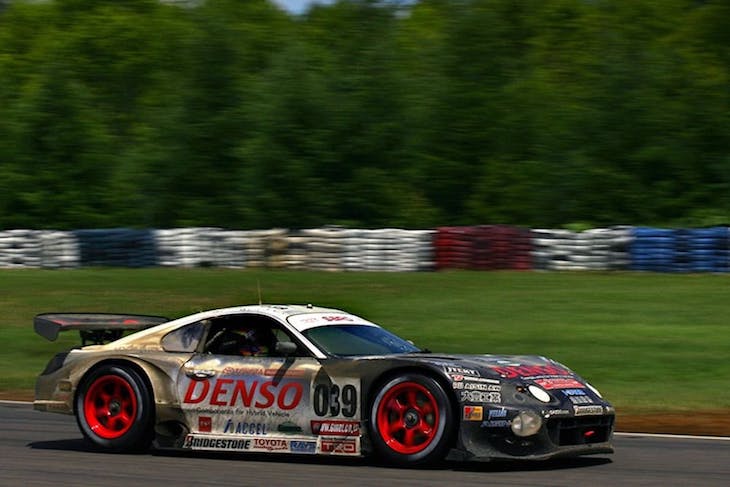
The Supra delivered on the promise of the concept, Akira Iida, Takayuki Kinoshita, Tatsuya Kataoka and André Couto winning the race 19 laps ahead of the second-place finisher, a sledgehammer to crack a nut it might have been, but the Supra the first hybrid-powered vehicle to win a race, the Supra delivering 10% better fuel economy than the 2006 Lexus and with significantly better brake wear than predicted thanks to the front axle regeneration.
2008 Gumpert Apollo
The troubled Gumpert supercar outfit were next to investigate the potential for hybrid technology with a project to hybridise one of their spectacular Apollo supercars for a run at the 2008 Nurburgring 24 Hour.
The programme was brought together in an astonishingly short time, less than four months from the start of work to one of the world’s most challenging 24 Hour races.

One of the drivers of the project, quite literally, was ex F1 Grand Prix winner Heinz-Harald Frentzen. He would share the race drive with Dirk Müller, Dominik Schwager and Marcel Engels.HThe potent Apollo saw its regular 4.2 litre V8 replaced with a less powerful 3.3-litre twin-turbo Audi unit, boosted by a 100 kW, electric motor, powered by lithium-ion batteries that drew their charge from a regenerative braking system.

The car looked an impressive beast but lacked the testing miles necessary to take on the N24 challenge, the car went through two gearboxes, including a unit salvaged from a road-going show car in the paddock!
It would complete just 53 laps, and Gumpert would not return to the tracks, the looming effects of the global financial crisis saw the firm slip into bankruptcy in 2012.
Part 2 features the eve of hybrid tech in prototype racing – and the arrival of one of the big European guns!


