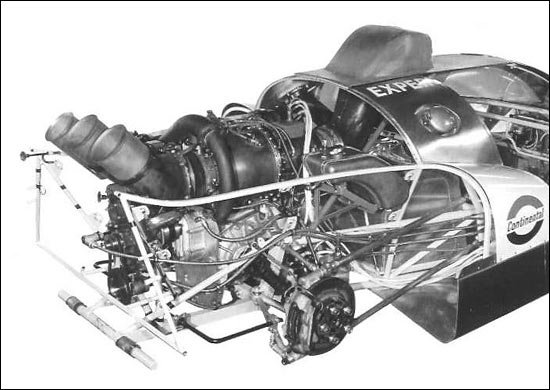
The FIA's announcement after the 1967 Le Mans 24 Hour race of a 3-litre engine capacity limit for sports prototypes, and a 5-litre limit for homologated GT cars, had a dramatic effect on international sportscar racing. One major consequence of the change in regulations was the withdrawal of the unlimited budget American factory effort from Ford and the covert programme carried out on behalf of General Motors by Jim Hall’s Chaparral team. Both manufacturers had spent vast amounts developing cars powered by stockblock based 7-litre V8 engines and history records that they retreated across the Atlantic crying, "Foul!”, never to return. But when the brave new World Championship of Makes began at the Daytona 24 hours in February 1968, there was an American manufactured car on the grid. The leading entries were 5-litre Ford GT40s run by the British JW Automotive team, doing battle with factory 2.2-litre Porsche and 2.5 litre Alfa Romeo prototypes. Seventh on the grid that lined up for the rolling start was the only American project ever to race under the new regulations. The Howmet TX (Turbine Experimental) was the brainchild of American sportscar racer Ray Heppenstall: his family owned the largest privately operated steel business in the country. In this 1991 interview with Alan Lis, Ray, who sadly passed away in 2004, reveals the background story of this car, one that caught the imagination of all who saw it (including dsc’s editor, who was one of many at Brands Hatch on April 7 1968, and watched it race in the BOAC 500). Much of this interview was conducted during a visit to Stonehenge - with Ray Heppenstall telling the story as he and Alan Lis toured the ancient monument in Wiltshire!
How did
you come to design and build the Howmet TX? “Howsound got scared off by the financial ramifications for them if I had been killed in a car bearing their name, and it was about four or five years before they could be approached again about motor racing. The next time I tried was on the programme for Daytona in 1967, where I ran a modified Ford Falcon sedan. They kicked in a little bit of money towards running there and during the race meeting the idea of the turbine engine programme, one that we had talked about in ’63, came up in conversation - and it was decided that it was the right time to do this. “Fleming recommended it to John Burke, then president of Howsound, which at that time was undergoing a number of changes, including the acquisition of a shareholding by the French-based multinational Group Pechiney, that resulted in the US company changing its name to Howmet. "I went home from Daytona and put together a proposal. To give an idea of what the car would look like, I took a plastic model of the Hussein sportscar - a John Mecom re-bodied Cooper Monaco - and the roof section of a model of the Ford J-Car, and glued it on the Hussein. After painting it and putting decals on it, I had the model photographed on a window sill late in the day, so the sun was shining down casting a big shadow. I then superimposed the car on a photograph of the Philadelphia Art Museum, which is a very impressive Greek style building, and presented the finished composite photograph to the Howmet board of directors, telling them that they could have something like this. They accepted the idea in principle and agreed to fund my going out to see if I could find an engine that would fit the FIA formula for 1968.” This happened
between the Daytona and Sebring races in 1967? How close
was the Continental engine to the 3-litre limit? So after
the visit to Continental you had an engine, how did the chassis
evolve? Did you
have drawings for the car you wanted to build?
What about
the transmission? “The FIA rules said that you had to have a reverse, which meant I should really have had a gearbox. Because it was never quite felt that the governor on the power turbine would handle the turbine being turned loose, we didn't dare go through a neutral so a conventional gearbox was out of the question. I went to a local airfield, picked up a starter motor from an old radial engine and set it ahead of the front drop gears. By running a shaft through with a little cog on the end I had an electric reverse, which met the rule and was easy and inexpensive to do.” Was the
engine installation also carried out at McKee’s? “By that time we were getting pretty tired, but I really wanted to see whether this thing was going to run at all. The brakes hadn't been bled, so I chained the TX to the front of the 55 Ford station wagon I had at that time, and using the station wagon’s brakes, we drove around the deserted parking lot and found that the car truly did run. We packed up for the night and went to the motel for a couple of hours sleep, before returning to the shop.
“That morning, I started looking around for a test track to run the car on. It should have been easy in Detroit, but I didn't have the necessary connections to use the Ford or GM tracks. The only SCCA track in the area was in Grattan, Michigan, which wasn’t too far away, but it was under six inches of snow. Eventually I lost all patience and put a Pennsylvania dealer’s plate that I had with me on the car, and drove it out of the Continental plant on to the city street at about 11am, and into bumper-to-bumper traffic. I drove about six blocks with a chase car that I hoped was right behind me, but because I didn't have any rear view mirror I couldn't tell. What turned out to be right behind was a police car! About six blocks north of the plant, I turned onto a narrow tree lined residential street and the temptation was too great. I hit the accelerator and then stopped after one city block. I had no instrumentation in the car which would immediately relate to road speed, all I had was a power turbine tachometer, which at that time was related only to power turbine RPM. As a result I really had no idea of how fast the car was or anything else. With the air coupling between the power turbine and gas turbine sections of the engine, the power delivery was so smooth that you had no sensation of speed at all. The engine went to full song as the car moved, and although the engine note changed as you accelerated, it was already at full chat, which was 57,500rpm! “Later on I did some calculations and worked out that in the length of a city block, I had gone to somewhere near 100mph and then stopped. The police car following had gone to 50 mph before stopping, and the officers were appalled that I was doing such a thing on a city street and hit the siren - which of course I couldn't hear above the noise of the engine. I went one more block on this residential street and turned right again onto the road back towards the plant. At that time the police car pulled alongside and I saw him. He motioned for me to pull over to the side of the road, but I didn't want to do that, so I motioned for him to follow me and went back to the entrance of the Continental plant. “I stopped outside and had a conversation with the officer. I didn't get a ticket since he hadn't followed me for long enough and I hadn't really done too much wrong. He was sure that I had exceeded the speed limit but he couldn't do too much about that because he couldn't say by how much or for how long. All I had really done was accelerate down one city block. He gave me the number of the local precinct and said that if I wanted to go out on the street again to call them in advance and they would give me an escort. I thought that was very accommodating - and pulled into the Continental lot.
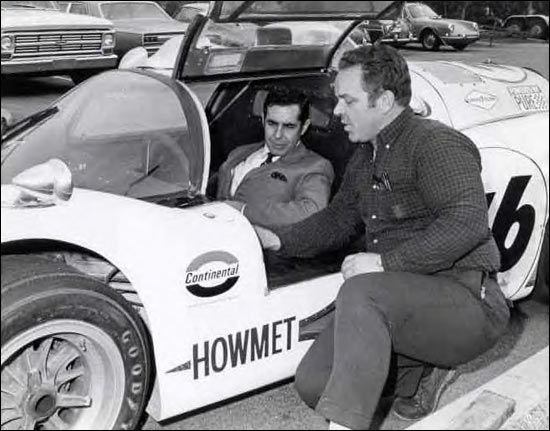
“I then called Fleming (in the car, above, with Ray Heppenstall kneeling alongside) at home and told him of my escapade. Of course what I was really telling him was that the automobile ran. The next thing on the agenda was to find some place to test it properly, which would give him a better idea of what was going on. By then Fleming was really afraid of what was going on with the car, it was fast becoming known as "Fleming’s Folly", but after the news that the car truly did in fact work, he got praise and commendation - until about 15 minutes later when he got a call from the CEO at Continental telling him about my run in with the police and saying "Do you know what that crazy bastard did?”
What happened
between then and the TX’s first race at Daytona in February
1968? “Then we took the car down to Daytona to carry out pre-race tests, of both the car and potential co-drivers. I had arranged with Bill France to supply him with posters for the race, which prominently featured the Howmet. When we went down to test, to get a bit more ink and publicity, we made an attempt at the closed course wheel driven turbine record. Parnelli Jones had set the record at 166mph with the STP Paxton car at Indianapolis in 1967. The STP turbine engine was much bigger than our Continental engine, produced a lot more horsepower and was capable of far higher speed, but the track at Daytona was much faster. “Dick Thompson came down to Daytona to try the car and he was first to take it out on the track. Within four laps he was under the previous sports car lap record for the road circuit. That came as an enormous surprise to all of us, because as previously mentioned, the application of power was so smooth there was just no sensation of speed in the car at all. One never really thought that one was going very fast. We were really surprised to find that we had such a potent automobile on our hands. “We were doing our testing during a Goodyear stock car tyre test, so we didn't really get a whole lot of time on the track. We had to run in the gaps between the stock cars. When I went out to try for the record, I had just four warm up laps before I started running for speed. It was all new to me, because I had never gone all the way around the tri-oval before. On the road course, you ducked down onto the infield just after the start/finish line and came back onto the outer circuit a bit further on, so that you were never going through the West banking flat out. The first time through there on full power was a bit of an experience, but the car handled so well and was so easy to drive that within a few laps not only was I not lifting anywhere, but I was using the banks to accelerate going down the straightaway. If you came in high on the bank and about half way round kind of turned left and dived down, you would go faster on the following straightaway. “Because of our association with Union 76 oil, and the other people that Bill France had helped us get connected with, when my lap speed reached 176mph I decided to stop. It was about as fast as I thought the car was going to go, maybe I could have got another 2 or 3mph, but I thought that the 176 mph record lap for a Union 76 car would make good print. “After the Daytona test we took the car home and set to work on preparing it for the 24-hour race. By then we had a second car, which was a new chassis frame with a slightly longer wheelbase, and Continental had agreed to supply us with another engine. Bob was sure that the longer chassis would make the car handle better, but I could never tell the difference between the two. At this point in time I was not intending to run a two-car team. In fact we didn't have enough parts for two complete cars for the Daytona race. The contemporary
race reports suggest that one of the cars was withdrawn because
of an engine failure? “At one point I did stick a rope across the garage doors that we were using and I didn't let people in because we were busy working. That way I suppose a lot of fairy tales got told.” The TX was
seventh fastest in practice and running just outside the top ten
when it the wall after 34 laps and retired. What happened? “During the Daytona test sessions we’d had problems with the wastegate, which was simply a large butterfly valve, and as designed by Continental called for a single stainless steel ring, much like a piston ring. In its original aluminium housing the ring was galling, causing the wastegate to stick. Before the Daytona race I went to a local parts store, where I bought a cast iron ring of similar dimensions and found that it was infinitely better. Ultimately it wasn't going to be the answer, but it was the best that we could come up with at the time - and so we went to Daytona with such a wastegate. Of course when Ed Lowther was driving the car in the race, the wastegate stuck wide open in the hairpin bend coming out of the infield and onto the tri-oval. He hit the outside wall and that was the end of our race. “After Daytona we went to the aircraft industry looking for a developed wastegate that might work, and found that Parker-Hannifin out in California had a couple on the shelf that would do the job admirably. We got those and fitted them to the two engines and never had another problem with the wastegate. For the
Sebring 12 Hours the TX qualified third fastest but made a slow
start and lost several places?
There is
a scary looking photograph of water being thrown onto the engine
during a pit stop. What was happening there? “Continental talked me into putting two electric gate valves in the fuel system so that we had some way of shutting it off if you ran into a problem where you had a runaway turbine, for instance if the governor didn't work. It was one of these valves that packed up part way through the race, even though it was an aircraft part, so one would have thought that it would have taken the pounding of an automobile chassis. “When the valve failed the engine was at full chat, so a shut down would mean a seizure. We could have waited about half an hour for the engine to cool down to ambient. By that time it would have free and been ready to restart, but we were in the middle of a race and I didn't have the patience to wait. I knew what the problem was, so all I had to do was find some way of cooling it down... fast. I grabbed a cooler bucket of ice water and threw it down the exhaust stack. This generated a lot of steam and a lot of fear, but it was more spectacular than it was dangerous. There were a bunch of people scurrying around for fear that the whole thing was going to blow up, but it worked a treat. “We by-passed the faulty valve and sent the car out again within a short time. Then a couple of laps later the car stopped out on the track. The other valve had failed, so I took some water out on the course and did the hot shut down routine for a second time. With the other valve by-passed we got the car out again and for a while it was running fine.” What was
it that finally put the car out of the race? In Part Two – The TX Comes to Europe
|


 “At
that point Continental pulled back and ceased to have full corporate
support for the project. They thought that somehow this engine was
going to live in a vacuum forever, and that if it ever blew up there
would never be anyone around. When they had agreed to do the car
project, it had never occurred to them that the vehicle was going
to be around people, and that if their was any trouble someone might
get hurt. When that realisation sunk in they were petrified at what
their exposure might be in such a case.”
“At
that point Continental pulled back and ceased to have full corporate
support for the project. They thought that somehow this engine was
going to live in a vacuum forever, and that if it ever blew up there
would never be anyone around. When they had agreed to do the car
project, it had never occurred to them that the vehicle was going
to be around people, and that if their was any trouble someone might
get hurt. When that realisation sunk in they were petrified at what
their exposure might be in such a case.” 
 “Blade
erosion from debris ingestion stopped us. The engine air inlet on
the roof was not filtered in any fashion. Most of the Sebring circuit
is lined with sand and it only took a few cars to spin off before
there was sand on the track surface, which got thrown up in the
air. With no filtering, the inlet swallowed a lot of sand, which
eventually caused tremendous blade erosion, resulting in a terrible
aerodynamic mis-match within the engine. There was an aerodynamic
surge that caused a terribly high-energy force through the acceleration
mode. As you tried to accelerate the result would be bang! bang!,
bang! from the engine. This misfire ultimately tore the helicoil
out of the left rear motor mount, and that was the end of our endeavours
for that weekend.”
“Blade
erosion from debris ingestion stopped us. The engine air inlet on
the roof was not filtered in any fashion. Most of the Sebring circuit
is lined with sand and it only took a few cars to spin off before
there was sand on the track surface, which got thrown up in the
air. With no filtering, the inlet swallowed a lot of sand, which
eventually caused tremendous blade erosion, resulting in a terrible
aerodynamic mis-match within the engine. There was an aerodynamic
surge that caused a terribly high-energy force through the acceleration
mode. As you tried to accelerate the result would be bang! bang!,
bang! from the engine. This misfire ultimately tore the helicoil
out of the left rear motor mount, and that was the end of our endeavours
for that weekend.” Contents Copyright © dailysportscar.com. All Rights Reserved. |