We’re a little late bringing you Janos Wimpffen’s initial observations from South Africa, owing to his discovery that the internet is not yet a mainstay of daily life in this part of the Republic – and completely absent from the circuit and his hotel! Thanks to some detective work, however, he has managed to find a working connection. Alas, it has not yet proved possible to send images, and they will follow in due course.
Welcome to Welkom! Located a few kilometers from the small modern city of Welkom is the Phakisa Freeway circuit—pronounced “Pa-kisa” by the way. We are about 100 km north of Bloemfontein, the capital of Free State, the country’s judicial center, and a major university town here in the central part of South Africa.
Free State is relatively flat, very agricultural part of the country and like most of South Africa lies along a high plateau, much of it at about 1000 meters in elevation. This high average elevation is one of the reasons many race teams and car manufacturers prefer South Africa as a venue for testing, giving good readings of air intake and aerodynamic measures that can applied in selected venues across the world.
Phakisa is about 300 kilometers from the major metropolitan area of Johannesburg and Pretoria. Therein lies a bit of rub about this weekend. Kyalami, certainly the most well-known African circuit, is in the metro area and is hosting the first round of this year’s Pro Tour. The Pro Tour consists of a mix of single-seaters (F VW and FF) plus production series such as VW Polo. The headliners include V8 (S. Af’s version of the Trans-Am) and the Shelby Can-Am center seat sports cars. These have all drawn away from the schedule conflicted Phakisa event being held the same weekend.
Nevertheless, the African 6 Hours remains an important race and represents South Africa’s reemergence onto the international endurance racing scene. The entry could not be more varied. It is open to all types of closed wheel cars that are nationally recognized: GT, prototype, touring, and even historic. It is organized by Classic Car Events, South Africa’s premier sanctioning body for historic races, rallies, and tours—Roger Pearce is their director, while former Motor Sports Association CEO, Francois Pretorius, is the chief steward. These two wonderful enthusiasts combined with the delightful camaraderie of all the entrants are reason alone why motor sports in general and endurance racing in particular should be on the rise. It has a place in this totally sports mad country. Browse through the TV stations and it is hard to find a non-sports channel. There is rugby, golf, rugby, football, cricket, and rugby.
Everything about this event is low-key. Most of the entrants know each other well enough that there is no end of good-natured joking up and down pit lane—it is going not just between competitors, but between them and the officials, marshals, friends, and families. This laxity extends to the schedule. There was to have been a 5-hour practice session today starting at 12:00. But as all the marshals seemed to be in place earlier, the pit lane was opened at about 11:45. About half-hour later it was noticed that only one car, the #26 Scribante Porsche 911 RSR, had a transponder mounted, resulting in no one else being timed. So the session was halted and instructions were given that none should leave pit lane without a transponder. Near the end of the session it was decided to lengthen the period by 30 minutes, giving one of the teams (the #86 Lola) some extra time as they had mechanical problems earlier in the day. The officials thought ‘why not—we’re having jolly good fun, let’s not stop now’. The marshals were promised extra beer.
This is all taking place under clear skies and about 30-31 degree temperatures—a nice summer weekend is in store. Racing in South Africa traditionally avoids activity on Sunday. Thus after Friday’s long free session, timed practice commences mid-morning Saturday with the 6 Hours flagged off at 13:00.
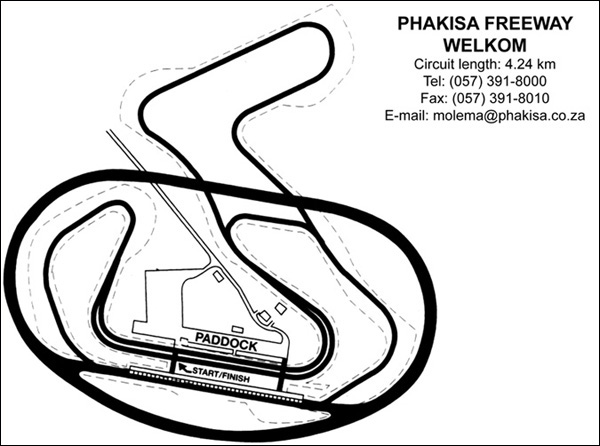
The 4.26 kilometer circuit is quite unique. It double backs on itself twice and is enclosed within an American style oval.

The oval was used but once—some years ago for an American Speed Association stock car race. The road course is rather bumpy, thanks in part to being located in a region known for mild seismic activity and sinking soils. Indeed the garages are at a level several centimeters below pit lane. Your average LMP car would tag the bottom in making that transition. Another unique feature includes some of the infield amenities. Teams camping at the circuit is a long tradition at Phakisa and their tents dot the area. Also available, but seemingly not in use, are several rustic cabins which would look at home in the Eifel. This is gold mining country, with mounds of tailings and a 4500 meter shaft located across the road. Appropriately, Phakisa Freeway is on the site of the former Goldfields Raceway.
This configuration results in two parallel straights, both located in front the pits. There is a long sweeping left hand pit exit followed by two decreasing radii right-handers with a medium length chute between them. After a fast left kink it opens onto the back straight, directly parallel to the oval. The pattern of rights but with shorter chutes between them is repeated and then comes the actual pit straight. A top time is considered to be in the 1:38 range.
Janos Wimpffen