Audi’s steamroller of the 2013 World Endurance Series continued at the six hours of Sao Paulo in Brazil a little over a week ago. After Stéphane Sarrazin had a coming-together with Dominik Kraihamer’s Lotus in the first stint, nothing was going to stop the two works Audi R18 e-tron quattros cruising to a dominant one-two victory.
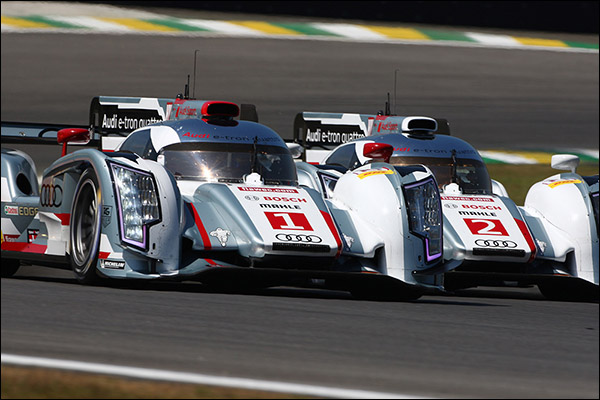
What was something of a surprise, though, was to see a wheel bouncing loose as Loïc Duval headed down the pit lane. The resulting slow lap to get it re-fitted would have been enough to scupper its chances for a race win, but two pit stop penalties (the first for 30 seconds, for pit lane speeding and the second for 1 minute for an ‘unsafe release’) put it far enough back that for a while it looked as if it would be pushed down to third place by the Rebellion Lola.
The fact that the remaining Toyota-engined LMP1 entry in the race could not overcome what amounted to more than three minutes penalty is further proof (if it were needed) of the uphill struggle faced by the LMP1 privateer entries this year.
For the bulk of the race, then, the interest in the race centred on the battle for GTE-Pro honours.
Prior to the race, the FIA World Endurance Committee applied further adjustments to the Balance of Performance table in GTE-Pro. At Le Mans, it was clear that the both the Aston Martin Vantage V8 and the Manthey Porsches (991) had a performance advantage over a single lap (see my article on p46 of the August edition of Racecar Engineering). As a result (of the performance advantage, not my article), both cars went to Sao Paulo with a 3mm reduction in the diameter of their air restrictors.
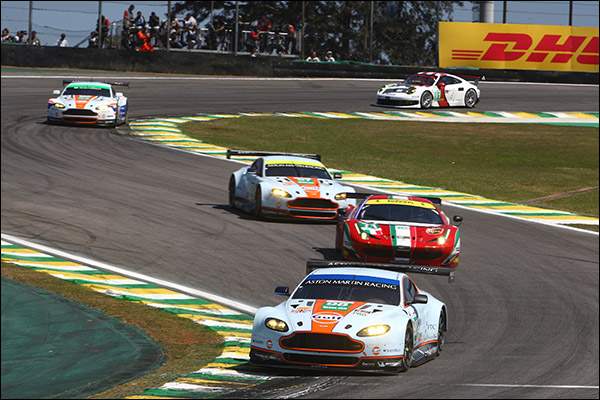
As far as Aston was concerned, this evened things up nicely, although the Porsches seemed to struggle more in the Brazilian heat. The first phase of the GTE-Pro race, up to the appearance of the Safety Car, 36 minutes into the race, was not a complete waste of time, as Gianmaria Bruni had converted fifth on the grid in his Ferrari to a lead over Darren Turner’s pole-sitting Aston of 7.587s. Although the Safety Car would remove this advantage, his pace in the early part of the race was a sign of things to come.
Revisions to the Safety Car rules, introduced for the first two rounds of the WEC, but not in force at Le Mans, allowed cars to pit as soon as the Safety Car had completed three laps. Once the pit lane entrance was open, the exit would also be open, provided no cars were passing the pit lane exit. This had the effect of removing the penalty for making a stop while the Safety Car was out, encouraging teams to call their cars in while the race pace was artificially slow.
However, with only a little over three-quarters of an hour gone, most of the GTE cars had used little more than half a tank of fuel, so it was an interesting time for strategy calls. As the pit lane opened, most of the leading GTE runners stayed out, but Pedro Lamy in the no. 98 Aston Martin, Jörg Bergmeister in the no. 91 Manthey Porsche, Davide Rigon in the 8Star Ferrari, and the Porsches from Proton and IMSA Matmut all came in.
As that first Safety Car period dragged on, to allow barrier repairs to take place, we began to approach the normal time of the race that refuelling stops would be necessary. Note that I said time not distance. Gianmaria Bruni brought the AF Corse Ferrari in after an hour and a quarter of the race (as he completed his 39th lap). The ever-frugal Ferrari took on only 48 litres, though, so clearly could have stayed out much longer, but the objective was to get the pit stop done while the cars on the circuit were still travelling at Safety Car speeds. Darren Turner stayed out nearly eight minutes (three laps) longer, coming in to hand over to Stefan Mücke as he completed his 42nd lap, but of course had to rejoin at the back of the line behind the Safety Car.
When the Safety Car came in, at 13:32, all the GTE cars had pitted once, all were on the same lap (except for the Krohn Racing Ferrari and the already-delayed no. 92 Manthey Porsche), but they were in the order that they had made their pit stops. So the class lead on lap 47 was held by the no. 91 Manthey Porsche, from the no. 95 and 98 Aston Martins, all of which had less fuel aboard than those cars behind (which had also been faster in the first phase).
However, Fisichella (in for Bruni in no. 51) and Mücke (in for Turner in no. 97) lost no time as the green flag waved, and quickly got themselves back into the lead of the class, ahead of Bergmeister (who had stayed at the wheel of the no. 91 Porsche).
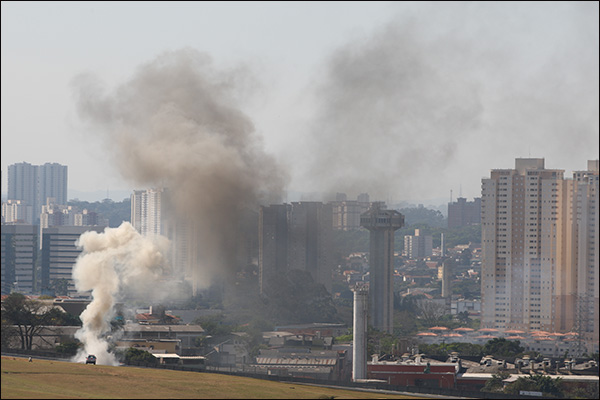
Meanwhile, further drama was unfolding behind, as Toni Vilander’s AF Corse Ferrari 458 Italia (no. 71) erupted in a blaze of flame. As the shadow of the black smoke crossed the circuit, the Safety Car was deployed again. This time, however, the Safety Car was withdrawn as it completed its third lap, meaning that the pit lane entrance was closed for the entire duration of the neutralisation, preventing any stops.
Thus we were left, with four and a half hours of racing remaining, but what was clearly going to be a two car race between the best Maranello and Gaydon had to offer.
Looking at these two in a bit more detail, I first look at the stint analysis from the green flag after Vilander’s fire, up to two laps before the chequered flag.
Firstly, for the no. 51 AF Corse Ferrari 458 Italia:
|
Stint
|
From lap
|
To lap
|
No. of laps
|
Driver
|
Average lap time
|
|
1
|
58
|
85
|
28
|
Fisichella
|
1m 35.403s
|
|
2
|
88
|
128
|
41
|
Bruni
|
1m 35.158s
|
|
3
|
131
|
169
|
39
|
Fisichella
|
1m 35.277s
|
|
4
|
172
|
210
|
39
|
Bruni
|
1m 34.593s
|
[sws_divider_small_padding]And secondly, for Aston Martin Racing’s Vantage V8, no. 97:
|
Stint
|
From lap
|
To lap
|
No. of laps
|
Driver
|
Average lap time
|
|
1
|
58
|
86
|
29
|
Mücke
|
1m 35.593s
|
|
2
|
89
|
127
|
39
|
Turner
|
1m 35.165s
|
|
3
|
130
|
168
|
39
|
Mücke
|
1m 35.260s
|
|
4
|
171
|
210
|
40
|
Turner
|
1m 34.620s
|
[sws_divider_small_padding]The total effect of these 147 laps (nearly four hours) was a net gain for the Ferrari of just six seconds.
On the pit stops, the story was rather different. The four stints shown above required three pit stops. For the Ferrari, the story of the three pit stops was:
|
On lap
|
At time
|
Time in Pit Lane
|
Fuel Added
|
|
86
|
14:38
|
1m 22.326s
|
86.17 litres
|
|
129
|
15:48
|
1m 20.582s
|
86.94 litres
|
|
170
|
16:54
|
1m 19.490s
|
79.57 litres
|
[sws_divider_small_padding]And for the Aston Martin:
|
On lap
|
At time
|
Time in Pit Lane
|
Fuel Added
|
|
87
|
14:40
|
1m 19.162s
|
85.57 litres
|
|
128
|
15:46
|
1m 18.353s
|
82.55 litres
|
|
169
|
16:52
|
1m 17.852s
|
82.93 litres
|
[sws_divider_small_padding]Which, in summary, meant:
|
No.
|
Car
|
Total Time in Pits
|
Total Fuel Added
|
|
51
|
Ferrari 458 Italia
|
4m 02.398s
|
252.68 litres
|
|
97
|
Aston Martin Vantage V8
|
3m 55.367s
|
251.05 litres
|
[sws_divider_small_padding]A net gain for the Aston Martin of seven seconds.
So, in theory, the Aston Martin should have won, right? Well, yes, but the eagle-eyed reader (of which I know this website has many) will have noticed that, in addition to leaving out the final two laps of the race in this analysis, I have also excluded the laps into and out of the pits on the three pit stops.
And although stalemate had set in for the final two laps, on the six critical ‘in’ and ‘out’ laps, the Aston Martin lost a total of 2 seconds. Which doesn’t sound a lot, but compare it to the 147 flying laps that the Ferrari took to eke out a margin of six seconds, as described above. Maybe it was this that made the difference between winning and losing the race, as far as the GTE-Pro class was concerned?
As far as I can work out, the biggest part of that difference was in the second sector of the ‘out’ lap, where grip – or at least, confidence in the grip – from the newly-fitted tyres, is crucial.
Another fascinating GTE battle is in prospect again at the next round at Austin, Texas. And in the interests of the race, let’s hope that the Manthey Porsches can find between 0.3s and 0.4s per lap that they need to join in the fight, without having to resort to more performance balancing…
Paul Truswell