Yup. Still raining!
For those that care, 18 cars appeared on track for the Thursday afternoon session. The appearance of the Ed Brown driven 02 ESM HPD marked the first appearance of a P2 car all day long. As earlier, it was Muscle Milk setting the fastest times, with the Delta Wing taking advantage of the wet conditions to be second fastest.
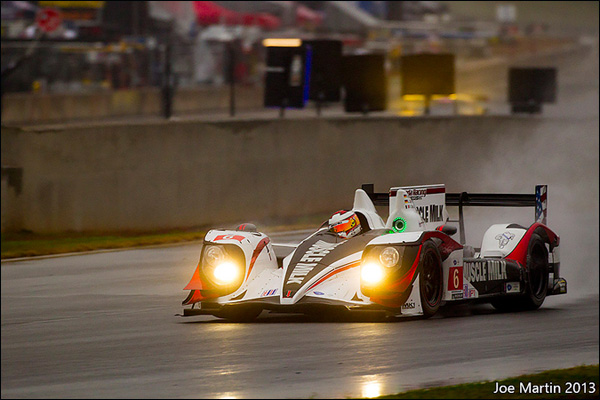
OK – so, what else is happening? The latest reports indicate that Friday and Saturday may be rain free, which is great news for all involved. Thank God.
Hmmm… What else? Hmmm… How about the GT class? OK. Glad you asked.
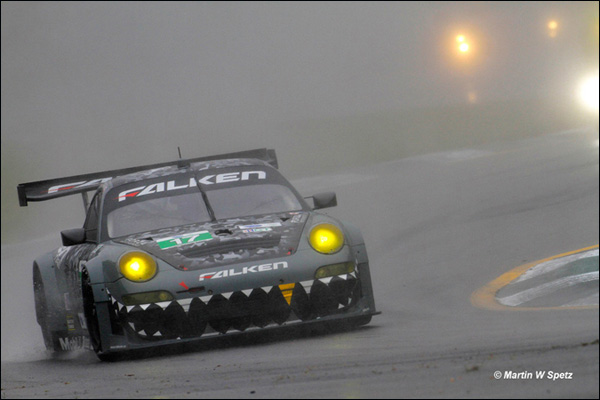
No where in the world is there a better class of racing than here in the GT category (soon to become GTLM). The ALMS features five makes of cars – Corvette, Ferrari, BMW, SRT Viper and Porsche and all are balanced to an amazing level of competitiveness, which makes the racing simply outstanding. Many times a track can and will be labeled as a “Porsche Track” or a “Viper Track”, but that’s pretty much gone away now. Thanks to Scott Elkins and his people, IMSA has done what may have been viewed as impossible – achieve a balance of performance between a diverse variety of cars. This does give us hope of what is to come as far as the upcoming regulations, starting in 2014…
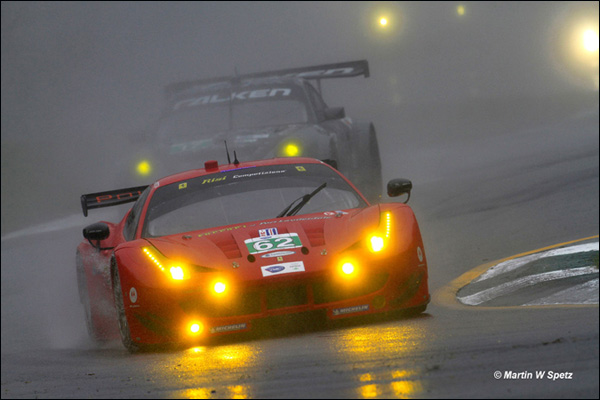
Also, the teams and manufacturers must be thanked for their support of the regulations. Without them there would be no class.
So what makes this class so competitive and so interesting? First of all, it’s the cars. They have the look. Not bone stock at all, but they have a look that is a good aesthetic compromise between what is a stock street car and the wild no holds barred and take no prisoners look of the much missed Group 5 era. People may complain that the BMW Z4 is more race car than street car, but the compromise works. It is a stunning car, especially in the black paint scheme.
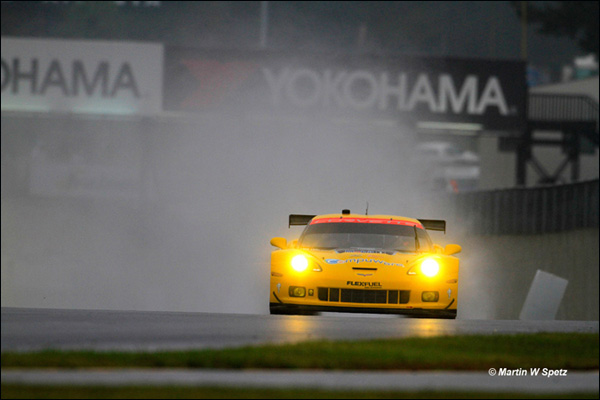
Sportscar racing fans are unique. Unlike some forms of racing, it is the cars that excite them, not the drivers. None other than Corvette driver and reigning class champion Olly Gavin agreed – “sportscar fans want to see the latest cars. They want to see the latest aero tweaks – they want to watch cars that look fast standing still. The ALMS has that in this class.” And then some.
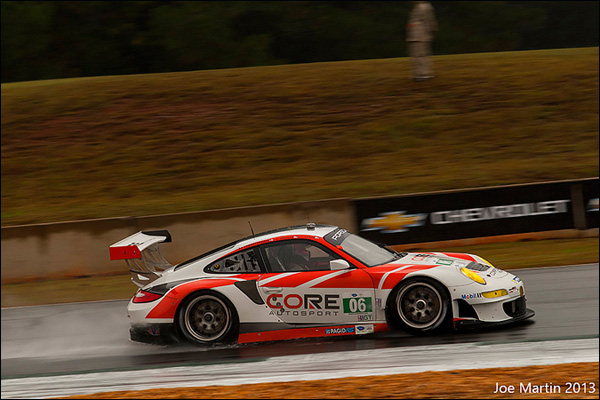
But according to Porsche Factory driver Pat Long, the class wouldn’t be as compelling without it being so competitive. “You can have the best looking cars around, but if it’s known before the race who is likely to win, people just won’t watch. They’ll stay away.”
That is what makes this class work – the looks of the cars and the fact that week in, week out, it’s difficult to predict who might win in the class. Gavin – “We’ve not always had the quickest car out there, as the C6.R is really at the end of its development cycle, but we’ve managed to win our share of races, especially over the last two seasons. But there is a real fine line in this class between winning and losing. Lately we (Gavin/Milner) have been on the wrong side of that, but it’s a testament to the class just how competitive it is – how hard you have to work for success in this class.”
New, or actually returning to the class is Robin Liddell, who last competed in the ALMS GT class back in 2007 in a Tafel Porsche. Over the last few seasons, Robin has been competing in the Grand Am GT class, first in the Pontiac GXP-R, and then continuing in the same chassis, reborn as a Camaro. “I’d forgotten about the grip levels of these ALMS GT cars. This Risi Ferrari is a long ways ahead of the Porsche I’d driven back then and is also quite a step above the Grand Am spec Camaro I’ve been driving the last 3 season. Up to a point, the Ferrari is like a prototype. The aero grip is impressive when compared to the spec of Camaro I’m used to, but the mechanical grip is most impressive. Not to complain about the Continental Tires we used in the Grand Am, but those were spec tires. That is totally different than the Michelins that are on the Risi Ferrari. The grip level is just so much more than I’ve been used to – I’m getting used to it and really enjoying it. My times are getting closer to Matteo (Malucelli), but I’m constantly reminding myself that I’m here to support Matteo and Olivier (Berretta). I need to go as fast as I can, but I also need to hand the car off in good shape. I have to keep it clean.” That is especially critical for the Risi team, which has been stung by multiple costly accidents throughout this, their comeback season.
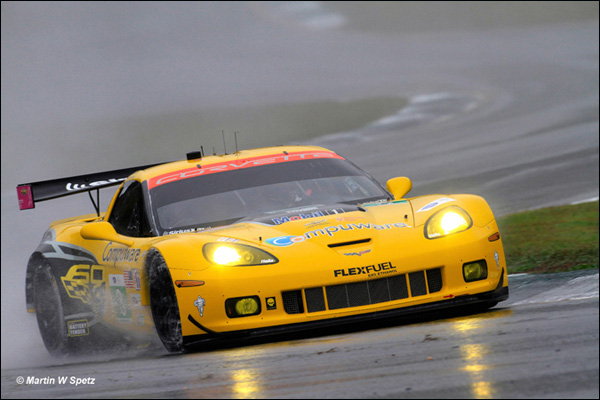
To a many of us, the constant reg changes appear to be very insignificant, but to a driver, the slightest restrictor change or weight adjustment is noticeable. Gavin – “Yes, you can tell the difference of even 10 kgs of added weight. It may not seem like much, but I’ve seen on our Corvette that a very slight addition of weight can make a huge difference. That added weight can simply put the car over the designed comfort level. I’ve experienced it and I think that’s what the Viper is experiencing right now. They had a slight weight penalty and since then they haven’t been as competitive as they had been.”
But the flipside of that is the team plan. It is not uncommon to have something held in reserve – some performance level that is held back, just in case the regulation changes become a bit more than expected. Of course no one will come out and actually admit to utilizing this practice, but most everybody will blame the other competitors of this. The problem for a team is much like poker – when and how much do you show?
Part of the intrigue of this class is that contrary to popular belief, it is possible for a racing class involving factory backed efforts to put on a competitive and entertaining show. Yes, the stakes are high for those factories involved, but the rewards are even greater when there are more competitors. What was better for Corvette Racing – winning in GT1 when it was pretty much only them competing or winning championships this season against a strong caliber of competition? Duh.
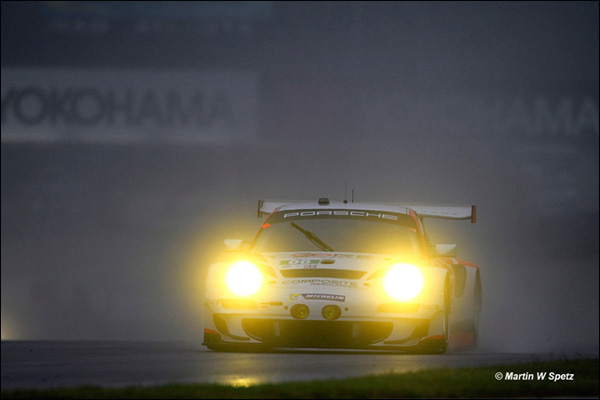
That pressure means that the factories become more involved in the politics of racing. Long – “Yes, there is more pressure when a manufacturer becomes involved. A manufacturer may be used to lobbying for their customers, but all of a sudden the game changes when that manufacturer supports or runs a team. The stakes are much, much higher.” Those heightened stakes also makes success that much more rewarding.
Thankfully, it appears as if the majority (if not all) of the players intend to continue next season into the TUSCC. Combined with the apparent continuation of the IMSA designed regulations, it looks like we may be able to continue to enjoy the great competition we have been used to as we morph into the new series.
Gary Horrocks