After the disappointment of the Fuji 6 hour “race that never was”, the six hours of Shanghai was all that we could have hoped for, at least as far as the fight for the outright win and honours in LMP1 was concerned. It was especially encouraging for Toyota fans, bored with Audi domination this season, that the Japanese manufacturer clearly had a quick car, and they proved it by grabbing pole position. It was apparent from the race here last year that the nature of the circuit hurt Audi, the number of slow corners meaning that the R18 e-tron quattros were able to use their electric ‘boost’ for a smaller proportion of the lap than hitherto in the season. Even La Source, at Spa-Francorchamps, is a wide radius corner compared to some of Shanghai’s hairpins.

Not since Silverstone at Easter have we had a race free of Safety Car Intervention, and even there, if you remember, we had a couple of periods of “Full Course Yellow” – first when an April shower doused the circuit and second to remove some debris. Not only was the Shanghai six hours free of any sort of intervention (apart from the occasional local yellow flag zones, which did not have a material impact on the race), but it was also run in dry conditions throughout – a perfect scenario for race strategists!
That is not to say, however, that the race was free of “what ifs”. Among three of the four works hybrids there were four defining incidents when things did not go to plan and I’ve plotted these in the table below:
|
Time
|
Lap
|
Details |
|
11:57
|
30
|
Puncture for no. 1 Audi – on lap 6 of stint |
|
14:01
|
96
|
Puncture for no. 8 Toyota – on lap 20 of stint |
|
15:16
|
135
|
Puncture for no. 7 Toyota – on lap 6 of stint |
|
15:31
|
143
|
Suspension failure for no. 8 Toyota – retired |
[sws_divider_small_padding]The car which ran without a hitch was the one whose drivers were trying to tie up the World Championship: Allan McNish, Tom Kristensen and Loïc Duval, of whom more later. Of the others, they each suffered slow punctures, and immediately came in to have all four wheels replaced. However, the no. 8 car suffered less, as it was further into its stint (the Toyota was doing 26 laps on a tank), and as a result was 46s clear of the field at the point when Anthony Davidson was seen cruising back to the pits with the front wheel akimbo.
So what had been a thrilling battle for second place, turned into a battle for the lead, with André Lotterer, Benoît Tréluyer and Marcel Fässler trading lap times with Alexander Wurz and Nicolas Lapierre. The graph below shows how the gap between the two fluctuated.
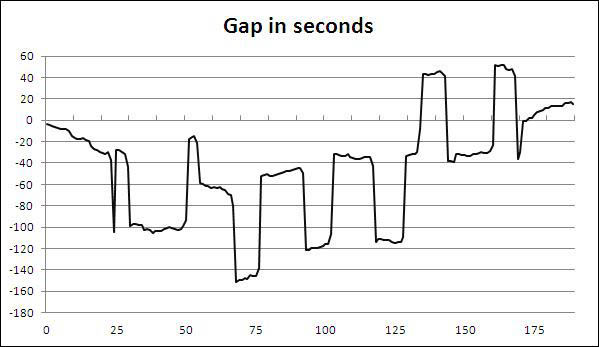
What the graph doesn’t show, of course, is where the no. 8 Toyota is. Indeed, if it had not been for that suspension failure, immediately after Anthony Davidson set the fastest Toyota lap of the race, then this article would almost certainly have been about how Toyota had beaten Audi in a straight fight, unassisted by safety car or weather.
What the graph does show is how the no. 1 Audi (in Lotterer’s hands) lost ground in the first stint, when the car was on an unsuitable tyre compound, then lost further ground when it had to call in the pits for its unscheduled tyre stop. Tréluyer’s ability to close the gap can be seen in the middle portion of the race, and then the sudden move to the positive side of the axis when the Toyota had its unscheduled stop on lap 135 can be observed. Finally, and perhaps most impressive, is Tréluyer’s final stint when (on new tyres) he consistently lapped almost a second per lap quicker than Wurz in the Toyota on used tyres.
The average lap times make interesting reading, as usual. First for the no. 1 Audi R18 e-tron quattro:
|
Stint
|
Laps
|
Average Lap Time
|
Driver
|
Notes |
|
1
|
24
|
1m 52.713s
|
Lotterer
|
Tyres from qualifying |
|
2
|
6
|
1m 52.146s
|
Lotterer
|
Different compound, tyre pressure alarm |
|
3
|
25
|
1m 51.305s
|
Lotterer
|
New set all round, full tank |
|
4
|
13
|
1m 52.318s
|
Lotterer
|
Short fuelled, used tyres |
|
5
|
25
|
1m 50.282s
|
Tréluyer
|
Hero stint 1 |
|
6
|
25
|
1m 50.459s
|
Tréluyer
|
Hero stint 2 |
|
7
|
26
|
1m 50.717s
|
Tréluyer
|
Hero stint 3 and an extra lap |
|
8
|
25
|
1m 51.209s
|
Fässler
|
As good as Lotterer |
|
9
|
21
|
1m 50.378s
|
Tréluyer
|
Winning stint |
[sws_divider_small_padding]From which the astonishing pace of Tréluyer can easily been seen.
Second, for the no. 7 Toyota TS030 Hybrid:
|
Stint
|
Laps
|
Average Lap Time
|
Driver
|
Notes |
|
1
|
25
|
1m 51.399s
|
Lapierre
|
Tyres from qualifying |
|
2
|
26
|
1m 51.125s
|
Lapierre
|
New tyres |
|
3
|
26
|
1m 51.278s
|
Wurz
|
New tyres |
|
4
|
26
|
1m 50.994s
|
Wurz
|
New tyres |
|
5
|
26
|
1m 50.581s
|
Lapierre
|
New tyres |
|
6
|
6
|
1m 53.451s
|
Lapierre
|
New tyres, tyre pressure alarm |
|
7
|
26
|
1m 51.373s
|
Lapierre
|
|
|
8
|
10
|
1m 50.998s
|
Wurz
|
|
|
9
|
19
|
1m 51.272s
|
Wurz
|
Used tyres |
[sws_divider_small_padding]From which the most noticeable thing is perhaps the difference in average lap time for the stint in which Lapierre returned to the pits with a deflating tyre.
The abrasive nature of the track caused some media tongue-wagging before the event, but again, last year’s race was a clear indication that tyres would be changed at the end of every stint in the race – unless you were at the wheel of a Rebellion Lola, which is certainly less hard on its Michelin tyres, than the works LMP1 Hybrids.
One thing that caught my attention, though, was the short stint by Lotterer at the end of his driving shift. When he came in with the puncture after just 6 laps of his stint, he was sent on his way with a new set of tyres and the car topped off with fuel. As the tank was already three-quarters full, the stop took just 59s from pit in to pit out. Lotterer then did a full stint of 25 laps and then came in, I expected, for a full service and to hand over to Tréluyer.
On the pit wall, though, Leena Gade and Howden Haynes had a different idea. They knew from qualifying that the tyres, while they would not last two full stints, would last long enough for half a stint. So they elected to allow Lotterer to drive that half stint (on half a tank of fuel) now. André came in, took on just 28 litres of diesel and was on his way again in just 41s. The lap times on used tyres were around a second a lap slower, (for 13 laps) but the time saved in the pits was around 40 seconds – it was a strategy call, along with Tréluyer’s sublime driving later, which played a large part in their winning the race.

Of course it was a risk, since if the safety car had put in an appearance, everything would have changed anyway; but in the wide open spaces of Shanghai’s Grand Prix circuit, it was a risk worth taking.
Let’s not overlook the performance of the no. 8 Toyota TS030 Hybrid in the hands of Anthony Davidson, Sebastien Buemi and Stéphane Sarrazin though. The average lap time stint analysis looks like this:
|
Stint
|
Laps
|
Average Lap Time
|
Driver
|
Notes |
|
1
|
24
|
1m 51.544s
|
Davidson
|
Tyres from qualifying |
|
2
|
26
|
1m 50.900s
|
Davidson
|
|
|
3
|
26
|
1m 51.185s
|
Buemi
|
|
|
4
|
20
|
1m 50.760s
|
Buemi
|
|
|
5
|
26
|
1m 51.348s
|
Sarrazin
|
Single stint |
|
6
|
21
|
1m 51.840s
|
Davidson
|
Back to pits to retire |
[sws_divider_small_padding]According to my projection, if it had kept going, the no. 8 car would still have ended up ahead, despite Tréluyer’s heroics, to the tune of nearly six seconds. If Fuji was something of a gift for Toyota, there’s a good argument that they were robbed in Shanghai.
The only thing that came as a slight disappointment in the race was the performance of the no. 2 Audi. All weekend, it seemed that McNish, Kristensen and Duval had their eyes firmly fixed on the prize of the World Championship. As a result, they played no part in the battle for the outright lead of the race. This, it would seem, was the plan. Take it easy, finish the race in the top four, bring home the championship, was Kyle Wilson-Clarke’s message to his drivers.
Fair enough, you may say, FIA World Championships don’t come along every day. But just suppose, for a moment, that instead of racing at Shanghai, the Championship-deciding seventh round of the WEC would have been Les Vingt-Quatre Heures du Mans. What then? Can you see Allan, Tom and Loïc being happy to tool around in third or fourth place to get World Championship points when a Le Mans win was at stake? Perhaps it is a good thing that Le Mans is so early in the championship that it cannot possibly decide the outcome of the title.
Paul Truswell