One of the perks of being a motorsport journalist and broadcaster is that you are paid to do what you love most, and would probably do anyway even if you weren’t paid, writes Mark Cole. A downside is that you’re not out there racing yourself.
My 10-year race-driving career ended in 1974 when I hung up my helmet after the British Airways 1000 Kms at Brands Hatch; my Chevron B21 had run out of steam, I had run out of money, and the job of press officer at Thruxton was awaiting me. I have not driven a race car in anger since, much as I would love to get back behind the wheel.
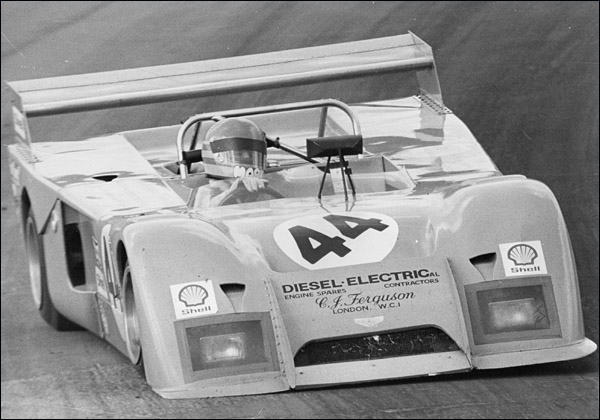 Mark’s last race in a Chevron B19/21 in 1974 – sportscars have changed since then
But that doesn’t mean I haven’t kept up to speed, occasionally with DTM or GTE passenger rides, but mainly on Play Station checking out tracks before each British Eurosport WEC broadcast. And then there is Wirth Research, which for the second time in four years invited me to sample their LMP2 sportscar simulator at Bicester. The timing could not have been better, just a couple of days before our end-of-season live coverage of the Bahrain Six Hours, and who should be waiting to shoe me into the hot seat? None other than Strakka’s two-times Le Mans 24 Hours winner Jonny Kane.
Nick Wirth and his team have always been at the cutting-edge of digital technology, famously designing the Honda HPD prototypes using CAD-CAM and CFD, all on computers, without going near a wind-tunnel. Those designs could then be tested to destruction on their Dutch Cruden Bv simulator, which since 2007 has modelled every track on which sportscar and Indycars are likely to race.
Four years ago I had David Brabham in my headset as I lapped Silverstone GP circuit. This time, Jonny mentored me around Mid-Ohio, which at 3.8-km was one of the shorter tracks on the IMSA schedule, super-challenging with its blind brows and double apexes. I was again on board the HPD (or Acura in American parlance), but advances to the system now means it is far more sensitive to dynamic input and the track is in 3D; drivers such as Jonny and Brabs will spend up to eight hours a day testing aerodynamics, suspensions, drivetrains and – working with Michelin – virtual tyres.
Racing boots and gloves on, I waited for fellow DSC contributor Paul Truswell to climb out – “that’s my first time in a race car,” he beamed – and I was then locked into the tight-fitting seat by active racing belts, which give under acceleration and tighten under braking, and had the headset fitted so that Jonny could talk me out of trouble if needed, and I could talk to him. The moment the car starts to move you know you’re in for a rough ride – every ripple, every kerb is felt through the steering wheel and through the seat of your pants.
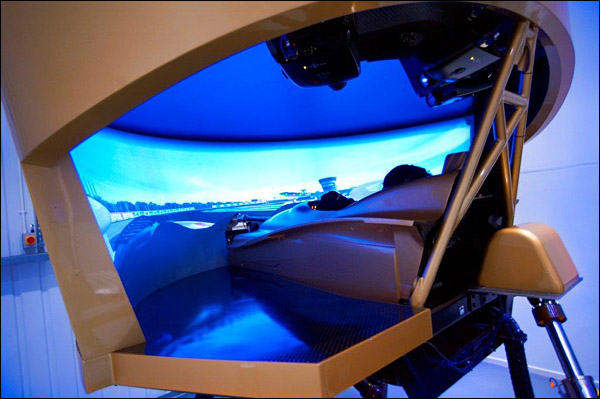 Wirth’s Cruden HPD simulator does everything but turn you upside down
Using the paddle sequential gearshift, you quickly hit sixth, only to panic as you realise you’re already into a third-gear corner. But the brakes are hugely effective, and allied to the downforce which the little prototype generates, you scrabble round safely. As you put the laps together, the G-forces start to grab at your head, and a quick spin at the bottom hairpin as I clatter over the kerbs pulls at every muscle in my body.
Once I have proved I can put a 15-turn lap together without putting it off the road, Jonny says “okay Mark, go for it!”, and I do, feeling more confident by the minute. It is at this point that I forget I am in a simulator, much as an airline pilot does, and I really am racing against the clock at Mid-Ohio, where HPD scored both P1 and P2 wins between 2009 and 2012.
Too confident – I was corner perfect until the final turn, where, determined I could do better than Mr Kane, I put the power on too early, looped the back end and headed straight into the guardrails. That and Jonny’s “your 15 minutes is up” brought me back down to earth with a bump. Perhaps I should stick to the microphone!
Cruden’s Maarten van Donselaar walks over to ask how I like his latest dynamics; I am impressed. “You might find it takes a while to get your equilibrium back,” he says. “We call it the broken escalator phenomenon; you step onto the step assuming it’s moving, and because it’s not, you lose your balance.”
The simulator is just the tip of what Wirth Engineering does; founded by Nick is 2003 after his own Simtek and then Benetton Formula 1 days, the company went down the aerodynamics route for Honda in the Indy Racing League, helping the Japanese manufacturer to win the 2005 and 2005 titles, as well as the Indy 500 both years.
When Honda’s US arm Honda Performance Development decided to switch to sportscar racing, Wirth created the P2 ARX-01A around a 3.4-litre V6, which promptly won its first race at Sebring in 2007 with Andretti-Green Racing. The following year it won 6 of its 11 races, and when the move was made into P1 for 2009, it took pole at Sebring and won eight times from 10 starts. To date, it has enjoyed 50 class and overall victories, including two Le Mans 24 Hours wins with Strakka (LMP2 and a record 5th overall in 2010, and LMP1 privateer this year), the 2012 LMP2 win with Starworks, and won back-to-back the final two ALMS P1 titles with Muscle Milk Pickett Racing.
 The 2012 Le Mans-winning LMP2 Starworks HPD ARX-03b
During that time, Wirth designed the Virgin Racing F1 car for Manor Motorsport, the first-ever grand prix car designed entirely using CFP computer simulation technology. Awarded the Queen’s Award for Enterprise for export sales in 2008, Wirth Research has not put all its eggs in the motorsport basket. It is currently working with Lockheed Martin on an aerospace project – “can you imagine, a corporation of that size coming to an aerodynamics company next to a paint shop in Bicester for help?” grins Nick.
It is also working with international architects Foster & Partners on the effects of windshear on buildings, and is a consultant to the freight industry on improving economy through truck aerodynamics. But motorsport remains Nick’s motivation. “Formula 1 no longer has the leading edge,” he says. “Indycars and sportscars are where the rear technical innovations are, where the designers have the most freedom.
“We are already working for Honda on the aero changes which will be permitted to the Indycar Dallara chassis from 2015 and on their sportscar programmes. We still do everything in our virtual wind tunnel, CFD models running on our supercomputer 24 hours a day, 365 days a year, and not just for Honda; we work with others, including JRM Nissan and Michelin. And not just with CFD, we also have composite facilities at four UK sites.”
Nick still has a dream; and that dream is a Wirth LMP coupe. A 2012 Honda coupe was built virtually to replace the open-cockpit AXR, but funding was never made available. We were given a sneak ‘postview’ of it, a thing of real beauty, but it is now outdated and will remain under virtual wraps. A coupe is still in his head, and he is looking for a partner to breathe life into it – and his dreams have a habit of becoming reality…
Mark Cole