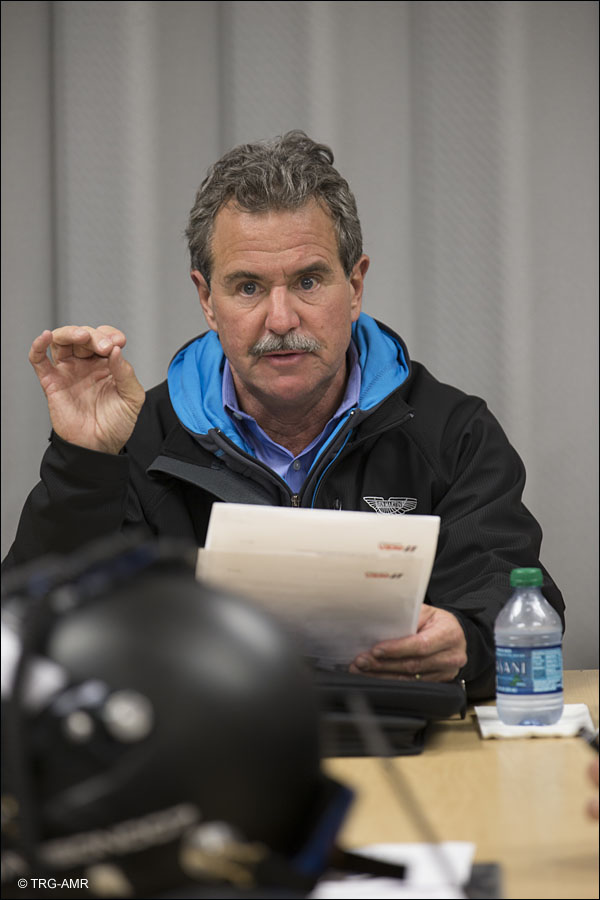

When DSC was approached on race-day morning at the Rolex 24 back in January and asked, “Would you guys like to sit in on Kevin Buckler’s team briefing?” we of course snapped their hand off. Such an opportunity comes along only……well, actually, we’ve never had such an offer before. What followed was not just a fascinating glimpse into the importance of such a meeting, but also an insight into the wealth of experience accumulated by Buckler (KB) and his team over the years and how they would be employing that as TRG-AMR made its race debut; and although the Sebring 12 Hours will have its own challenges, the same level of detail will be in evidence this weekend.
KB kicked things off by welcoming everyone to the meeting, explaining that there was much to go through and that there was a time limit due to other meetings elsewhere, but that this was an open forum and that questions should be asked.
“We’ve assembled a rock-star group of guys, and the team-chemistry and mojo and everything is probably the best I’ve ever seen. And that really makes you happy and, to some extent, confident coming into a weekend; knowing that you like your teammates and trust your crew. I can’t tell you how hard those boys have been working. Any chance you guys have the chance to give them an attaboy or thanks – even before the race happens – that’s great, because they appreciate it. They’re the heroes behind the scenes with the late nights in the workshop. Same with the girls – our operation wouldn’t work without those five or six. I’m surrounded in the office by powerful females and I feel like I’m going to get the crap beat out of me every day, but it’s all good and they keep me in line.”
The first point on the agenda was timeliness, with KB stressing the need for all the drivers to be familiar with the schedule and knowing where they needed to be at a certain time; and then for them to get there early to avoid being rushed and forgetting things – headphones, kit, etc. Just as important was the need to avoid being ‘over-scheduled’, particularly with friends and family; “From this point onwards, it’s kind of time to say ‘No’. There are certain obligations you have, but the more you do that the more you are going to diminish your ability to perform your job. You’ll end up getting to your first stint and find yourselves worn-out even before you’ve done any driving.”
Next topic was driver-changes, with the wise and experienced Calum Lockie telling KB that another half-hour of practice time was needed, whereas other drivers were perhaps a little reticent in admitting this.
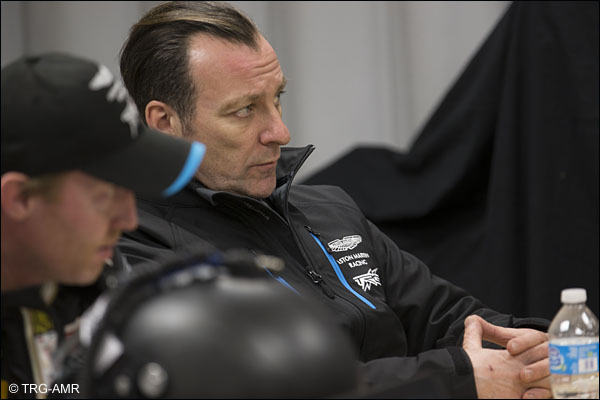
KB agreed that this was a good idea and ran through a few important points, beginning with, “Don’t rush it – an extra two seconds is better than a popped belt!” The seemingly-simple issue of the Driver ID switch was the subject of quite a lengthy discussion, owing to the possibility of an unscheduled summons to the pitlane during Green running if the driver gets it wrong. “The switched and leads are colour co-ordinated – memorise your colour!” was the instruction.
Amusingly, KB also revealed that an IMSA official had told him that he needed to wheel his cars out for a mass photo shoot at the time that the extra driver change practice would be taking place; “This wasn’t on the schedule so I told him to go screw himself; and then another official came along and I said the same to him. I then spoke to the other guys around us, so we’ve got a mini-revolt going at our end of the pitlane!”
Physical preparation for the stints was then discussed. “Hydration is key,” said a senior team member, “before, during and after your stint.” “And don’t hang around the pit after your stint,” added KB. “Get yourself to the RV for some rest as soon as you’ve debriefed – we don’t want to be throwing you out of the pit after 15 minutes. Go away, get some rest, and the girls will come and get you when it’s time for your next stint. Also, we have no free space in the pit, so every extra body is going to get in the way of somebody.”
With such a large grid at this year’s race, the next topic was the importance of getting parking right at pitstops to ensure that the car didn’t get boxed in – various scenarios of where and how to stop were discussed, even down to the importance of not switching the engine off until the car was in the box (i.e. not coasting the final few feet) in order to avoid a penalty.
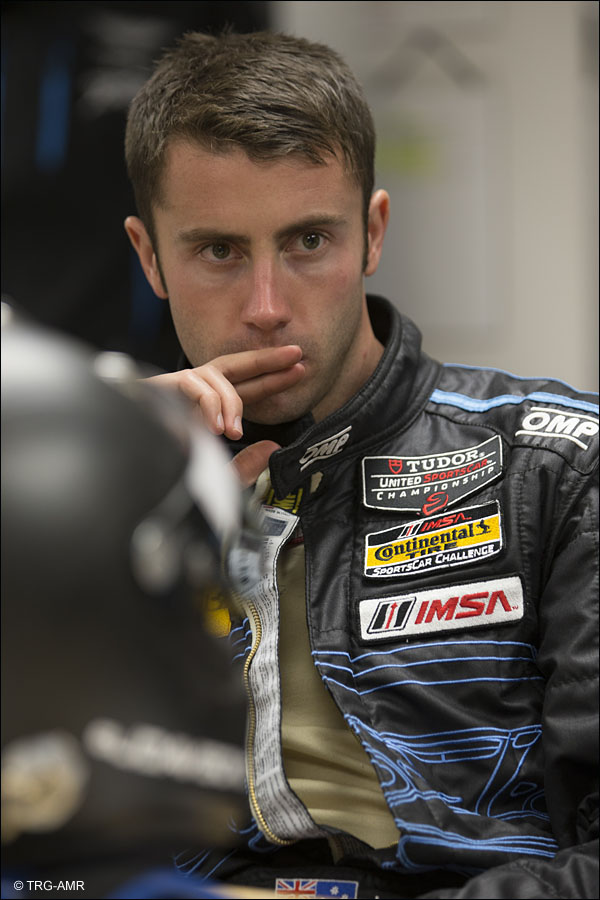
Radio protocol was next on the list; “Some of you guys are clear as a bell, some of you we can’t hear. Please speak clearly and press the button a moment before you start to talk – in the excitement, you press the button when you start to speak and we only hear half of it. We don’t want to have a long dialogue with you guys, especially those of you who don’t like talking much on the radio. So, clear, articulate, into your microphone; and please acknowledge anything we ask you, even if it’s just a ‘copy’. As regards the spotters – if you want the spotters to call your cars, let us know. If you want them to be silent, let us know.”
The spotter team was under the control of Paul Schroeder, and he talked about how they could help in the event of a problem; “If you need to pull off at an emergency exit around the track and aren’t sure how to get back to the garages, the spotters can guide you, because you can find yourself among the fans.”
KB again: “If you make any adjustments on the dash because of changing conditions, make sure you tell your engineer as that he can reset it if necessary.
“In the event of a puncture and you can keep going, drop down and limp it back. If the tyre is flailing and damaging bodywork, make use of the many turnouts around the track and we’ll guide you back, or we’ll tow you back behind the golf cart if necessary.
“On the subject of golf carts, they start to get stolen around now – would you believe that one key fits all carts – so lock your steering wheel. We’ve only lost two, one here and one at Sebring; the one at Sebring ended up on a bonfire somewhere and my American Express got pretty hard that day!”
The meeting then swiftly moved on to race strategy: “If it goes early yellow, my plan is to stick David in, because we’re protecting David and Al on points – running a championship, I’ve got to get these guys in the car. We’re not out to beat our chest on national television right now. If we run green, in a good situation we want to knock out as many of our requirements early – it opens up the options playbook massively when the sun comes up tomorrow if other teams still have three stints they must do and we have one.

“So we’ll probably start with a single for everybody. If it goes yellow near the end of your stint and it bunches up again and you’re feeling good and want to do another stint, let us know; but remember, it means another hour in the car.”
Driver rotation and changes were quickly covered, but again there was another small but important detail to bear in mind; “If you are in the car when we’re doing a brake-change, keep your feet tucked under the seat – it’s so easy to hit the pedal and pop a piston, which means another 20 minutes!”
With numerous caution periods a guarantee at Daytona, KB talked the whole team through the process of wave-bys and the importance of getting it right – potential to make back up one or two laps on the leader – without making an error, “The guys in the grandstands will call you out on any mistake!” And he wasn’t just talking to the drivers; “Paul – your guys need to be on the ball with this. If there is a major crash, I need the spotters to say ‘Big crash in the Bus Stop’ or wherever and to immediately tell us where the cars are. If we can get you in before the pits close, that could mean you get a wave-around and then gain another lap when the leader pits under yellow. So Paul, those are your data points – we need to know where the leader is and where our guys are.”
“In yesterday’s race, there was a 10-15 second delay from incident to caution, so that’s the window today in all likelihood,” said a team member. “You have to have all four wheels under the double yellow lines when the lights change to be able to make a stop, so that’s your commitment.” “We’ll be monitoring the radios, so we’ll wave you through if the officials say you didn’t make it,” added KB. “We’ve got to be on top of it, because we can screw ourselves if we try to be too clever.”
KB then reversed the situation and talked about the scenario of what to do if a TRG car was the class leader at the time of a caution; “The important thing is not to lose out – you’ll have worked hard to put those guys behind you, so it’s freaking blasphemy to allow them past at the caution! The only way to do this is to stay out and pit immediately as soon as it goes green – that way we lose half a lap tops without having allowed anyone to get a lap back.”
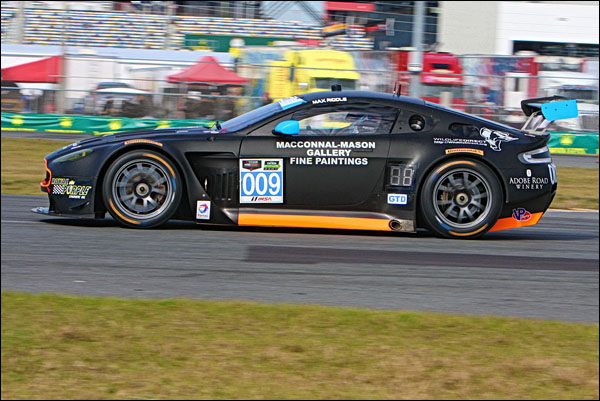
Penalty box protocol was briefly discussed before the conversation moved on to what to do in the event of radios going down; “If the radios go down and there’s a caution, hopefully you will know where you are in the field and who the class leader is. If you are low on fuel, it’s probably best to pit. If you are okay on fuel, stay out – you might get a wave-by. It’s going to have to be a judgement call when it comes to the wave-by – if you take an illegal wave-by, there’s a stop and hold plus four minutes penalty, so you’re going to lose two laps.” The importance of anticipating and being ready for the restart was then covered, as well as being wary of the Bus Stop.
With the briefing approaching 40 minutes, KB began to wrap things up. “Guys, we’ve got a damned good package – we’ve got a good team and good drivers and we’re way forward of where I thought we’d be when we started this whole thing at the test. So we hunt what we eat; we don’t need to go out there and be drag-racing someone on the banking and bringing attention to ourselves. For the next 24 hours, you need to be doing everything you can to stay off the radar. We’re crafting ourselves a fantastic programme for this year, we’re finally competitive with the other cars, and we want to be smart. What both crews need to be thinking about is ‘absolutely no scratches’ – no issues, no risk; at the risk of a couple of seconds a lap – it’s okay. You lose a couple of seconds a lap over a 30-lap stint and you’ve lost a minute – it’s so much better than doing a splitter or flat-spotting a set of tyres. Guys – 100%, just think it, be it, know it; just take it easy. Sometimes the Devil’s there tempting you, so don’t fall for it.”
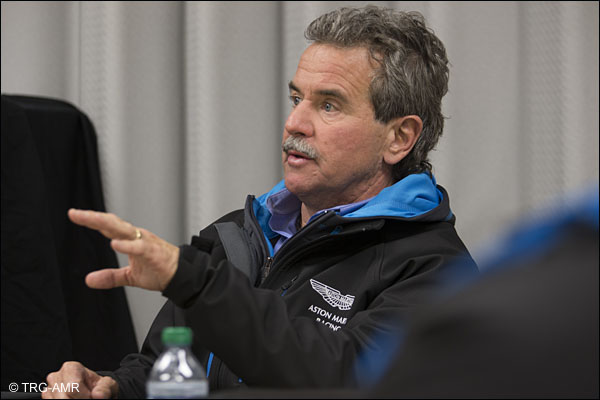
“There’s going to be a couple of German companies out there who want to kill each other, and there are some big egos in the Italian cars, so I really think that one of our cars can take the win. We represent the Aston Martin brand in the US and it’s a privilege for us, so we want to make them proud over in England.”
On this occasion, things unfortunately didn’t go TRG-AMR’s way over the course of the race. But with so much attention to detail and with such an obviously professional set-up, there’s no doubt that the team is going to be right there very soon.
MH