Fresh off the initial win for the C7.R at Long Beach, Corvette Racing allowed some time for the media in their blow-up play-pen on Friday at Mazda Raceway Laguna Seca, giving some life to what was otherwise a pretty quiet day. This is even more timely, given that Garcia/Magnussen teamed to win here at Mazda Raceway Laguna Seca for the second win in a row.
The general consensus amongst Corvette Racing thus far is one of satisfaction when looking back at the introduction of the C7.R to racing. The car has been fast and had the pace to win each of the 3 races it had entered so far – it just wasn’t reliable early on, namely at Daytona and Sebring. Doug Fehan explained, “when we’d started the C7.R program, the merger of the ALMS and Grand Am wasn’t in place yet. We had a development plan based upon the usual ALMS schedule, which didn’t include Daytona. Adding in Daytona, plus the Roar Before Test forced us to go racing much sooner than we had originally planned.”
Gary Pratt added, “the car was a revelation to the drivers early on – they all loved it and it was an immediate improvement over the C6.R. There just wasn’t much left in the C6 – it was pretty much developed as far as it could go.”
To Olly Gavin, one of the noticeable improvements is in the chassis. “The chassis is noticeably stiffer than the chassis of the C6. We’ve tested at Road America extensively and there are some corners there that we use the curbs. Early on in the C7 development, we had both cars at our disposal. With the C6, you’d feel the suspension first, then you’d feel the chassis flex, almost like an additional spring feeling. The C7 is so much stiffer – you don’t feel that secondary chassis flex like we did with the C6. That is a big improvement for us as we begin to learn the new car. It still has a unique Corvette feel, only now it’s greatly improved.”
For Fehan, the synergy that the Corvette Production Group and Pratt-Miller have developed is critical to the success of what Corvette Racing has had through the years. “When we started the program, we had no input into the C5. We had to develop a race car out of what we were given. But then, with the various C6 variants, we were able to progressively use some of what we learned from racing and apply it to the street car. That in turn didn’t just make the street car better – it made the race car better too. Now, when you look at the C7, you have to realize that some of the aero package is derived off of the CFD program developed at Pratt-Miller. There is a purpose to the design of the new Corvette. It isn’t all aesthetics. We know how to make a good race car out of a production car, but the race car can only be as good as what it is based upon.”

Pratt realizes that it is this cooperation that has allowed what was originally expected to be a 3-year program to now last 15 years and counting. “The cooperation between the groups has continued to improve through the years and from it we have been able to improve not just the race car, but also what we sell to our customers.”
It is this synergy that is critical to the success of the program. This is different than the GM involvement in the Prototype class. Fehan – “In the prototype class, the racing effort is in the hands of independent teams, all with their own budgets. We let them do what they do best – we simply continue the engine development and assist some on the aero at Pratt-Miller. That is completely different than what we’re doing with our GT program. There simply isn’t as much relevance with the prototypes.”
It was at Long Beach that the team scored a dominant win, thanks in great part to a great start by Antonio Garcia. Early on, Garcia was able to get past Ed Brown and his slow to come up to speed P2 car. “To be honest, this was something we discussed as a team before the race. We knew we had a chance to gap the rest of the class if I could get past one of the prototypes. There was some risk in the move I made, but I felt it was pretty safe. I almost got past the other ESM car too – I started to make a move, and then I sensed they were starting to close the door, so I backed off.” That made the rest of the race pretty easy, especially for Jan Magnussen, who brought it home the rest of the way.
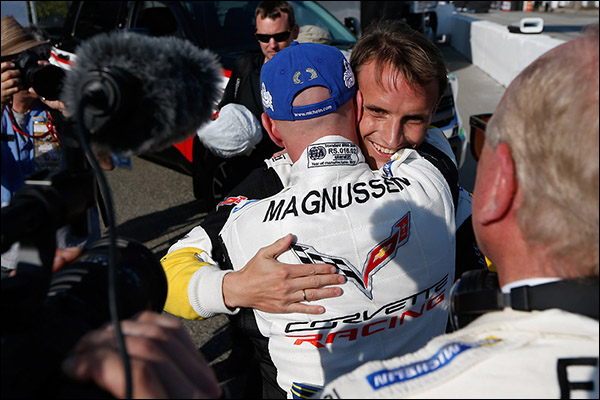
Long Beach was unique, in that it was the first of the races in which it was only the P and GTLM classes. That contributed greatly to what was a caution free race for the full 100 minutes. Mags – “it was a much easier race, in that you knew who you were up against. You knew that the majority of the drivers on track were experienced and you could actually tell what they were doing.”
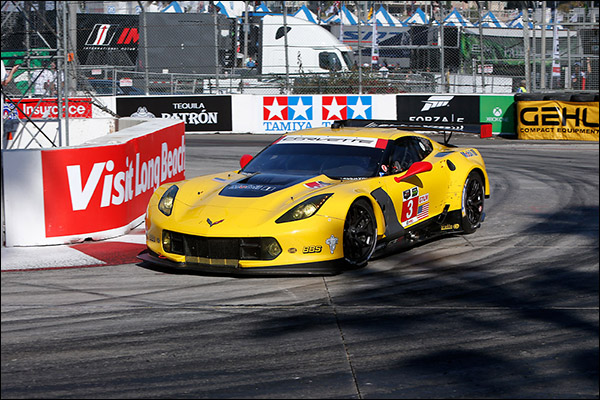
For Olly, that was a good change from the mess we’d seen at Sebring, but it also changed the complexion of the race. “In the usual multi-class race you rely on traffic conditions to create situations that can lead to a pass. We didn’t have that at Long Beach. Part of the problem we had at Sebring was due to not just the various classes, but also due to the lack of experience of some of the drivers on track. I’m not sure how some of the drivers got their credentials, but it was obvious that there were some drivers that were in well over their head in trying to race at Sebring.”
Up next, after Laguna is preparing for Le Mans. Already the team has trucks on the way over to France. But next up for the team itself is a pre-Le Mans test at Road America, where the team will put the two C7.Rs through their paces. There is a third car – the original test car – but that is all of the C7.Rs that have been built up. Is that a concern, to only have two race cars heading into Le Mans? Dan Binks (car #3 crew chief) – “no, not really. We know that if we badly damage a car at the test, we can send it back to Pratt-Miller to get repaired in time for the race. I guess it’s all part of being a factory effort. We don’t look to waste money, but we do know that if we need to, it’s available to us. It is weird though to think that our food budget for the team is probably more than my dad spent for a season back when he was racing.”
One of the things that the team is looking forward to at Le Mans is the chance to use the newly developed “radar mirror”. Mags – “at first I couldn’t believe we were wasting our time developing a new mirror. I’d rather be testing the car to sort out an understeer or something like that, but now I see just how special that system is and how it can be so important for us at Le Mans. Sometimes when one of the ultra fast P1s come up on you, their lights simply make the mirror useless. Now, with the radar system in place, it shows not just where the cars are, but it also shows their closing rate and shows which direction they are looking to go around you. If a system like this was in place in the past, I think we’d have had a few less serious wrecks at Le Mans than we’ve had.” This system, developed between Pratt-Miller and Bosch is now owned by Bosch and available to anyone. Currently SRT Viper is utilizing the system, after earlier looking at developing one on their own.
While Corvette Racing has always prided themselves on their North American racing efforts, you can be sure the team is anxious to get back and re-establish their presence in France
Gary Horrocks