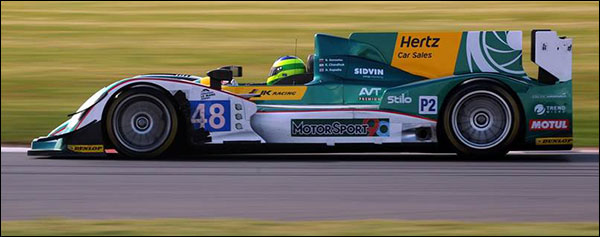
All Le Mans rookies this year must undertake a compulsory session on a simulator before taking to the track this weekend – Whether they are ex F1 stars or Gentlemen having made their way up the ranks the session is obligatory.
There’s been a fair degree of quiet cynicism about this measure, introduced in the name of increased safety, so we asked Alex Kapadia to report back from his experience of the session last week before he takes to the track on Sunday as the reserve driver for Murphy Prototypes, the Silver ranked Brit aching for an opportunity at the big race!

I am running on the test day with Murphy Prototypes to qualify me to start the race if needed and to be a reserve driver for them.
I had to book in to do the rookie simulator test with AOtech their base in St Pierre du Perray about 30km south of Paris. The course is mandatory for all new drivers from this year onwards and it runs from 8.30am until 6pm.
The cost of the course is an eye watering 3000 Euro (plus VAT) and initially I thought the same as many, that this was a money making exercise. However having now completed the course I have a rather different point of view.
I had got the Eurostar across the night before so as not to be late in the morning and needed to be back at Gare du Nord in Paris by 7pm so I needed to leave promptly.
I arrived half an hour early in the hope I could start early to give myself more time to fight my way back through the Paris traffic. I was greeted by AOTech director Guillaume Legoff. He was extremely welcoming and showed me round the sim and explained the programme for the day. I was the only person doing the course that day but I was to be joined by Oak Racing Team Asia driver David Cheng who had already done the course and was back for more time on the sim.
The course would cover learning the circuit, driving in traffic of differing speeds, the unique safety car arrangements for Le Mans with 3 safety cars, the new slow zone procedures, driving in the wet and driving at night.
Having already raced in ELMS events and having won my class in the Dubai 24 hours I was not worried about the traffic or the night driving but the safety car and slow zone aspects interested me and I thought it can only be beneficial to fully understand it and have given it a trial run in the sim first.
The sim was bespoke, made with their own software and did not use rfactor or similar products which I am used to seeing on sims. The tracks are all laser scanned and they had to be licenced by the ACO to do this for Le Mans.
It uses a motion platform which I was wary of as I have never experienced a good version of this. I have found that the sims I had tried using motion had always struggled to synchronise what you see with what you feel and I have often felt ill after using them.
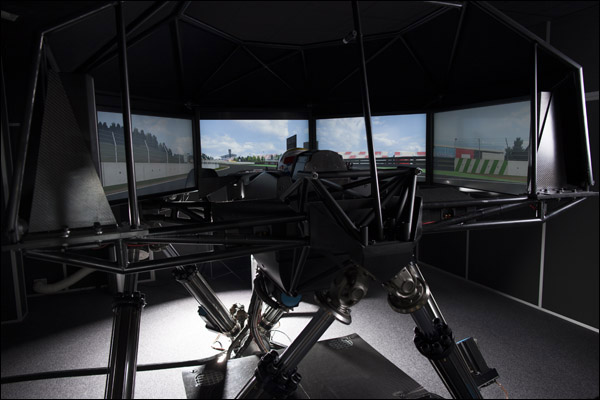
Given this and that you cannot simulate a constant g force only a change in direction of g force, I had been of the opinion that if you cannot get it right it was better to scrap the motion platform idea and just focus on the physics model of the car.
I kept an open mind though and was pleasantly surprised by how it felt.
The thing that this motion platform does well is to simulate yaw so you can feel when you are starting to rotate the car into the corner. This is lacking in many sims and you have to work purely on visual stimuli.
We started off doing half an hour just lapping the circuit on my own with no traffic as I got used to the sim and they steadily increased the motion. Then we moved onto lapping with other cars and this was all straightforward.
Before lunch we did a short briefing on the safety car procedures at Le Mans using the three safety cars and learning where they would join and leave the circuit and I learnt how I could identify which location each safety car was from and when I needed to be ready for the restart for each car.
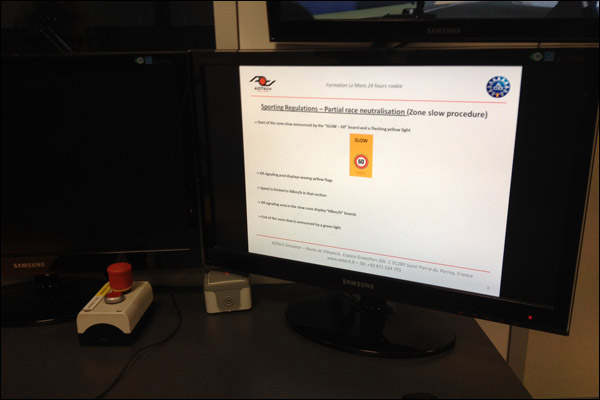
Then came the really interesting bit. The new rules concerning the slow zones.
Having raced a lot in Dubai I am used to the Code 60 rules that they have there. This has always been a good system but rather than do this across the whole length of the Le Mans circuit the new rules for this year are that there will be a slow zone where drivers must do 60kph through this zone.
Previous to this there will be a slowing down zone. In reality the slowing down zone will be a “flat out until the last possible second then jump on the brakes zone” and there are harsh penalties for each 1kph you exceed the limit by in the slow zone.
We practiced this on the simulator and it was easy to confuse the orange board marking out the start of the slowing down zone with the yellow board marking the start of the slow zone. It is possible that drivers may slow suddenly for the wrong board and this itself could cause accidents. Getting this right and also maximising your speed before the slow zone will be crucial in doing quick stints. For this reason alone I felt the course was worth doing.
It’s worth saying too that I also feel that the drivers who have done the race before but who have not practiced this will be at a slight disadvantage going into the race as it will not yet be second nature.
We then finished the day with some night driving and driving in the wet and then a final run which encompassed everything that we had covered.
My view has changed towards the course now. I think it was a very worthwhile exercise and while I still feel it was expensive, if it reduces the chance of an accident, a costly mistake or even a few seconds being lost during a stint then it was worth it.
So by next Sunday night I will have completed the simulator course and hopefully done my rookie laps although all without a ride for the race. It will have been worth it though as you never know when someone may drop out.
Now I just need to find myself a drive for the race!