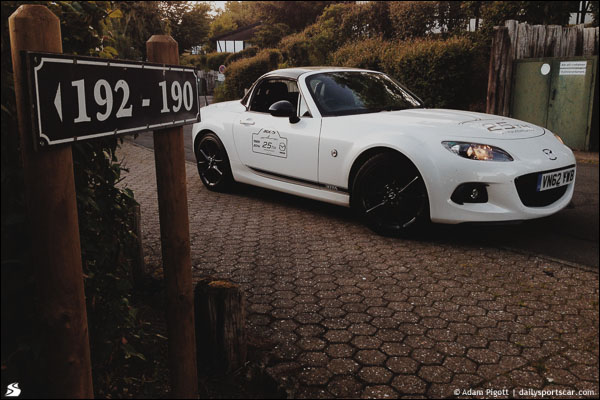
Whether you’re a driver, mechanic, journalist or fan of sportscar racing, it’s a safe bet you’re familiar with the most direct route from the Eurotunnel terminal at Coquelles in northeastern France to Spa-Francorchamps or the Nurburging. Turn left on to the E40 autoroute off the train, set the cruise control, hope the Brussels ring road traffic isn’t too bad, then take the exit after four or five hours’ driving. A dull but effective way of getting to two of the most evocative racetracks visited all season. But with the keys to Jota Sport’s enhanced version of the classic Mazda MX-5 roadster in my hands, a dull but effective motorway slog just wasn’t going to cut it this time around.

Jota had just triumphed in the LMP2 class at Le Mans, yet another long-distance challenge awaited just a week later in the form of the Nurburgring 24 Hours, where the team would be running a road-going MX-5 with only mild safety-related modifications in the race’s V3 class for almost completely standard production cars. The effort formed part of Mazda Japan’s celebrations to mark the 25th anniversary of its hugely popular little roadster, and Jota’s experience running production MX-5s in Britcar and developing a GT4 version for the 2012 British GT season would prove invaluable here.
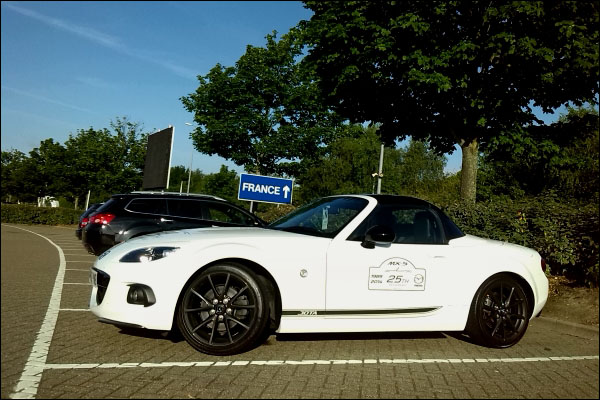
The bright white Jota MX-5 GT that I picked up from the team’s premises on the Kent/East Sussex border represents their knowledge and experience of running racing MX-5s being applied to make the road car more capable, potent and engaging than it already is. An engine remap, sports exhaust and uprated suspension are the headline changes, and the 350 or so miles driving through France, Belgium and Germany ahead would hopefully reveal how successful the end result was.
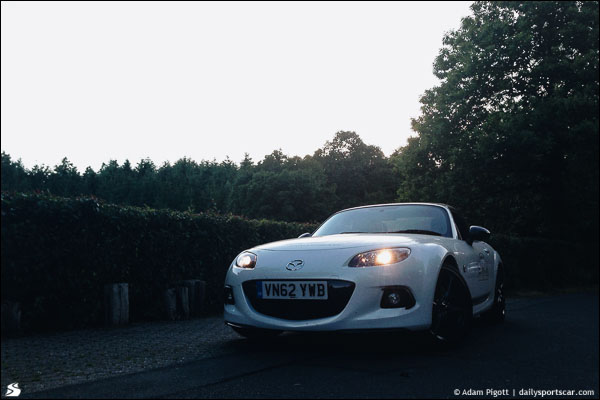
The changes aren’t all under the metal, though – the GT also boasts some visual flourishes to set it apart from the standard car. As it’s based on the Roadster rather than the Convertible version of the MX-5, a power-folding hard-top is standard, and on this car it was finished in black to contrast with the white bodywork. You also get classy 17-inch anthracite alloy wheels, a racy-looking carbon rear diffuser and a centre-exit exhaust configuration.
The first destination punched into the sat-nav on leaving the Eurotunnel was the town of Ypres in western Belgium. For better or worse, that name will always be associated with some of the most horrific battles of the First World War, and some reflection on the past seemed appropriate with the anniversary of the outbreak of the conflict in June 1914 fast approaching.
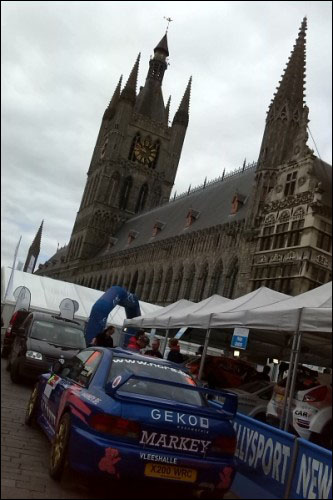
But of course, Ypres means something else entirely to motosport fans – it’s home base for one of the classic European tarmac rallies, which has run here since 1965. My original plan of getting a picture of the Mazda in front of Ypres magnificent Cloth Hall (a reconstruction of the destroyed original that took over 30 years to complete) went out the window when I turned a corner in the town centre to be greeted by barriers and rally cars – welcome to service! A completely unintended coincidence – but fortunately my intentended destination, the In Flanders Fields museum, remained open amidst the whirring of air guns and clinking of spanners in the town square.
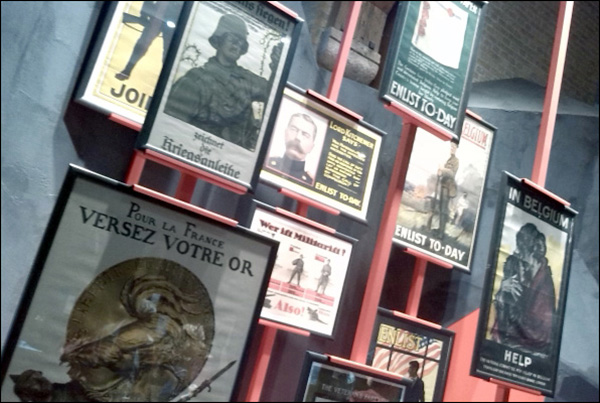
When you can jump in your car and drive to any number of European countries in a matter of hours without seeing so much as a border guard, it’s very easy to forget just how radically different the continent was 100 years ago. But reminders of the past are never far away on the former Western Front – from the neat green Commonwealth War Graves signs at the roadside to fascinating museums like In Flanders Fields. The area around Ypres was subjected to almost constant fighting for the entirety of the 1914-18 war, but this place does an admirable job of expressing the horror and enormity of the events that took place here, making clever use of modern technology to help visitors grasp the sheer scale of what went on.
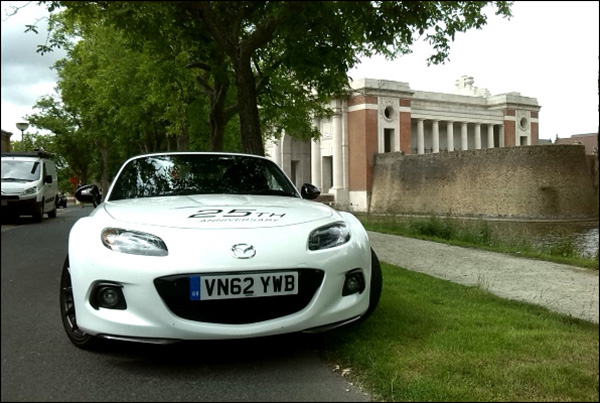
The other lasting reminder of the war in Ypres is of course the Menin Gate, and imposing structure on the way out of town dedicated to the memory of 54,896 Commonwealth soldiers who fell on the battlefields around here but have no known grave. Like all memorials of this type, you can’t help but linger on at least a few individual names, recognising that each one had their own story, life and family. I can think of few better ways of putting everything in perspective. You could spend hours there quite easily, but with time getting on, I had to hit the motorway and clear Brussels to be sure of making the Nurburgring at a civilised hour that evening.
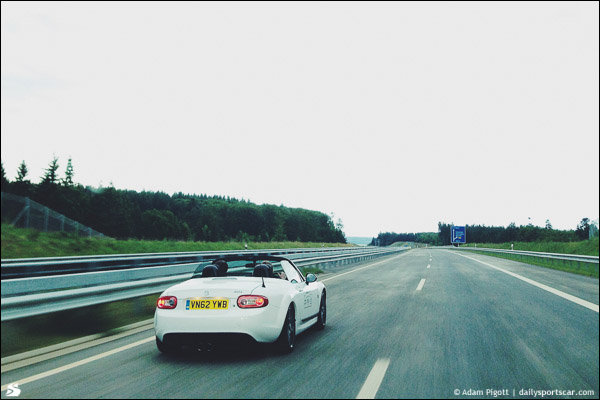
An hour or two on the E40 revealed the Jota Mazda to be a reasonably good crusier – something you might not expect from such a focused sports car. The snug and supportive Recaro seats are a big help in this regard, as is the upgraded sports suspension with Bilstein dampers. It’s a stiffly sprung car, no question, but there’s a pliant edge to the ride, and those sharp, wince-inducing crashes over bumps you experience in some hardcore hot hatches are notably absent. On the downside, the exhaust does drone a bit cruising at around 3,500rpm, and even the premium seven-speaker Bose audio system can struggle to make itself heard over the din.
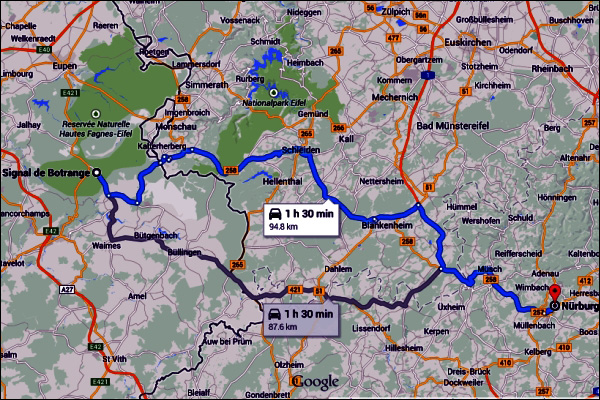
But get off the motorway and on to a back road, and you won’t care what music is playing. So, on the stretch of the E40 between Verviers and Eupen, I did just that. My intention was to bypass the long motorway route that passes Aachen and Kerpen before turning south just west of Cologne, and instead follow a more direct path to Nurburg through the Hautes-Fagnes nature reserve in the Ardennes – stopping off at the highest point in Belgium on the way.
And once off the motorway, the MX-5 GT did indeed come into its own. Hold on to the gears into the upper reaches of the rev range and you’re treated to a proper snarling, racecar-like howl. The steering wheel comes alive with feedback from the front tyres and the sleek body remains satsifyingly flat during cornering. The Jota car sits 20mm closer to the road than the standard machine and gets a 45bhp power boost from 158bhp to 203bhp. The basic characteristics of the MX-5’s engine haven’t changed – so it hasn’t been transformed into a low-down torque monster and still thrives on revs – but Jota has added just the right amount of grunt to allow the Mazda’s chassis to demonstrate what it can really do. Suffice to say, owners of standard MX-5s who’ve long suspected their car could easily handle a bit more power will find their suspicions were correct.
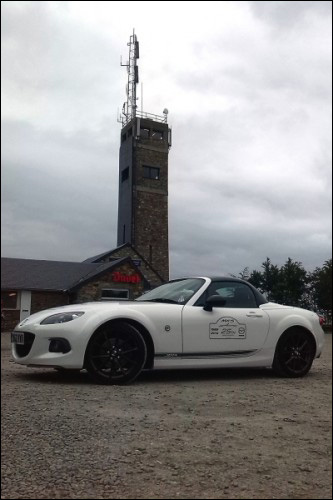
The roads became wider and smoother as they began to gain altitude and cut through the dense pine forests of the Ardennes – a familiar landscape for anyone who’s been to Spa. My stopoff point would be the Signal de Botrange – a stone tower built in 1934 at the centre of a high plateau that, at 694 metres above sea level, is the highest point in notoriously flat Belgium. This is also the coldest part of Belgium during the winter, regularly getting heavy snowfall and serving as the starting point for cross-country skiing routes. The weather was decidedly more hospitable on this occasion however, allowing time for a quick coffee in the resturant at the base of the tower.
Not long after leaving the Signal and rejoining the road, Belgium becomes Germany, Ardennes Forest becomes Eifel Mountains and the grin on my face becomes even bigger as the proper switchback roads leading to the Nurburging make their presence felt. This is where the Jota MX-5’s ultra-precise steering, accurate gearshift, light weight and low seating position combine to deliver that classic, exhilarating, rear-wheel-drive sportscar experience. The final leg of the journey along the B258 is by far the most entertaining, and while devouring the Autobahn at warp speed in a big luxury saloon brings its own satisfaction, I think I know where I’d rather be.
Words: Stephen Errity
Images: Stephen Errity/Adam Pigott/Newspress