It’s been a while since being able to really sit and take notice of what’s going on in the Pirelli World Challenge, as their race always seemed to take place at an inconvenient time when covering an ALMS race. Finally it was time to say enough is enough – it is time to give the series some proper attention and what better time to do that than at Road America, the National Park of road racing. That Dyson Racing was making their first run in the series with their new Bentley was absolutely a bonus.
Walking the paddock on a quiet Thursday at the track found a rather large contingent of competitors on site, all ready to go, but also all happy to be there. It was quite refreshing to find a paddock where everyone was more than willing to talk and to find even competitors hanging about with each other during the course of the weekend. From a casual observation, it looked like the new Bentley Boys were constantly showing off their new Bentley to not just media and to Bentley guests, but also to their new competitors.

It was later on that same day that I was warmly received by the series and time was sorted to get some time with Scott Bove, President and CEO of the series, which is celebrating its 25th season of competition. “I think you’ll find that to a person, everybody in this paddock competing with us wants to be here. Well, I take that back – there is one guy here that never seems like he wants to be here, but come every event, he is here, ready to compete.”
Through the 25 years history of this series, there have been many changes, but right now the series may be on the verge of enjoying its greatest success. The series itself has roots that go all the way back to 1972, where the SCCA formed a race series for showroom stock cars, with a $3000 price ceiling. Eventually the series morphed into a widely successful venture, based upon success that the SCCA had in staging a 24-hour race at Nelson Ledges in 1980. From this success, the Playboy United States Endurance Cup sprung forth in 1985, with Escort (Radar Detectors) replacing Playboy as the title sponsor in 1986.
In 1990, the series made a major change, in that they adopted the universally accepted Group A regulations and while doing so, changed the name of the series to World Challenge. The series has gone through tremendous changes over the years and while it has seen some ups and downs as far as success, it appears as if going back to its roots and hooking up with the universally accepted GT3 regulations has helped place the series on the verge of achieving its greatest success.

By going with cars that are readily available, plus are diverse and come already homologated via the FIA, the recipe for continued success has quite likely been achieved. The growth the series seen this season, highlighted by the high profile efforts of the K-Pax McLarens and now the Dyson Bentley points to a series on the rise and also presents a new and different alternative to sportscar racing in North America.
 For Scott, this has been a work in progress for quite some time.
“We bought the series from the SCCA six years ago. There are six of us on board here as owners, but I’m the one running the show. I’m a firm believer that in the case of racing a dictatorship is the way to go. I believe that by keeping the customers happy, we’ll be successful.” This “dictatorship” comes at the request of the owners. Their feeling is that the series that have been successful worldwide have been run individually rather than by committee. The owners went this direction as they feel it is the most efficient and effective way for their business.
One of the unique perspectives that Scott has is who his customer really is. The ALMS had the “For the Fans” motto, but that’s not the case here. He’s quite clear when he says his customers are the competitors in the paddock.
“It wasn’t an easy decision, but ultimately I have to look after them. They truly are the customers that I need to keep happy. If I keep the competitors happy, there will be large enthusiastic grids. When the large enthusiastic grids deliver a good show, they keep the promoters happy, which in turn will bring in the fans and also the sponsors.
“I view my job as listening to the customers and to grow this business – our brand of racing. We all partner together – the drivers, teams, sponsors and the series – to give strong value to all involved.”
One of the unique aspects that Scott and his team have incorporated into the series is one of trust. All of the data from the races is available to all of the competitors. “Yes, it is accessible for all to see. There may be times when some of the competitors are in disagreement with us when we make changes, but we’re willing to listen and make it a good show. I have to remember that our paddock has many rich and powerful people in the business world and they like to be powerful here too, in what is in essence their play. Things may not always go their way, as I have to look at the overall picture and what is best for the series, but the communication channels are always open.”
Also keeping the competition honest is a points package that rewards drivers for qualifying on pole, leading a lap, leading the most laps and also for setting the fastest lap in the race. It is also the fastest lap times turned that sets the grid for events where there is a second race for the weekend. All of this is designed to keep the competitors honest and to reward those that really go for it in the sprint race format.
One of the strengths of the series right now is that they are truly committed to the GT3 format, one which has been very successful in Europe. “We went through a transition a few years ago. We saw the degradation of the GT class and a spike of growth in the GTS class. When we saw no growth of the GT class at all, we started to look at the GT3 spec cars. Originally it was with special wings and body kits, then we decided simply use the FIA GT3 homologation as delivered. It really was a no brainer.
“We’re using Pirelli tires here, just like in Europe so we can pretty much use the homologation as they have established. Now we’ll make adjustments here and there – our tracks are different here than in Europe and sometimes require slight modifications to the regulations, but we work with the FIA to achieve a good balance. The important thing here is that these cars competing here are the same competing around the world.”
Some, like me, remember and have a tough time saying World Challenge without adding SPEED in front it, as SPEED was a long time sponsor of the series. But while it was a sponsor, SPEED really didn’t do the series any favors, as the races were broadcast at weird and inconvenient times. One of the first things that Scott and his team did was to get out of the SPEED contract. “We looked at what we had and what we needed to do. The first thing was to get out from under SPEED. They thought we were crazy, but I didn’t really see the benefit in sticking around. By leaving, we were able to get the series naming rights back, which was a huge positive for us. Then we hooked up with Versus network, which eventually became our TV partner, NBC Sports. “
“We were with Toyo Tires for quite some time, but their street tires were not really conducive for our race cars. They were a good partner, but they also realized it was time to move on when they did. That open door brought in Pirelli as not just a partner, but also the series naming sponsor. In fact they just renewed their title sponsorship for another 5 years. All of these moves increased our visibility greatly – we went from 20-30k views per showing on SPEED to nearly 400k viewers earlier this season at Long Beach. I’d say it has all worked out well for so far.”

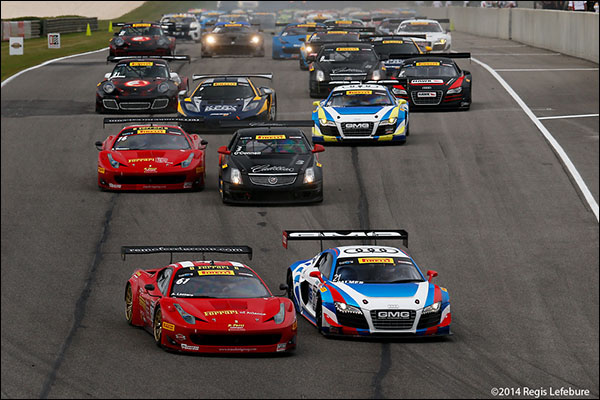
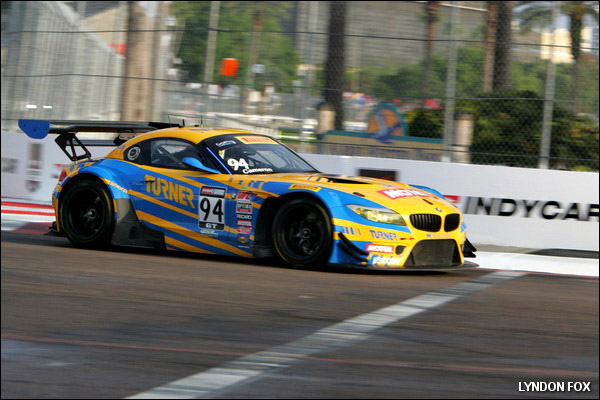
One of the aspects of this series is simply the cars racing. Saturday morning before the race, I spent some time walking the grid. While I knew there were some pretty special cars in the series, it really didn’t sink in in a big way until I did that grid walk. Besides Cadillac, there is Audi, Porsche, Ferrari, McLaren, Lamborghini, Mercedes and now Bentley in the GT class, with more to come. Then there is the GTS class, where Ford, Chevrolet, Kia, Aston Martin, Porsche and Nissan are competing. That is not including the TC, TCA and TCB classes, which race separate from the “big class” where Nissan, HPD, Kia, Fiat and Mini are competing regularly.
It is the lower classes that allow the World Challenge to have a true ladder approach, where someone can start off in the lower classes and work towards moving up. “We’ve designed it that way – no need to step into open wheeled cars. Here you can stay in similar cars, all production based and simply move up the ladder, going as far as your skill level and budget allows.”
“The manufacturers have also become strong partners with us. We currently have 18 manufacturers who are all paying to be on our manufacturer’s council. That number should be growing also. I expect to see Nissan returning in the GT class, likely to be joined by Lexus as well as a GT3 spec Cadillac.” And that is in addition to the already announced but delayed Acura.
Part of the growth of the series for the future includes some stand-alone events, which may include endurance format races. “We’re in negotiations now with some premier tracks in North America for events where we will be the series at the track. We want to bring the entire series and showcase what we have. The plans are still being sorted, but our thoughts are that our usual sprint race on Saturday, followed by an endurance race on Sunday might be a good showcase. What we need to sort is exactly how these races will take place. Our customers are interested, so we need to look into it. We need to be careful though, as pit stops can add to the equipment costs associated with racing and we need to be sure that we don’t excessively don’t add to the cost to compete.”

Another change may be the separation of the GT and GTS classes into separate races. “We think we’ve reached the point where we will need to separate the classes out in order for them to grow. Right now, 50 cars in a race has become somewhat a limiting factor. In order to allow each class to grow, we need to allow them the space to do so. We figure with the cars already announced to be coming into the series, we will likely reach 30 cars in the GT class. That just wouldn’t be possible with the class combined with GTS.” That also addresses the point Remo Ferri brought up in a recent interview where he brought up his concern over his Ferraris running in a race that features cars like Kias – cars that are not near the same demographic that his beloved Ferraris are.

The series employs a simple and common sense approach to the –Am drivers of the series. They have a separate category in the GT class, effectively a championship within a championship. This allows the amateur drivers a place to compete for the glory and also keeps the GT class strong car count wise. The drivers category placement is determined by a common sense approach combining the already existing driver ranking system with some simple World Challenge regulations.
“Our approach is that bronze drivers automatically are –Am drivers. That is simple. Then we take the silver list and divide it in half. When you look at it, it’s pretty simple to determine a dividing line in that category. If you fall into the top half, you’re in with the pros, while if you fall in the lower half of the silver, you’re an –Am. Once an –Am driver finishes on the overall podium, they’re move up to the pro category. The only time we wouldn’t move someone up was if they simply backed into that overall podium – such as in a race where attrition paid a huge part in their placement. We try to keep it simple – for us, our partners and the fans.”
It is this keep it simple approach, as well as a common sense attitude that will go along ways in keeping this series as a viable and successful place to race. As Scott likes to say, “we believe we are the best value in Motorsports and we want to keep it that way.”
Gary Horrocks