The run to the flag for the 2014 Total Spa 24 Hours was as good a GT race as has been seen for many months, but whilst we admired, enjoyed and celebrated the seven hour run to the checkered flag for the second time in just over a year we witnessed a major endurance race where multiple issues arose, in particular in this instance in the race’s early running, that deserve, and indeed demand, discussion and resolution.
First though a couple of establishing points:
This article is not about blame and neither will it be offering opinion or examination of the incident that led to the most serious consequences.
With Marcus Mahy still in hospital, (and our very best wishes are with him for what we hope will eventually be a full recovery), and with no direct reliable information on the cause and contributory factors surrounding the accident that befell Marcus’s and Vadim Kogay’s two Ferraris that brought out the red flag to allow a medevac helicopter to attend the scene, it is not for us to opine.
There will though very clearly need to be a full investigation into that incident as there are some factors that are clearly visible in the publicly available images of the aftermath that could barely be of more concern.
GT3 Cars in 2014
Put simply GT3 cars are getting faster and faster.
How much faster?
In qualifying for the 2006 Spa 24 Hours (with the circuit still sporting the old Bus Stop), the fastest then current GT3 car qualified in 2:28.606, by the following year (the first with the new Bus Stop) the cars were already 2.5 seconds faster (in GT1 by comparison the difference year on year with the circuit change was three tenths of a second!)
Times progressed steadily from there, but this year saw a big leap forward again, all 20 of the cars in superpole beat last year’s pole position time, and the pole time proper was a full 2 seconds faster than in 2013.
A further comparison – this years pole setting WRT Audi set a time just six thousandths of a second slower than the full house, All-Inkl all pro-crewed GT1 Lamborghini Murcielago that sat 12th on the grid in 2007 amongst a large pack of GT1s, scroll back a few short years earlier and the time would have seen the car in the middle reaches of the top 10.
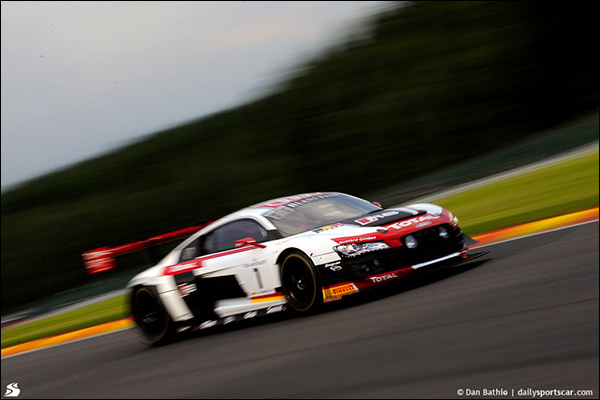
These cars are now seriously quick.
With now limited developments allowed, and with times coming that much more quickly it seems apparent that the cars are leaning more heavily on either or both of tyre tech or aerodynamics, neither is conducive to a gentleman driver friendly package.
Add to that the fact that a large number of drivers, both Pros and gentlemen, observed that the 2014 Pirellis are hard to bring up to and retain heat and in the particular circumstances of the series of early race incidents a partial pattern starts to appear.
Successive Incidents
Amongst the four incidents that followed one after the other there were some common factors between 1,2 or 3 of the accidents, but certainly the only principal universal link was their chronology.
Incident 1
The first incident, featuring Gentleman driver Vyacheslav Maleev in the #100 SMP Russian Bears Ferrari looked to be a straight fumble, the Russian clipping the kerb and losing the car up through Eau Rouge, into the barriers and damaging both ends of the car before it came to rest on the exit of Raidillon
The questions that arise here are around the apparent length of time that it took to mobilise the Safety Car, bearing in mid the position of the damaged car, the readily apparent danger to the driver, and not least the very considerable debris field on both sides of the car.
There are certainly further questions, which we cannot answer from the available TV evidence, about the display and/ or visibility of flags, certainly cars were entering the accident site at very high speeds several seconds after the car had come to rest.
So was that a Race Control/ communication issue, a local marshalling issue, a driver discipline issue, a marshal post/ flag sighting issue or a combination of any or all of the above?
Looking back at the incident afresh Maleev is very fortunate indeed that he wasn’t collected by any one of half a dozen cars coming into the incident zone at speed.
It’s worth repeating too though that both Alex Buncombe and the driver of the WRT Audi that were directly behind Maleev both did remarkable jobs of avoiding the stricken Ferrari.
Both the TV commentators and indeed the Radio Le Mans observers passed comment on the potential for tyre damage from the large proportion of the field that ran through the debris, and both too passed comment on the relative lack of resource apparently deployed in the clear up.
Incident 2
As the race went green once again it went almost immediately back to a Safety Car as Tim Mullen in the #101 Von Ryan Racing McLaren impacted the wall on drivers right at Blanchimont at very high speed.
DSC is now aware that the incident was apparently triggered by Tim Mullen suffering some form of tyre failure (believed to be right rear) as he came into the corner, the car snapping away and laving Mullen with no chance.
It is a tribute to the strength of the car that Tim was well enough to be released from hospital later in the evening.
The standing question here though is whether the failure was debris related – the TV footage does not show the car passing through the Raidillon incident zone at speed but the whole field passed through the zone at caution.
Incident 3 (and 4)
Again as soon as the race went green there was a further incident, again at Raidillon, this time involving the #15 Boutsen Ginion McLaren of Karim Ojjeh, the experienced Gentleman driver losing control of the car and impacting the Barriers on the inside at pit out, very hard with Xavier Maassen spinning his HTP Mercedes in avoidance.
We have not spoken to Karim but have been told by two sources that have, who both say that the driver claims to have been caught out on tyres colder than he expected.
That brings forward a further factor, raised repeatedly by both Gentleman and Pro drivers, that the tyres were impossible to keep up to heat effectively at the prevailing Safety Car speeds.
At around the same time as this incident there as a further, entirely separate incident at La Source as Jorg Muller (in the #66 Marc VDS BMW) ploughed into the rear of Giacomo Piccini’s #11 Kessel Ferrari.
Incident 5
With the McLaren recovered, and Tim Mullen on the way to the medical centre, and both cars involved in the BMW on Ferrari incident in pit lane, the race went green again, but once again there was an almost immediate incident, again at Eau Rouge/ Raidillon.
This time it was Andrew Danyliw, in the #50 AF Corse Ferrari, the Canadian another to lose the car on cold tyres (this the explanation given directly by Danyliw), the 458 running wide through Eau Rouge, hitting the barrier and then coming to rest, having suffered heavy rear end damage, facing the wrong way and in the middle of the track at Raidillon where it was collected in rapid succession by a number of cars including Andrew Howard in the Beechdean Aston Martin, the #85 HTP Mercedes of Xavier Maassen, Demirdjian’s #16 Boutsen McLaren, and Tim Müller’s #458 Rinaldi Ferrari.
The questions here are principally around the repeated incidents, on a restart after a Safety Car period at more or less precisely the same part of the track featuring non-professional driver,and with either very near misses, or serious contact, from multiple following cars.
Points Arising
Across the incidents above as a whole the following questions and issues arise:
- With the cars now so fast with such a mixed ability field is it time to apply a higher qualifying standard?
- The size of the grid, and the huge range of ability and experience, plus the certainty of racing in darkness, and the very high likelihood of mixed weather conditions too seem reason enough to perhaps consider some form of pre-qualification or training?
- The speed of the Safety Car and the potential alternative for a graduated increasing speed controlled release (Code 60, Code 100 etc).
- The ability of the tyres to retain operational heat under Safety Car conditions
- The subsequent effects of releasing a long stream of cars, with mixed ability drivers with the hugely challenging Eau Rouge the first corner that half the field encounter (other than the first gear La Source). ie, should the field be released elsewhere on the circuit?
- Sight lines and concentration levels required in those circumstances at Eau Rouge, and,
- From at least two Pro drivers – questions about the sense of painting the barriers and tyre walls in red and yellow and/ or the lack of high visibility night visible warning light systems at several parts of the track.
The Spa 24 Hours is one of the world’s great endurance races and has consistently produced world class GT racing for well over a decade.
We have little or no doubt that the incidents above will have produced no less horror and dismay amongst the powers that be than they did in the paddock, the press room, the grandstands and amongst TV viewers.
The key point now is how rapid and comprehensive the response will be.
GG