Amongst the memorable moments at the excellent Silverstone tribute to Sir Jack Brabham on Thursday was my very first opportunity to meet one of my all-time motorsport heroes.
Gordon Murray was, and is, a design maverick, one of a kind and an icon of the sport.

His portfolio contains some astonishing work, and some extraordinary lateral thinking.
But the reason I see him as an icon comes for the project he headed up after his F1 days.

The McLaren F1 GTR was the last real GT racer to win the Le Mans 24 Hours. Yes the Porsche 911 GT1-98 won three years after the McLaren’s 1995 victory but by then GT1 was in the midst of a cost increasing spiral that would kill the class, and had already seen the cars looking more like prototypes than many prototypes even today manage!
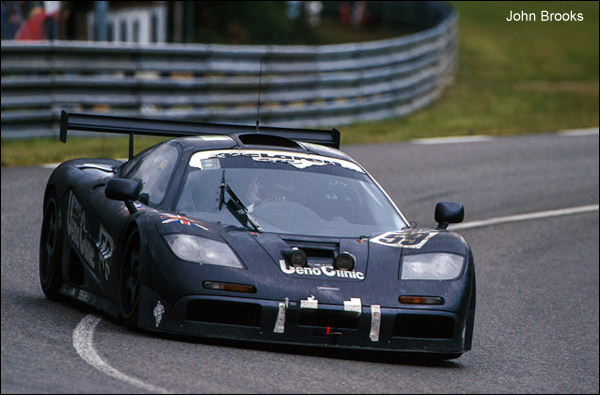
The McLaren in contrast was never designed as a race car. The race programme, in the then new and shiny BPR Series, came at the behest of its wealthy buyers (and in fairness all McLaren F1 buyers were wealthy).
To create the GTR version of the F1 required attention to cooling, aerodynamics and, of course, a racing rollcage with carbon brakes also added into the mix. In a prelude to present day GT racers the epic BMW V12 was air restricted to produce less power than the GTR’s roadgoing sisters (though the race car was lighter).
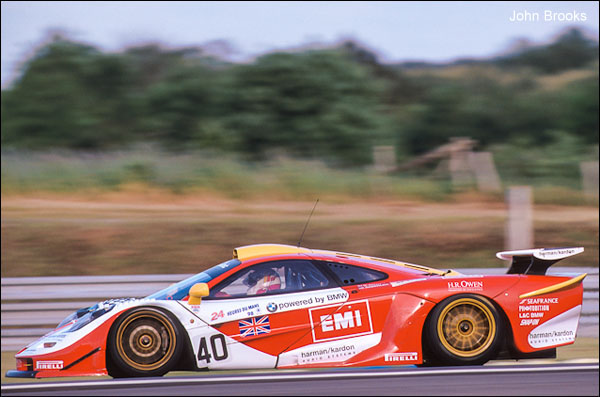
There’s little doubt that there was always the potential available to rework the cars as race cars but that should not get in the way of the fact that the F1 was first and foremost a road car. Few top line GT racers since then have retained as much of their road car dna as Gordon Murray’s masterpiece, still, even two decades on, many enthusiasts number one on a list of the best hypercars ever built.
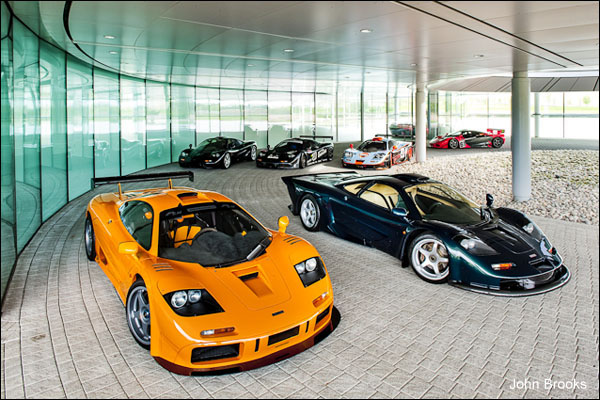
After a brief chat about the F1, and the proposed parade at Le Mans in 2015 featuring as many of the 28 race cars built as possible we moved onto more contemporary sportscar themes.
It’s clear that Murray still sees the sportscar racing scene as fascinating, the openness of the rulebook appealing to his thought process, a ‘kick in the door and do something extraordinary genius’ in contrast to Adrian Newey’s ability to exploit a gap in the regs to the max. But the now 69 year old feels that the sport has taken a wrong turn, and missed an opportunity.
“The LMP1s are spectacular things, but they really are spaceships nowadays aren’t they?
“I’d like to see something emerging that has far more of a direct link to the road cars. GT racing can and should be something that attracts far more manufacturer emphasis. I think doing that would see relevant technologies progress to road cars far more quickly.
“I think too that we’d be taking a big step forward if we took a look back in time.
“There was a time when there were two important winners at Le Mans. the overall winners of course, but also the winners of something called the Index of Performance. Something that attracted small and quirky manufacturers, all in the quest for efficiency, fuel efficiency in particular.
“It was worth winning too, brought huge publicity for the winners and really, in the modern world, there could scarcely be anything more relevant.
“I’d love to see that back, and with real status for the winners. I think it would be a huge opportunity for the sport, and for the clever guys in the industry that could build and market these technologies.”
What might these racers look like?
“That’s for others to judge but having an open mind to a rulebook is already a big step towards it. They’ve taken steps in the Prototype rules to open it up. Now they should look at the bigger wins by doing it with GT too.”
Food for thought indeed as the clock ticks closer to the seemingly inevitable ‘electrification’ of further areas of the sport and the industry marches ever more in step to the efficiency beat.