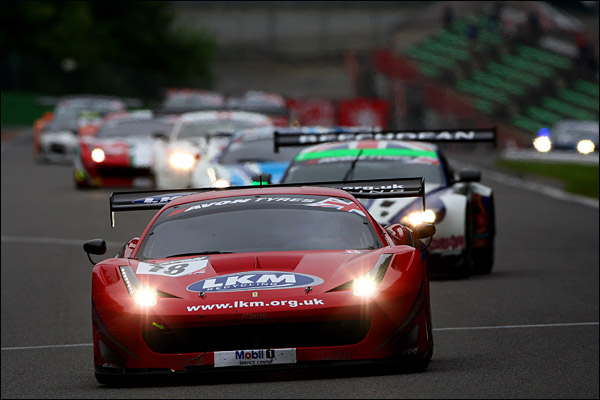
The recent announcement that Gary Eastwood and Adam Carroll will be returning to the British GT Championship – with Eastwood particularly bullish about his prospects for the title in 2015 – is an apposite illustration of the progress made by FF Corse since its formation in 2009.
Already a familiar name in UK and European club racing, the team has amassed an impressive record of success in its first six years of existence:
• 96 Race/class wins
• Winners in every race series competed in
• Nine Titles & Team accolades
• Two championships in 2014
• 2014 Overall Britcar Endurance Champions
• 2014 GT Cup GTC Class Champions
• Race winners in British GT in 2014 Rockingham
• Highest placed Ferrari in British GT 2014 & 2013
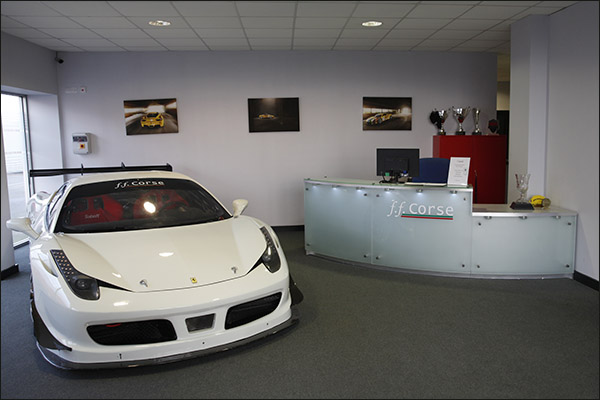
To find out more about the history of FF Corse and its plans for the future, DSC popped along to the team’s impressive 30,000 square foot base [formerly the A1 GP headquarters] adjacent to the gates of Silverstone circuit, where we met owner Anthony Cheshire and long-time FF driver coach Jamie Stanley. We began by asking what the ‘FF’ stood for.
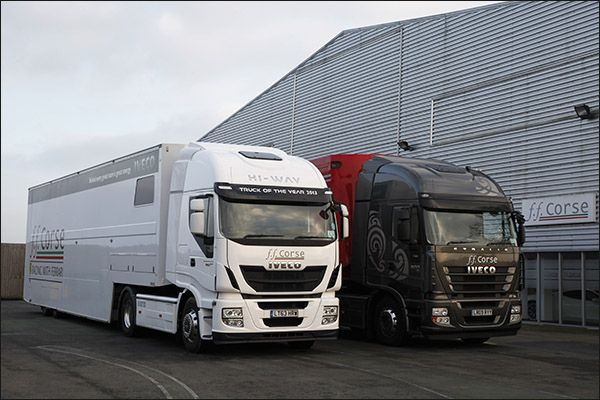

AC: “It doesn’t really stand for anything. There is the obvious suspicion that it’s something to do with Fiorano, but we have no formal ties to the factory and we like to joke that it stands for Flippin’ Fast! ‘Corse’ is obviously Italian for ‘racing’. The name is clearly very similar to AF Corse, but when we started we didn’t realise that we’d be going up against them quite so often!”
So how would you describe the company?
“FF Corse, I suppose, is a specialist Ferrari management service. We specialise only in looking after Ferraris – I’m not interested in going outside of that under the FF Corse brand due to the strong relationship we have with Ferrari – but with that we’ll do anything related to Ferrari GT cars, which nowadays primarily means Challenge and GT3 cars. Historically we’d just provided a client service for client-owned cars – if a customer wanted to race in GT Cup or British GT, for example, we’d provide the support for them to facilitate that – and we had amassed a huge amount of product knowledge with the cars; and both myself and Ilan Manor [Technical Manager] had a Ferrari background prior to FF Corse.
 Anthony Cheshire
“In terms of the core business, we started in 2009 with four guys committing to a race programme and two committing to a trackday programme. By the end of that year we were at 15. By the end of the next year we were at 25. Then it was 30, then 35 and we’re now at around 40. We’re pretty much at saturation with those numbers. Yes, you can always do more, but I don’t think we’re ever going to see 80 cars or anything crazy like that.

“Trackdays are a massive part of what do and are for gentlemen drivers who have a Ferrari and aren’t ready to go racing or who don’t want to go racing, but want to have some fun in their cars.
“Whether our customers just want to take part in the Trackdays or whether they want to go down the racing route, we will support them in their goal, and we do it under the umbrella of a members club. Most of our clients are cash rich but time poor – typically entrepreneurial types who’ve spent 20 years or so building a business in hands-on, head-down style, who’ve now got to a stage in life where they can pursue a boyhood dream to drive racing cars. They aren’t interested in trailing a car behind them from circuit to circuit and getting their hands dirty in the engine bay. We take all of that away from them and provide them with an opportunity whereby they can just turn up and focus on driving the cars, and at the end of the day a job-list is created for us to sort before they next turn up.
 “Hang on – that’s not a Ferrari!” “No, but it’s based on the Enzo chassis!”
“The members club also provides a social element whereby the trackday driver can talk to the likes of Gary about his racing and it creates an aspirational pyramid.
“We’re now branching out a bit and offering a facility for people to come and drive cars without having to purchase them. Previously our investment in the infrastructure – trucks, equipment, personnel, etc. – worked in terms of Ferrari Challenge, but when we started to move towards British GT and GT3 cars, we realised that a new approach was needed. When a customer would enquire about running in GT3, we’d tell him that, yes, we could do it but he’d need to go and buy a GT3 car [at €400,000]; at which point the phone would go dead!
“The reason Gary [Eastwood] is racing his own car in British GT is that he came through the programme – trackday, Ferrari Challenge, GT Cup etc. – and knew what we could do and that he wanted to race a GT3; for him it wasn’t a risk. But he is the exception and for others it isn’t that simple. Hence the decision to acquire our own car, which came about following a very serious enquiry about renting a GT3 from us – I hedged my bets and said yes, which led to some frantic phone calls as I tried to find a car I could hire. Nobody had one to rent, but I was offered one to buy and after some thought I agreed.
“We now have two GT3 cars, one of which we ran last year and one which we’ve recently acquired in bits and are building back up.
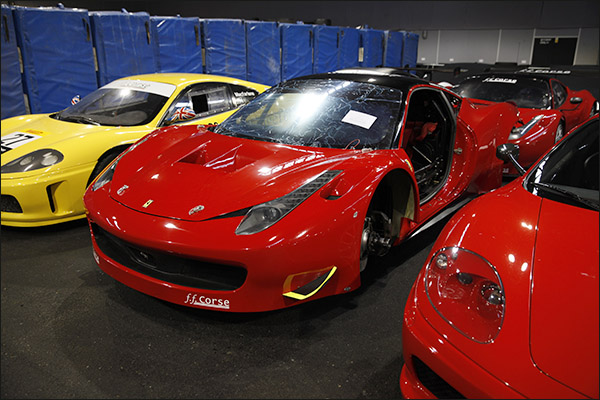
“We’re also getting more involved in the European Ferrari Challenge Series and so have taken a 458 Challenge car which we can offer to people to test in or to race in.”
How does the GT3 differ from the Challenge car?
AC: “There’s a big step-up from Challenge to GT3 in terms of car maintenance and running costs. The Challenge is a very solid car and none of the components are really lifed; the maintenance is more preventative than anything. They have standard engines, road-derived gearboxes, and they just run and run. We have a 430 rental which has done 30,000km on the engine under race conditions; and we have a number of client 458s that are close to that number.

“The perception is that Challenge cars are expensive to run. They aren’t; they’re cheap to run, but they are expensive to crash because all parts come from Ferrari. The GT3 car is a different kettle of fish altogether; much more stressed. And the Challenge cars are bloody quick! With the aero kits that we’ve developed fitted, we’re probably three seconds away from a GT3 car, which isn’t a lot. A 458 Challenge can comfortably outperform a 430 GT3, which is bonkers, and shows how much things have moved forwards. And really the only thing then governing it is mechanical grip; the GT3 has a wider track and wider tyres – yes, it has a Hewland race box, which is a hundred kilos lighter than the road box over the rear axles, which also makes a big difference – but predominantly the grip is so much greater on the GT3 than on the Challenge car.
“We developed a basic aerodynamic kit for the car for Gary Eastwood a couple of years ago, when he was racing in Pirelli Open and GT Cup, which was a carbon splitter and a carbon front bumper and a rear wing to create the balance; which was pretty much it apart from some diveplanes. But last year we realised that we were facing some stronger competition in Britcar and GT Cup and so introduced an evolution version of that, which was a revised bonnet and aero-ducting; so instead of the air being ducted into the wheel arch as on a standard car, the air exits out of the bonnet in similar fashion to the GT3. There’s a bit more venting on the front fenders to excavate even more air, while the rear diffuser has also been modified away from a standard road car version – more visual than anything – towards a full racing version. We’ve actually been surprised at the scale of the laptime improvement made with the evo; it’s moved the car on massively.

“The inherent characteristic of the standard Challenge car, and most Ferraris in fact, is very balanced leading into a gentle understeer. But when we created the modifications and took it out for the first time, the first thing we found was that the car had huge oversteer; the front was so planted that the rear was breaking away. We got the balance back after some work, but it showed how much more grip had been created.
“The mods are legal for Britcar and GT Cup and the kits have sold really well globally. We’ve sold five to Taiwan and have also sold them to New Zealand, Japan, Belgium, Slovakia; it’s been a good stream for us.”
How many of your members do go on to race?
AC: “About 50%. Some are people like Jacques Duyver, who started with a trackday and now races wherever he can, whereas others try it and decide that it’s not for them and stay with the trackdays.”
JS: “We don’t push anyone to go racing. It’s very much driven by their desire to go racing. Our job is to facilitate that desire and to take them as far as they want to go.”
 Jamie Stanley
AC: “We work very hard on creating a programme to suit their individual characteristics and to achieve what they want to get out of it. So if they start making motions towards racing, we’ll then talk to them about the process to obtain a licence and, once they’re at a certain level, talk to them about taking part in a testday, which is quite different from a trackday.”
JS: “We also have people who join us adamant that they are going to go racing straight away and who perhaps overestimate their level of talent. In that case, it’s our job to manage their expectations and find their true level before taking it from there. We first need to rein them back to make them a safe and confident trackday driver, before then working on building up their speed.”
AC: “Our clients tend to be naturally very competitive people, and tend to have…”
JS: “…a preconceived idea of where they want to be.”
Which takes some managing?
AC: “Sometimes. I think they then start to understand that they perhaps won’t be on the podium within the first couple of races. But they are also very intelligent people who tend to understand how and when to use other people’s knowledge and skills; that’s how they’ve become successful people in their private lives.
“They understand that it takes a certain amount of time and investment to get to a certain level. They want value, of course, but if we present the plan in the correct way they’ll respect our experience and come to an agreement on moving forwards.”
What’s it like taking an enthusiastic but raw novice out on his first track lap in such a powerful car?
JS: “This environment is actually quite nice. It’s the client’s own car, so they know its value, and they tend to be a lot more respectful of what you have to say than a school driver who just turns up with a voucher to drive someone else’s car – that can be quite terrifying at times!
“As they start to progress it gets less and less comfortable. Someone like John Seale, who I drove in GT Cup with, can now do a lap of the Silverstone GP circuit in sub-2:10 in a Challenge car, which is pretty good going. So when I’m in the car with him and he’s down to a 2:12/2:13, I can get quite twitchy as I know how hard I have to work to get down to a 2:07/2:08, and he’s making the car move around just as much.
“But we’ve got an extensive data-library for every car – pretty much every lap every car’s ever turned – and nearly all the cars have video feeds, so we can do a lot more than just sit next to them in the car. And we have data from all the circuits that we’ve raced at. So, for example, we have all the data from Sam Smeeth’s season of European Ferrari Challenge from last year and can use that with any driver who wants to race in the series this year.”
AC: “The Race Logic systems are amazing, so we can do things like overlay video from the clients lap with that from an instructor’s lap and stop it at any time, so the client can see where he is in relation to a pro and where the car is on the kerbs, etc. And anyone can use it – you don’t need a data-engineer to do everything. You don’t even need to remember to turn the video on, it’s all automatic.”
JS: “The instructor stays with the client all season as much as possible, to build a level of trust. We are there to offer advice and help, which may include fitness, simulator work, etc. The important thing to remember is that you can’t tell the client what to do, you can only advise.”
What is the scale of the organisational challenge for such a packed schedule of events?

AC: “It’s a seven days a week commitment, that’s for sure. But it’s a passion, which is why we do it.
“We send out the list of dates to our members at the start of the year and then they can book in, be it trackday, test or race. Our members tend to like to get organised early and then we sit down with them and work out an individual programme with them.
“Every morning at 11.00 we have a management meeting with myself, Ilan [Technical Manager], Andy [Events Manager] and Sarah [Finance Manager] where we sit down and throw the problems on the table and kick ideas around as to how we’re going to solve them. The next day we see how we’ve moved them on or if there are still things we need to do. We started doing this probably a year ago and it works so well; it’s now vital to what we do with so many things going on.

“For example, we’ve hired Portimao exclusively for two days in March and will be taking around 10 cars. We’ll likely have six instructors on hand for eight drivers – a couple of clients probably won’t want to drive with an instructor at Portimao.
“In terms of racing this year, in addition to the Ferrari series, we’ll have Darren Nelson and Nigel Greensall in GT Cup with the GT3, as well as Jamie and John again for GT Cup. Happily, there are no clashes with British GT and GT Cup, so Jamie can race in both. Gary and Adam are in British GT, and we’re working on making the second GT3 busy in terms of British GT, Silverstone Blancpain and Silverstone GT Open. Potentially, we’ll be racing here at Silverstone on six successive weekends this year.”
Are you comfortable with the volume of racing you’re involved with at the moment?
JS: “You always want to do more, but we’re looking at adding cars to existing race commitments rather than adding championships.”
You’ve mentioned entering the Silverstone rounds of the BES and GT Open. Are you looking to expand into European GT racing?
AC: “I do see that side of the business developing and I think future growth is going to be more at the top end – i.e. the GT3 markets, which are getting bigger and bigger.”
JS: “We’ve always been seen as a members’ club, but we’re now trying to make people more aware of the options we can offer on the racing side.”
AC: “We want to expand into international racing, but not at the risk of the core business, and not by doing it badly. There’s no point doing this if we lose our hard-built reputation for quality.
“Ultimately, I would like to say that FF Corse’s going to do Le Mans; that would be fantastic if we could do that one day. But I’ve seen far too many race teams commit to that badly and at a risk to the business, and then the business falls apart and fails because they’ve either taken their eye off the ball or have spent too much money or just don’t have the capability of doing it. You can only do what you can do, and you’ve got to do it right.”
Would you ever consider adding other marques to your repertoire?
AC: “FF Corse will always be purely Ferrari. I worked for Ferrari for ten years before starting the company and we have an excellent relationship with the factory. There’s no point in bringing in other brands under the FF banner as that will dilute the knowledge and I think it’s always a mistake when teams do that.
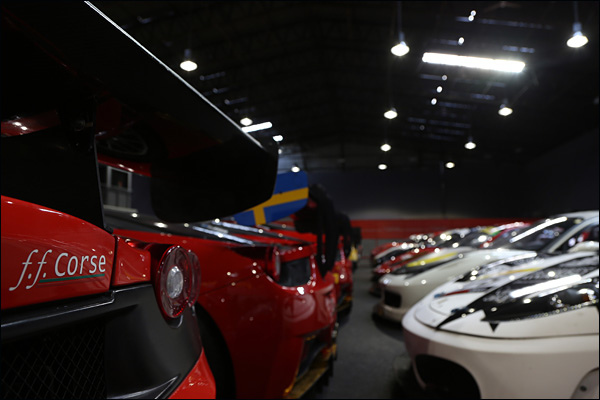
“We made a commitment, before the cars came out, to be the UK experts on the 458 Challenge and GT3. We invested in the technical and diagnostic equipment and sent the guys on the courses in order to get ahead of the game. So when something goes wrong with a car there’s a huge database of knowledge and experience and we can get things sorted quicker than anyone else.
“And our clients tend to be Ferrari enthusiasts. They’re unlikely to switch marques, but they do have the money to spend their money on a plane or boat for example.
“You have to keep the trucks rolling to stay in business. I can think of no other industry where you get to the end of October and every single commercial contract you have in place has ended; and you’ve had to make a substantial investment in order to facilitate those contracts.
“So it’s our job to extend the ‘life-cycle’ of that enthusiasm for Ferraris for as long as possible.”

We left Silverstone hugely impressed by FF Corse, both in terms of the scale and professionalism of the operation, but also by the focussed ambition of Anthony Cheshire – clearly a very steady hand at the helm. Could the team one day rival its Italian near-namesakes? Only time will tell, but one suspects that they’re up for the challenge.
MH