My Father tells a story about me as a little boy frequently. When I was young, we would go to car races together. Before the start of a heat, he would ask me, “Paul, who’s your pick for the win?” I would always reply with, “I’m not sure yet.” Then cheekily, after the flag would drop, and the race started, the car that shot to the lead would be my choice, “the one in front!” I’d proclaim. Everybody picks their favorites in racing differently. Some of us have a personal story of meeting a driver and became loyal to them ever since. Others have been captured by that certain magic from witnessing a car go from the back of the pack to the front to take the lead. Many have found allegiance with a team from personal relationships with those working down in the pits. We all have fan favorites. For me, it’s been one car. A car that truly startled me into love. This is that story.
I hopped out of our rental car. I didn’t even bother with my camera. I wanted to soak this moment in time up. I walked as fast as I could over to the fencing. You all know the type of “walking” I mean, like a young child that’s excited to get down to the tree on Christmas morning but isn’t allowed to run in the house. I arrived at Turn 1 at Sebring International Raceway. I’m 5’ 6” (maybe an extra half inch on a tall-day), and height is a commodity at Sebring. You’ve never seen something so flat in your life. If you own a chair and live near Sebring, FL., consider renting it out during the middle of March, you could be making some serious money.
With no chair or object to stand on, I grabbed onto the catch fencing like a monkey, stuck the toes of my feet into the chainlink holes and propped myself up an extra 4-6 feet. Finally I could see the track. I’m always surprised at how narrow racetracks look when you’re next to them. You picture on TV this vast playground of tarmac that race car drivers have to play with. But, in fact it’s only a narrow ribbon of asphalt and concrete with little room for mistake. I was in position and ready. It was early that morning, so there wasn’t much noise from the crowd, or other cars on track for that matter. I was actually pretty surprised at how quiet, then I heard it.
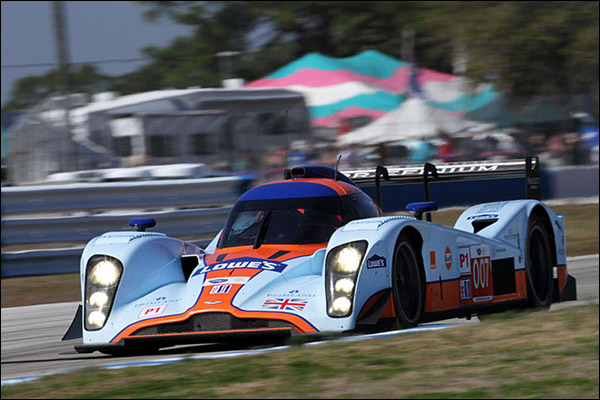
From the distance to my right, up the front straightaway, this absolute shrill cry climbing in volume, pitch and ferocity. You could hear the driver shifting his way through the gearbox to top gear, with a violent burp between each gear change. The car now was throttling down the straightaway, completely flat out, with no intention of turning direction ever again.
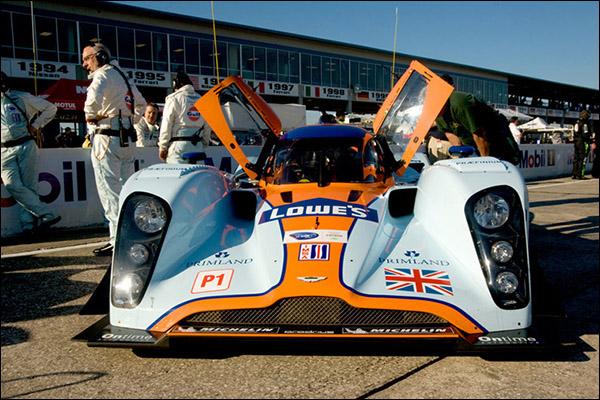
My heart was racing, and despite Florida’s sunshine, I got goosebumps across my entire body. The war cry kept getting higher and higher pitched. I didn’t know sound went that high. Then, the most beautiful of Earth’s physical laws, the Doppler Effect, took over as Aston Martin Racing’s LMP1 Prototype racing car, the Lola Aston Martin DBR1-2, blasted past me, changing pitch from a shrieking V12 scream as it approached me to a howling banshee of a wail as it blasted away down the front stretch. The driver downshifted twice, engine screaming in protest, with the car bouncing ferociously across the tarmac, arcing towards the apex. And just like that, my life was changed forever.
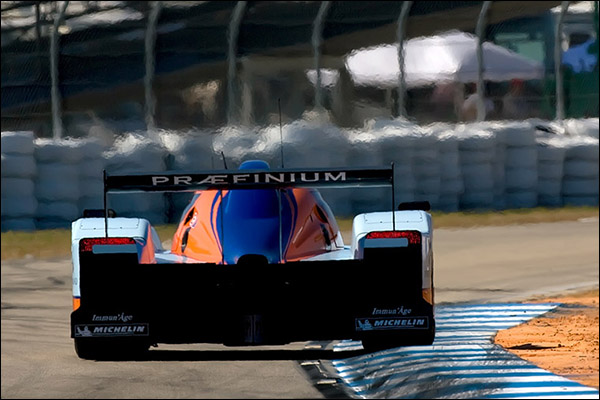
The DBR1-2 has a storied history. The car was designed in conjunction with Lola, the famous race car chassis manufacturer. While they helped pen the beauty of the car, Aston Martin Racing provided the signature piece: a truly shocking V12 that screamed up and beyond the heights of early-90’s F1 engines.
The car debuted at the start of the 2009 Le Mans Series, and dominated the entire year, including a powerful performance at the 24 Hours of Le Mans, crushing all but the then dominating manufacturer-backed diesels of Audi and Peugeot.
The car was run the following year by Aston Martin Racing in 2010, with success worldwide. 2011 saw the car move to privateer running as Aston Martin Racing launched their proprietary P1 project in the AMR-One. One DBR1-2 traded hands famously to Muscle Milk Racing in North America and joined the ranks of P1 cars competing in the American Le Mans Series that same year.
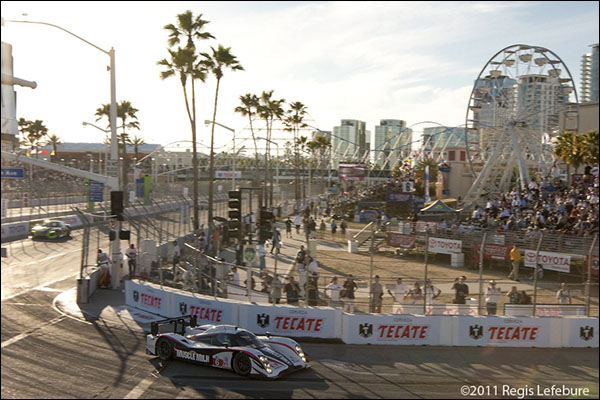
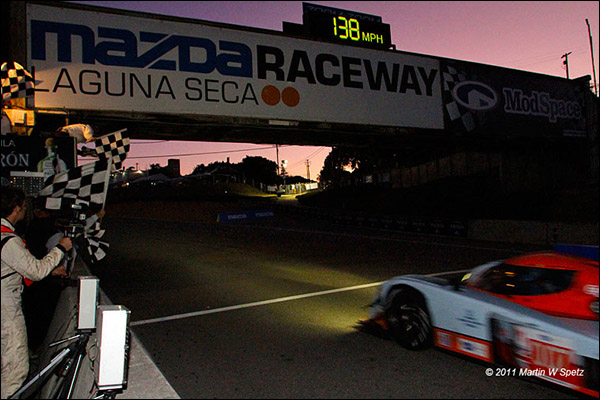
But, as the campfire story goes, the AMR-One was doomed from the beginning, and after it’s truncated debut at Le Mans, 6 laps completed between the 2 cars during the race, Aston Martin Racing abandoned the project and brought the ‘ol girl out of mothballs and ran the DBR1-2 at the 6 Hours of Laguna Seca, where it won overall, and then at Petit Le Mans to finish off it’s competitive career. A few short years and the Lola Aston was done.
To sit and define what makes a racing car a “fan favorite” is a tricky task. A fan favorite is a chosen personality, car, team or place in racing that pulls at your heart and tickles your brain. It’s that “X factor” that crosses the divide from “another great race car” to something that we buy models of. A fan favorite is the autograph we’ve got to get, have framed and then displayed proudly. A fan favorite can be seen in thousands – just look for the seas of people donning the likeness of a team’s colors. Fan favorites in motorsport are everywhere.
On an early French morning in June 2009, the Lola Aston rolled out onto the Circuit de la Sarthe for the first time. Everyone shot up, and thought, “what in the world was that?!” I imagine reporters may have checked their watches to make sure they hadn’t gone back in time to a period when Matra’s in French blue raced through the countryside.
Not only did the spectators and the fans love the sound from the Lola Aston that day, the competing teams and drivers were delighted as well. Interviews throughout race week included passages about how wonderful it was to hear a glorious engine note around the French circuit filling the trees and open fields.
Sound is an integral part of racing. It’s an integral part of motorsport and motoring in general. We pay premium dollar to have our cars sound different. For some, we even pay to have our cars sound like a different car. Yes, sound is crucial. And on the list of items to be checked off for a race car to be favored amongst the masses, it having a lovely sound goes a long way. And, my, oh my, does the Lola Aston have that box ticked.
From 2006 until 2012, if you were searching for a great sounding P1 car, you’d have been left searching for quite some time. Diesel technology had taken Le Mans by force, and the high-tech diesels of the day were beautiful. They were sculpted beauties that looked so aerodynamically efficient, you’d thought they were confused airplanes looking for an airport. They were the fastest. And, above all else, they were silent. The sound of an Audi R10 racing past you sounded more like a UFO or jet-engine than it did a race car.
If you stood at the right point on a corner, you could hear the tires rumbling across the curb strips louder than you’d hear the engine. That was the status quo at the French classic for half a decade. Quick and quiet – eerily quiet.
Seeing the Lola Aston in person is something to cherish. So much of the experience of being trackside at a motor race is what you hear. As you stand stationary against the edge of the track, you can hear the Lola Aston as clear as crystal. The Lola Aston’s engine note would climb and fall beautifully, as though it was set to music.
Every upshift, downshift, application of bone-shaking traction control, every lift and squeeze of the throttle – you heard the car’s entire experience on the track from wherever you stood. Every lap was as though you were right there with the car, along for the ride. Then in that moment when the car flashes in front of you the graceful beauty is instantly replaced by the sheer ferocity and unbridled brute power that a racing prototype has.
The Lola Aston drivers threw the car into corners, clipping the apex, bouncing across the inside curbing, then tracking out to the rumble strip, abusing the tires across every inch of that striped curb.
The engine note went from a smooth rising wail to a choppy and audibly interrupted mess of traction control – you could practically feel the car’s 12 cylinders trying to put their power down to the ground, all while the electronics were having nothing of it.
Then, in the blink of an eye, the electronics gave way, and the engine note was crystal clean again, rising up to the heavens through each gear change down the straightaway.
Now years later, the Lola Aston sits on my bedroom dresser, in 1:18 scale form. As long as I’ve owned the model, I’ve looked at it and never truly thought of the memories I have of the actual car racing in front me. Experiencing the Lola Aston was far too large, far too intense, full of passion and sheer noise to sit neatly, dusted once a week, on my bedroom dresser. No, the Lola Aston for me will always be in my head as the car that audibly frightened me into submission. Demanding it be my fan favorite.
Paul Marquardt