The car’s a Ferrari and the name sounds Italian, but the team is most definitely German. Based around 20km from the Nurburgring, Rinaldi Racing has begun to make a name for itself in European GT racing over the last few years. It’s a small and close-knit outfit that takes just eight people on the road to races, while also mantaining a road-car repair and restoration business back at home base, making this a seven-days-a-week operation.

The team takes its name from founder Michele Rinaldi, an experienced Porsche technician, who between 2000 and 2010 looked after the motorsport customers of the Porsche Centre in Koblenz. In 2010, he decided to set up on his own, servicing and upgrading roadgoing Porsches and running race cars in the VLN and Nurburgring 24 Hours under the Rinaldi Racing banner.

In 2013, the team stepped up onto a wider stage, entering a 911 GT3 (above) in the International GT Open championship for pro driver Marco Seefried and customer Vadim Kogay. But despite Rinaldi’s longstanding links with Porsche, he had his eye on another marque – Ferrari – and since the start of the 2014 season, the squad has turned out with a pair of 458 GT3s, mainly in Blancpain GT events.
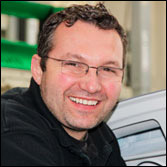 “For me to work with Ferrari is really nice,” says Rinaldi (left). “It’s a really good race car, and even though it’s sometimes difficult to perform with this model in the Blancpain championships, I still like it. In my opinion, Porsche doesn’t go about GT3 customer racing the right way. It’s more focused on the 911 GTE and the 919 prototype programmes, as well as the 911 Cup, which obviously are good for the company as they make it a lot of money!”
And it seems not even the appearance of an all-new 911 GT3 at the recent Nurburgring 24 Hours will be enough to tempt Rinaldi away from his current Italian machinery. “I saw it at the Nurburging, yes, but I still don’t see a strong GT3 programme there in the future. It’s a nice car, but I think Audi, Mercedes and BMW make much more of an effort with their GT3 customer programmes, Porsche doesn’t do much in comparison. It is a bit difficult trying to push Ferrari in the German market, but I want to work with them and get their GT3 car a bit more in Germany.”

In contrast to some of the bigger factory and factory-supported teams in Blancpain GT, Rinaldi is a small and lean organisation – as mentioned above, just eight people travel to races to support the two-car effort. “Our workshop is small, we have a small budget and just eight guys, but I think it’s okay,” Rinaldi tells us. “We’re running one car in Sprint and two in Endurance this year. For me, the Blancpain series are really nice for us and our customers, and as long as they’re happy we’ll stay racing here.”
“It’s definitely hard work,” he adds. “When we get back from a race weekend, we have to go back to working on the road cars as well as preparing the race cars for the next event, then we’re off to the track again. The summer is really hard on my guys, but that’s how it is! You need young guys with lots of energy and no family to do this.” Rinaldi adds that it’s also vital to make sure there’s enough road-car work to keep the team going in winter.

So who are the small but dedicated crew behind the scenes at Rinaldi? “There’s two mechanics per car – Maxime and Marius on the green #333 of Marco, Norbert Siedler and Rinat Salikhov. Then on the black #66 car for Steve Parrow and Pierre Kaffer we have Lars and Thiim. Then there are two tyre men, plus me and my engineer, who’s been a good friend for a long time. We have a laptop, but we still record a lot of information about setups on paper – it’s old-school racing!”
As for the team’s pro drivers, Rinaldi says: “Marco, Pierre, Norbert are all good friends of mine – we’d worked together for a long time before I started the team and I think it’s important to have friends around you.” In Blancpain Sprint, the team fields and all-Pro line-up of Seefried and Siedler, while in Endurance, the German duo team up with young Russian Rinat Salikhov.
The team had a particularly good outing at Monza this year, where Siedler qualified the #333 on pole, Salikhov kept amongst the frontrunners during his stint and the car eventually came home second overall – later promoted to first when the winning Lamborghini was excluded due to a technical infringement. Kaffer also qualified second and ran strongly until Parrow brought the car home 21st overall.

The contrast with Monza 2014 couldn’t have been starker: then, after a typically strong qualifying performance and opening stint from Seefried, Kogay got in the car and struggled with a brake problem, going off the track several times. And after a very serious crash at Spa involving the Kessel Ferrari of Marcus Mahy, the Russian stood down from the cockpit and hasn’t raced at a Blancpain event since.
“Vadim had a really bad season last year, it was really difficult,” admits Rinaldi. “He’s very busy with his business now and still helps me a lot with budget for the team. He might come back to race in the second half of this season – either in Blancpain or maybe the GT Sports Club races for gentlemen drivers only – we want him to come back.”
“Monza this year was definitely much better,” he adds. “Rinat had crashed very early during the official test at Paul Ricard, so we didn’t have as much running as we’d have liked to going into the opening weekend. But he’s young, eager to learn and always improving and came back with a great performance in Italy, so we were really happy.”
Stephen Errity
Images: David Lord & FOTOSPEEDY