I was pleasantly surprised upon leaving Silverstone a couple of hours after the British Grand Prix.
After a five year self-imposed hiatus from experiencing a Formula One race first hand, the feel of being there to see the top of the motorsport tree has changed. It helped that the race itself was one of the more exciting ones in recent memory – with intermittent rain towards the end spicing up the action – nevertheless it’s hard to fault ‘the show’ too much because it was actually very entertaining. Seeing a Brit win at Silverstone was also a big perk, despite me having less of a rooting interest in Lewis Hamilton these days….

F1 isn’t what it used to be for various reasons good and bad, it’s not what I grew up with but it still remains the only form of motorsport that Joe Public keep tabs on all year round. F1 was unmissable in my house as recent as 2010, but I don’t feel guilty for missing the odd race here or there anymore. That’s nothing new though, because I swear by the late 90s/early 00s cars while many people of my Dad’s generation swear by the 70s and 80s; preferences are generational, people keep watching as it gradually changes.
Let’s start with the negatives because admittedly there were a few. The current era of F1 cars are vastly underwhelming to watch pass by, they just are. Going in I was sure they couldn’t be as disappointing as I’d heard, but they were. The last time I stood trackside was back in 2009 at Spa, when they were ear-splittingly loud and therefore looked ‘quick’. This year saw the drivers come within five seconds of the lap record but it didn’t feel that way, especially watching them at low-speed where they didn’t look half as awe-inspiring as they once did.
The low-pitch hum of the 1.6 litre V6 turbo engines is quiet and quite dreary – like the mid-race weather – and it definitely takes away from the experience of attending an F1 race. The beauty of sportscars, one of the reasons I love it, is variation in looks and sound, the feeling that the regulations allow for differences. Nowadays F1 couldn’t be any more opposite. Something has to be changed in this respect, or the crop of young fans watching now will grow up with uninspiring noise levels coming from F1 exhausts and get used to it.
The GP2 cars are far louder, being able to hold a conversation while watching a gaggle of F1 cars fly down the Hanger Straight isn’t a good thing in my opinion!

Making the trip to the British Grand Prix is also expensive, VERY expensive. I was lucky to have been granted a media pass for the weekend courtesy of Cameron Twynham, so I didn’t have to stomach the cost of admission, camping and grandstand seats. The Silverstone executives slashed the prices at the turn of 2015 to get more people in, and it worked, but if you paid full price it’s hard to justify the value for money. It costs hundreds to sit on a grandstand, and around a ‘hundy’ just to get in for the weekend. £67 just for Friday practice if you booked in advance and £90 for official parking for three days really isn’t a good deal.
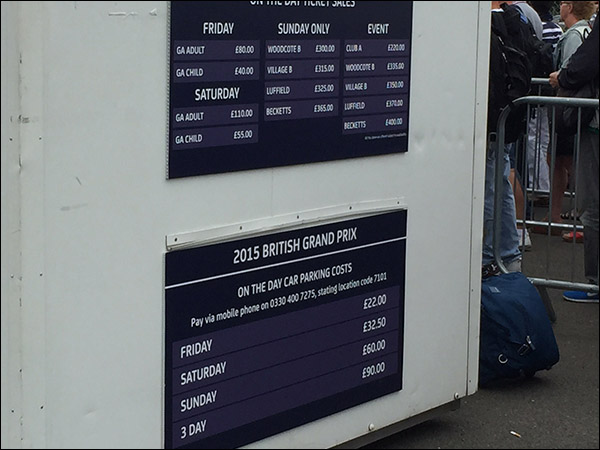
For what’s effectively a sprint race plus practice and qualifying I think it’s borderline ludicrous to pay full price. When discounted it was more reasonable – with general admission tickets under £100 – but it’s still not great when you could do a full week at Le Mans for roughly the same budget when everything is totalled up up.
Next year’s FIA WEC round at Silverstone meanwhile has seen ticket prices rise by £5 to £40 for the weekend, which is a testament to the state of sportscar racing at the moment. Sportscar racing has a lot going for it, but one thing it doesn’t have is the same feeling that it’s an ‘event’ outside of the marquee races. Here’s where my take on the weekend gets positive.
I’m a sucker for a big sporting occasion, and the Grand Prix definitely provided that, which is why I have an unexpected urge to consider returning next year. Silverstone was rammed, with a supposed record crowd of over 140,000 on race day. Yet it still didn’t feel uncomfortable.
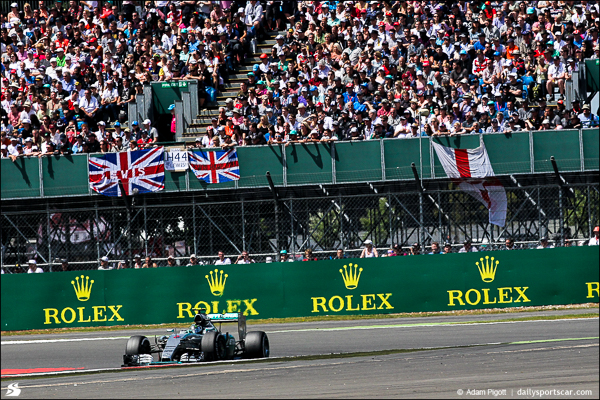 Every grandstand was seemingly full for the race, and that transforms the experience at the circuit. From the huge cheers as Hamilton took back the lead, to the big attendance for the post-race concert it felt like you were watching something that was special and meant something.
In terms of facilities from what I saw there were plenty of food stands dotted around to ensure queues were short. And to my surprise even the prices weren’t too bad, coming in at well under Wembley Stadium prices.
The concerts on in the E-Zone in the centre of the circuit were worth going to each night, with the stage acting as screens and a place for public driver interviews during the day. It had a miniature festival atmosphere, especially after the race when I had a watch. To attract a family audience, making it more than racing is key, so adding the Typhoon display and an activity area for kids was also a plus.

On the subject of screens, there were also plenty of them so even roaming spectators could follow the action – the only plus of the quiet cars meant you could hear the circuit commentators throughout the race too. Standing on the inside of Copse like I did for the race was therefore a pretty good vantage point with everything considered. For someone who feels a little like a fish out of water out of a press room at a motorsport event nowadays, spectating was actually really fun.

After speaking to some friends, I was equally pleased to hear that the camping for the weekend was apparently vastly improved and a great family experience. The Woodlands site was secure, had plenty of places to eat and drink, a good amount of space and even a stage showing kids films each evening.
I almost wanted to leave with the opinion that attending a WEC race is far better than Formula One. But actually, while I still feel sportscars are more of an on-track spectacle now, and better value, the atmosphere at the Grand Prix was so good it almost completely made up for it.
It’s far more of a close second than I imagined.
Stephen Kilbey