Just like Daytona International Speedway is being remodelled, so is the IMSA Weather Tech Sportscar Championship. The difference is that while the Speedway remodel is complete, the changes to the racing series are just starting.
For 2016, it is the GT classes that are remodelled, GTLM has been brought closer to current street car technology with the allowance of turbocharged motors, among other things, while the GTD category has joined the rest of the world in adapting the GT3 regulations. Part of the spectacle of sportscar racing is the cars and the changes in these classes will make them the ones to watch especially here at Daytona.
GTLM
Now it gets interesting. For 2015, the class lost the two Vipers. For 2016 they lost Falken. Both are significant loses, but I doubt anyone would say that losing those two outweighs the addition of a two car Ganassi led Ford GT program.

The addition of the Ford GT program is likely the biggest boost IMSA has received in quite some time, potentially it’s the biggest boost ever. The addition of the Fords significantly raises the profile of the sport to the general public and adds even greater interest to the fans of the sport.
How they perform is another question. This class is the one in which the term sandbagging is the most tossed about and for good reason. With so many factories involved and the resulting pressures to be competitive being balanced by the sometimes drastic Adjustments of Performance bulletins that are prevalent over the course of a season, nobody seems to want to show their true hand too soon.
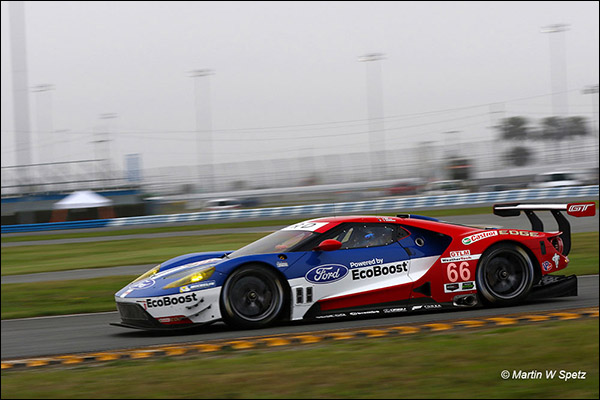
With new turbo-charged cars now featuring by Ferrari and BMW as well as the above mentioned Ford, it might be a bit premature to expect a win out of that trio. But that may be old school thinking as the reliability of new cars just seems to be so much greater in current day racing. But that said, 24 hours at Daytona is a long time, especially for essentially brand new cars with zero race experience.
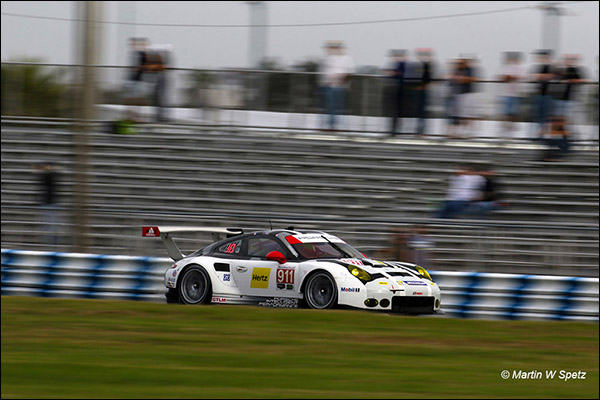
That said, the class mostly enjoyed a nice balance between 4 of the 5 makes represented at the Roar. Much like early last season, the Porsches were not in challenging position at least time wise. The CORE entered team seemed content to go about their business as planned and leave bragging rights to the others. With a line up of Pilet/Tandy/Estre in the #911 and Bamber/Makowiecki/Christensen in the #912, there is no shortage of talent ready to go here at Daytona.
One team not able to go about their track plans was Risi, who was forced to forgo the test as their car was not yet built. The car though has been shaken down at Fiorano (below), and is en route to Miami for delivery directly to the track for the race. It’s potentially then a rough road ahead for drivers Fisichella/Vilander/Rigon/Beretta and the rest of the team entering the race but at least there will be additional Ferrari entries this time from both Scuderia Corsa (Pier Guidi/Premat/Serra/Rojas) and SMP Racing/AF Corse (Shaytar/Bertolini/Bruni/Calado).

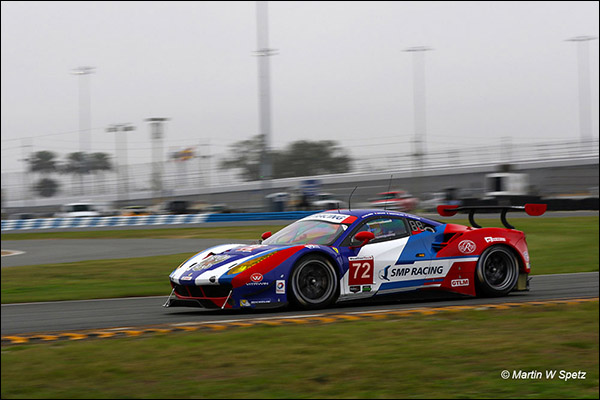
Significantly among those bragging of fast times would be BMW and Ferrari. With new cars on hand for both, it was rather unexpected to see them consistently at the top fighting with the not as greatly modified Corvettes for the top times in class. But to be honest the times were so close at the Roar, it doesn’t really matter. This will be all out war this year.
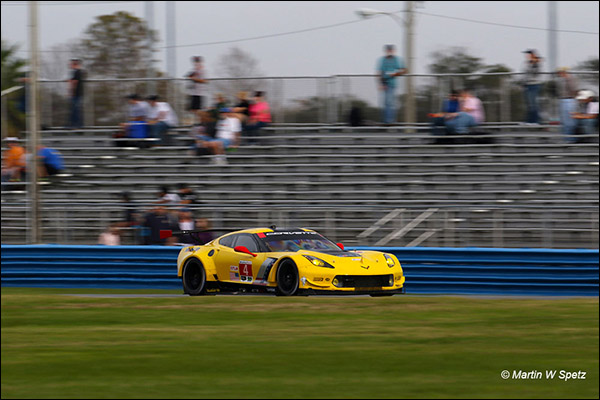
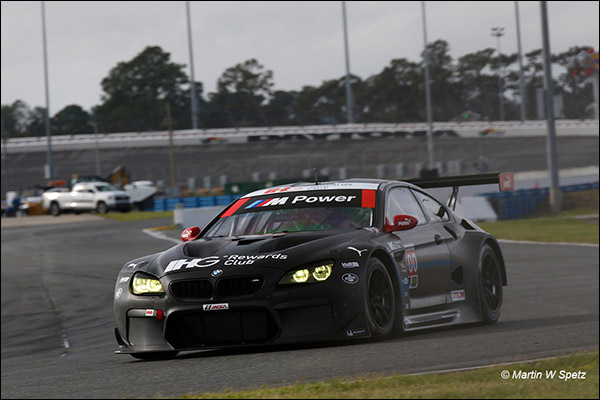
Corvette will be sticking with the usual pairing of Magnussen/Garcia in the #3 and Gavin/Milner in the #4 with unusual assists from Mike Rockenfeller for the #3 and Marcel Fassler in the #4. BMW counters with Auberlen/Werner/Farfus/Spengler in the #25 and Luhr/Edwards/Witmer/Rahal in the #100, numbered in recognition of BMW’s century anniversary.
Ford – well it was a rather low profile test for them time wise, they too seemed content to go thru their paces, although incidents did limit the track time for both cars. Dirk Muller had an off in the #66, which he shared with Joey Hand and Sebastien Bourdais while the #66 will feature Ryan Briscoe, Richard Westbrook and Stefan Mücke for the 24 hours.
Adding to the intrigue in IMSA 2016 is the class balance. Based upon times at the Roar, it is quite likely the GTLM cars will be right up in the midst of the PC cars, which could cause all sorts of mayhem during the race.
When all is said and done, it wouldn’t be surprising to see the class battle come down to a Corvette vs. Porsche battle, but don’t be surprised if there is a Ford taking the checkered flag first. After all, wouldn’t that make some great headlines?
On the post Roar balance of Performance front, in GT Le Mans, no weight changes were made, and only one air restrictor change has been implemented. Corvette Racing’s C7.Rs have smaller holes to feed air to its V8 engines, and lost a total of 0.4 mm from the twin restrictors, which now have 29.9 mm openings to breathe through.
Turbocharged GTLM cars from BMW (sweeping boost reductions), Ferrari (sweeping boost reductions), and Ford (sweeping boost reductions) have had adjustments, except for peak RPM boost.
Fuel tank capacities and fuel flow restrictors for all five GTLM manufacturers have been set by IMSA for its big season-opening race. BMW’s M6 (+9 liters to 104L, 33.5 mm), Corvette’s C7.R (+6 liters to 92L, 32.0 mm), Ferrari’s 488 (78L, 29.5 mm), Ford’s GT (+3 liters to 98L, 35.0 mm), and Porsche’s 911 RSR (+6 liters to 91L, 32.0 mm) represent the anticipated consumption and flow rates required to keep the cars on equal footing. BMW had the rear wing Gurney flap height increase (+10 mm to 15 mm total).
GTD
22 entries for GTD. That is impressive.
What is even more impressive is the balance of entries in this class:
Aston Martin Vantage GT3: TRG, AMR
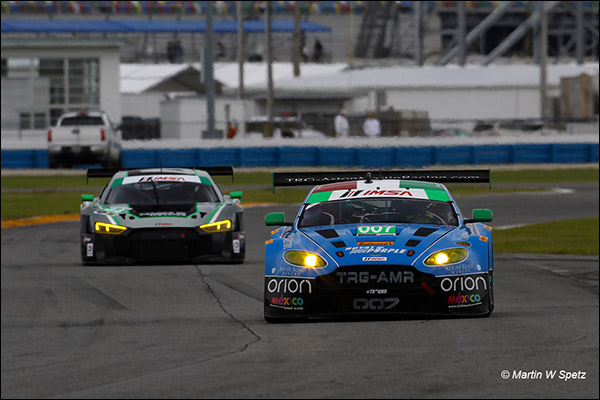
Audi R8 LMS GT3: Stevenson (2), Magnus, Flying Lizards (Audi R8)

BMW M6 GT3: Turner (2)

Dodge Viper GT3-R: Riley (2)

Ferrari 458: Scuderia Corsa, Spirit of Race

Lamborghini Huracan GT3: Chance, Konrad (2), O’Gara, Paul Miller

Porsche GT3-R: AJR (2), Black Swan, Frikadelli, Park Place

Besides the obvious question about how the cars compare to each other is what may be an even more important question, how do the class cars compare to the other classes.
Given that the typical GT3 spec car possesses greater downforce and is slower in a straight line than the 2015 spec GTD car, it is hoped that the speed differential will be much greater on the banking, which may bring back that precious appearance of speed differential, one that was a significant spectacle from the Daytona glory years.
It is also hoped that the much more friendly to Am-drivers GT3 cars, with all of their driver aids and increased downforce will lead to less incidents during the event.
But now comes the difficult aspect of this class now, it is all change and it will be extremely difficult to know who is who without a program. It isn’t just new cars, it is also established teams with new cars. Teams like Magnus, which have long been associated with Porsche have changed. In this case, they are running an Audi, while Paul Miller Racing who had an Audi last year is now racing a Lamborghini, while Stevenson steps up from the Continental Series to race a pair of Audis. Besides being loaded with cars, this field is absolutely packed with high caliber drivers, many having strong ties to factories. This is going to be very difficult to keep straight all race long.
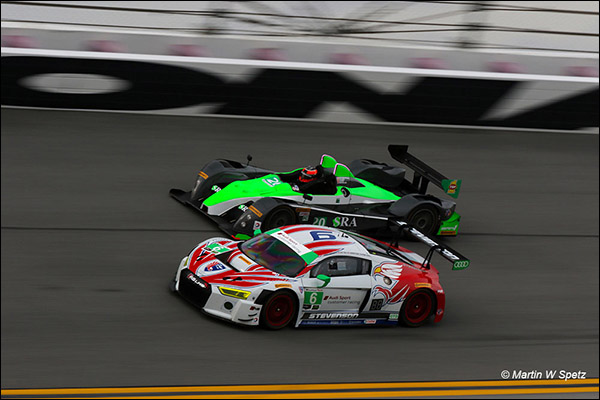
In a race like this, it likely comes down to preparation and reliability above all. The pre-race balance adjustments should address the speed amongst the contenders and if they do it properly it will come down to a combination of the above, plus longevity, absence of issues and just plain luck.
As far as being prepared, it was obvious that some were more prepared than others. As expected, Alex Job had his two Porsches ready to go and it was the #22 that led the times. Just slightly slower was an impressive effort for Paul Miller Racing as they had their Lamborghini up and ready early.

It was a very encouraging Roar for the Stevenson Racing return to GT racing as they made their Audi debut. Through the sessions, the team worked away with the car, eventually turning the 3rd fastest time in the sessions. This has to be an encouraging start to a new era for the reigning Continental Tire Sportscar Challenge GS championship winners. 4th quickest in testing (despite the absence of “Queen of the Nurburgring” Sabine Schmitz who will be joining for the race) was the Frikadelli Porsche, a welcome reward and a great first step at Daytona for what is now rare, but used to be common, a European team starting the season at Daytona.
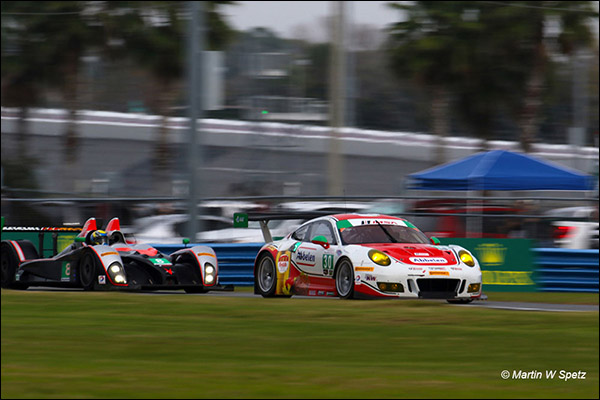
22 GT3 cars at Daytona? Who would have thought…
There are post Roar test BoP changes aplenty in GT Daytona, all eight models, with the exception of Porsche’s 911 GT3R, received minimum weight changes and most also have engine air restrictor changes for the Rolex 24.
Aston Martin’s V12 Vantage (-10 kilos to 1250 kgs, more airflow with +1.3 mm to 42.0 mm total), Audi’s older R8 LMS (-10 kilos to 1290 kgs, more airflow with +1.7 mm to 54.0 mm total), Audi’s new R8 LMS GT3 (+20 kilos to 1300 kgs, less airflow with -2.0 mm to 38.0 mm total), BMW’s M6 GT3 (+10 kilos to 1310 kgs, adjustments throughout its boost tables), Dodge’s Viper GT3 (-20 kilos to 1320 kgs, less airflow with -1.0 mm to 38.0 mm total), Ferrari’s older F458 (-20 kilos to 1280 kgs, RPM limit -200 to 8200), and Lamborghini’s Huracán GT3 (+20 kilos to 1280 kgs, less airflow with -2.0 mm to 37.0 mm total) have been modified for the race.
On the fuel tank capacities and fuel flow restrictor front, Aston Martin (+13 liters to 103L, 30.5 mm), old Audi (+3 liters to 107L, 34.5 mm), new Audi R8 (+4 liters to 90L, 27.0 mm), BMW (+9 liters to 104L, 30.5 mm), Dodge (+4 liters to 107L, 34.5 mm), old Ferrari (94L, 32.0 mm), Lamborghini (+1 liters to 90L, 27 mm), and Porsche (-1 liters to 84L, 25.0 mm) are locked in place. The only turbocharged GTD entry, BMW’s M6, has received notable boost reductions throughout its rev range, barring peak RPM.
Gary Horrocks
BoP Notes from Marshall Pruett courtesy of Racer.com