


I must admit, I always enjoy going to the Dubai 24 hours. The location is not particularly inspiring, and Dubai does not (yet) enjoy the heritage of motor-racing’s traditional winter homes in Florida or the Antipodes, but the weather is generally pretty agreeable, the welcome is always hearty, and the whole event serves to start the season on the right note. Added to that, we were rewarded with a great race this year too. Before the race, it was hard to pick an obvious winner from strong entries from Mercedes, Ferrari, Audi and Lamborghini. Certainly all four cars were fast enough to win, but 24 hours is never that simple, particularly at Dubai.
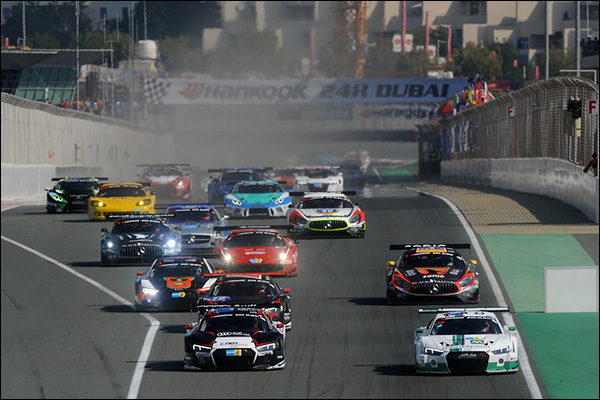
With 98 cars taking the start, the Dubai Autodrome was the busiest racetrack in the world, certainly in recent memory. Previous highs at Petit Le Mans, of 20 cars per mile or a car every 75 meters were soundly beaten: at Dubai we reached more than 30 cars a mile, that’s a car every 55 meters! Bearing in mind that an SLS Mercedes is very nearly five meters long, then that’s not a lot of breathing space. If the same density of cars took part at Le Mans, there would be 247 starters. That’s not a thought I would like to dwell on for long. (Actually, I hope no-one from Creventic reads this, as they probably would get that many entries if they tried to organise a 24hSeries race at the Circuit de la Sarthe).
There can be no doubt that the density of the traffic has a large part to play in the character of the Dubai 24 hours, as does the fact that all cars have at least one amateur driver on the crew, even in the A6-Pro class. At times, it was a bit like a battlefield out there, as each stint was as much about not having an accident as it was about turning in good lap times.
While a lot of credit was given to Adam Christodoulou and the other drivers of the Black Falcon SLS AMG, starting from the back row of the grid, and finishing in second place overall, their task was only different from those starting at the front of the pack in that they did not have the luxury of three laps of running with no traffic at the start of the race.

It was disappointing that neither of the two new Black Falcon Mercedes AMG GT3 entries featured, the faulty compressor that stopped Bernd Schneider’s charge was a fault that the team had not experienced before, and a part that comes directly from the older SLS, so its failure was not expected. Equally unexpected was that Jeroen Bleekemolen should make the misjudgement that resulted in contact with another car and lead ultimately to the retirement of that car as well.
In terms of outright pace, the new Mercedes, including that of the Ram Racing Team, were not quite a match for the Audi R8 LMS, (as can be seen from the table below), and of course Audi’s superiority was in numbers as well.
The following table shows the best and average lap times for my pick of the leading A6-Pro cars:
| Pos. | No. | Car | Best Lap Time | Average Lap Time |
|---|---|---|---|---|
| 1 | 19 | Team WRT Audi R8 LMS | 1m 59.212s | 2m 01.706s |
| 2 | 16 | Black Falcon Mercedes SLS AMG | 2m 00.946s | 2m 02.788s |
| 3 | 4 | C ABT Racing Audi R8 LMS | 1m 59.239s | 2m 02.018s |
| 5 | 14 | Optimum Motorsport Audi R8 LMS | 2m 00.304s | 2m 02.266s |
| 8 | 333 | V8 Racing Chevrolet Corvette | 2m 00.528s | 2m 02.035s |
| 10 | 26 | Konrad Lamborghini Huracan | 2m 00.727s | 2m 02.814s |
| 21 | 30 | Ram Racing Mercedes AMG GT3 | 2m 00.614s | 2m 02.454s |
| 37 | 28 | Land Motorsport Audi R8 LMS | 1m 58.712s | 2m 01.228s |
| NC | 11 | Scuderia Praha Ferrari 458 Italia | 2m 00.650s | 2m 02.040s |
| NC | 2 | Black Falcon Mercedes AMG | 2m 00.328s | 2m 01.960s |
| NC | 3 | Black Falcon Mercedes AMG GT3 | 2m 00.626s | 2m 02.305s |
One of the attractions of endurance races like this is the complexity of the matter. For the drivers, it is relatively straightforward: go out there and drive as quickly as possible without crashing or breaking anything on the car.
But for the teams, there is generally far more to think about, and with so many cars on the grid, there are undoubtedly more stories to be told than I can describe here. In a race where the total distance completed by all the cars taking part would have got you 60% of the way to the moon (honestly, you can work it out!), it would be impossible to analyse everyone’s dramas, so I’m just going to pick out a few highlights here.
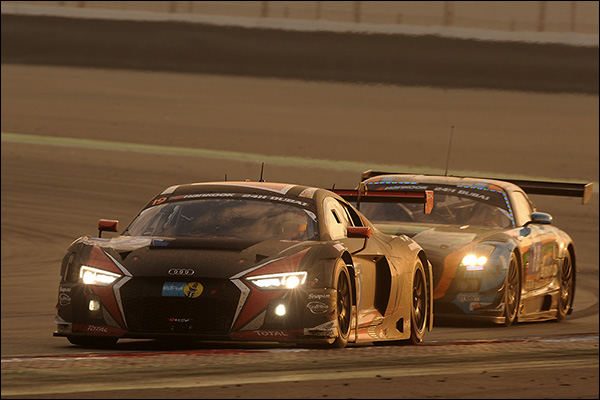
For the Belgian Audi Club Team WRT Audi of Laurens Vanthoor, Michael Meadows, Stuart Leonard and Alain Ferté, it was a pretty satisfying win – most certainly a team effort, and each of the four drivers played their role. The regulations require each car in A6 to have at least one AM driver (who has to drive for two hours) and no more than two PRO drivers (who may not drive more than twelve hours between them). The decision to use Alain Ferté (who turned 60 last year) as the AM driver was inspired. The former French Formula Renault and Formula Three champion may never have got his chance in F1, but had an illustrious career in sportscars driving for Jaguar, Mercedes and Peugeot. Those with long memories may even recall him setting fastest lap in the 24 hours at Le Mans in 1989 at the wheel of an XJR-9 and in 1994 he set the pole position time in a Courage. He visibly enjoyed his outing in the Audi, and would no doubt have happily driven it more.
Here is the breakdown:
| Driver | Stints | Laps | Time | Best | 20% Average |
|---|---|---|---|---|---|
| Vanthoor (PRO) | 7 | 231 | 8h 52m 23.988s | 1m 59.212s | 2m 01.222s |
| Leonard (Semi-Pro) | 4 | 97 | 4h 10m 25.492s | 2m 02.729s | 2m 03.316s |
| Meadows (Semi-Pro) | 5 | 170 | 6h 28m 56.389s | 2m 00.494s | 2m 01.727s |
| Ferté (AM) | 2 | 90 | 3h 24m 26.817s | 2m 01.267s | 2m 02.429s |
It goes without saying that it was a well-deserved victory for Vincent Vosse, Pierre Dieudonné and the rest of the team, the only hiccup being early in the race, when Stuart Leonard lost a lap queuing for fuel at the end of the pit lane. The car dropped from the lead back to 16th place with just two hours gone, but the rest of the race went smoothly and at 5am the team re-took the lead and was not headed again.
Perhaps the least-eventful race was had by the A6-Am winners, Hofor-Racing, whose Mercedes SLS AMG finished in fourth place overall. Electing to run in the 2m 05s bracket, Christiaan Frankenhout, Kenneth Heyer, Michael Kroll, Roland Eggiman and Chantal Kroll took full advantage of the 50kg weight break and 120 litre refuelling limit, spending just 1h 07m 58s in the pits (15m less than the winning Audi and with 7 fewer stops). As the only non-AM driver on the crew, Heyer was inevitably the quickest; but in the 193 laps he completed, only five of them were under the limit. A further three “jokers” were burned by Frankenhout, who completed 196 laps in total, leaving Eggiman and the Kroll father-daughter to complete the other 189 laps with an average lap time around 2m 09s.

With the cars constrained by a minimum reference lap time, consistency is always important, and as can be seen in the table below, Frankenhout deserves even more credit that Heyer:
| Driver | Laps | Laps in 2m 05s | Laps in 2m 06s | Laps in 2m 07s |
|---|---|---|---|---|
| Heyer | 193 | 68 (35%) | 52 (27%) | 14 (7%) |
| Frankenhout | 196 | 114 (58%) | 34 (17%) | 14 (7%) |
| Eggiman | 83 | 2 (2%) | 6 (7%) | 13 (16%) |
| C Kroll | 50 | 0 | 4 (8%) | 8 (16%) |
| M Kroll | 56 | 0 | 0 | 0 |
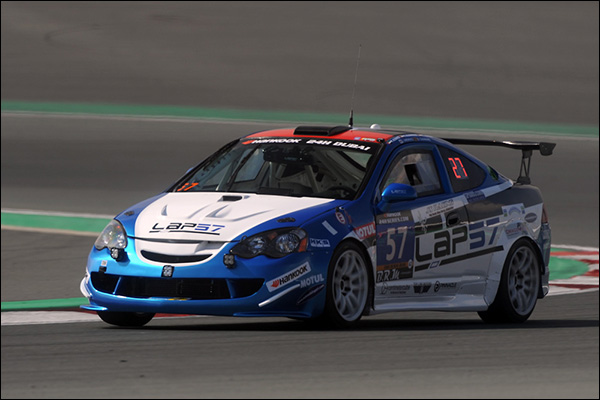
Finally, in a race that is full of stories, one that might have been missed was the fight in the A2 class. In the end, it was between the no. 165 Besaplast Mini Cooper S and the no. 57 Honda Integra of the Lap57 Racing Team.

It was a race that was not won or lost by speed on the track, nor as a result of efficiency in pits. In the final analysis, it came down to penalties handed out for exceeding the driving time limits. Article 32.3 of the Sporting and Technical Regulations states that “The maximum driving time for each driver without a change of driver is two hours”. Mohammed Al Owais drove the first stint for the LAP57 Racing Team, and came in after 44 laps, following two code 60 periods, unfortunately though with a stint time of 2h 00m 01.108s, earning the car a one lap penalty. Junichi Umemoto took the car over from Al Owais, and went off for a 33-lap stint. It lasted for 2h 01m 02.425s: another lap penalty! Two stints complete and twice the driving time limit had be broken. After this, the team managed to get its sums right: and by the end of the race had completed 511 laps.
Meanwhile, over at Besaplast, the Mini was going well and spent much of the race in the lead of the class, it was a typically efficient German performance. Until Henry Littig was in the car for his third stint behind the wheel; he did 43 laps, but the stint time was 2h 00m 05.915s, earning the Mini a one lap penalty as well!
At the end of the race, the Mini had completed 510 laps, one lap less than the Honda Integra, but with only one penalty lap instead of two. With both cars therefore credited with 509 laps completed, the Besaplast Mini was declared the class winner by just 45s. But for the sake of getting the sums right on the pit wall though, the Lap57 Racing Team could have won the class comfortably.
And with such thoughts, the teams packed away their containers for the long voyage back to Europe. I know I have missed more stories than I have captured in this article, but such is the nature of the beast of the Dubai 24 hours. Although there were recriminations, reported on elsewhere, for most the race was a success. Out of 98 starters, 17 were not classified as finishers, and a further 15 were not running at the end of the race.
At the sharp end of the field, the race was run at a record pace: but for thirteen code-60 periods, which accounted for 4h 20m of the race, a greater distance would certainly have been covered – previous races have not had more than 3½ hours of neutralisation.
A worthy start to the 2015 FIA International Endurance Series season, there can be no denying that Creventic is getting its sums right!
Paul Truswell


