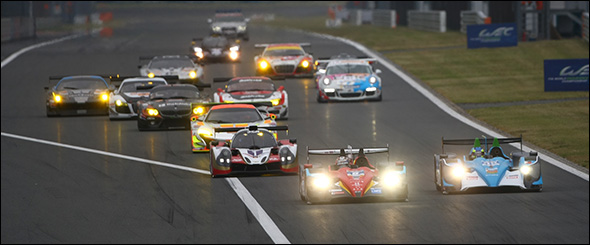
Asian Le Mans Series CEO Cyrille Taesch Wahlen was interviewed for the ACO’s website on the future prospects for the Series after an encouraging relaunch in 2015/16.
What was the ACO’s overriding goal in taking over the Asian Le Mans Series?
The aim was to restore faith in the project and give renewed impetus to local sponsors, teams and drivers. ACO has a reputation for professionalism and efficiency in its organisation, and by taking up the challenge, it sends out a strong message. At the same time, we had to gradually rebuild a starting grid worthy of the name. The idea is to have a true platform in Asia. We have therefore quickly followed it up with the Asian Le Mans Sprint Cup which will be launched in 2016, in addition to the Asian Le Mans Series, to offer a full range of races to the teams who want to compete in Asia.
How many cars will be on the grid in Zhuhai in October?
The majority of teams are looking to continue the adventure. Some are planning to double up and race two cars. There should also be some new teams coming in. The aim for the Asian Le Mans Series opener in China is to have as many cars on the grid (20) as the Sepang round at the end of January. To achieve this, we are setting great store by the series of short races (Asian Le Mans Sprint Cup) between May and September, as this will give teams who want to enter the Asian Le Mans Series other opportunities to race and maximise driving times, while cutting costs. The cars eligible for the Asian Le Mans Sprint Cup (LM P3 and carbon-monocoque Group CN prototypes as well as GT Cup cars) are in fact also allowed in the Asian Le Mans Series.
As far as the grid is concerned, is it fair to say that there is a need to develop a taste for prototypes in Asia, as they have been neglected in favour of GTs?
Yes, it is. The Automobile Club de l’Ouest strives to defend endurance, and particularly Le Mans-style endurance racing, with a true mix in the cars entered. So we need GTs, but we are determined to defend the spirit of prototypes, from CNs and LM P3s up to LM P2s. Prototypes are more easily accessible with our series. We have decided, for example, for the inaugural season of the Asian Le Mans Sprint Cup, that all of the races will be held in Sepang (Malaysia) because it is a superb racetrack that is practical and accessible, and because many teams are set up here. It is an excellent launchpad.
The calendar has therefore expanded from four races to seven if we combine the two series!
That’s correct. The Asian Le Mans Series is still our main championship, but the Asian Le Mans Sprint Cup meets a need. It should be easier for manufacturers to find customers as the cars will not just be running at the end of the year. The teams will see a better return on their investment. The Sprint series (with two 60-minute races at each of the three meetings for a total of six races) will form the base of the endurance pyramid, or the entry level to prototype racing in Asia. And with this calendar and our complementary offering, there is no downtime.
So there are grounds for optimism in 2016?
We have the chance to build a championship in potentially the biggest car market in the world. Most of the Asian teams that are now making a commitment have plans to race at the 24 Hours of Le Mans in the short term. They are very professional about it and aware of the sporting and financial implications of such plans. There are real grounds for optimism in that we are welcoming growing numbers of high-level representatives.
This year’s winning teams in the Asian Le Mans Series, Race Performance, DC Racing, Clearwater Racing and KCMG, will be appearing at the 24 Hours of Le Mans. Is this proof that the Asian endurance pyramid is working?
Absolutely. It sends out a strong signal that participating in the Asian Le Mans Series is a great springboard for the 24 Hours. If we look beyond this season’s winners, signs were already visible at last year’s 24 Hours. Earl Bamber, who won the race with Porsche, is a pure product of Asia as he triumphed in Formula BMW Asia and in Porsche Carrera Cup Asia earlier in his career. In LM P2, KCMG gave the Oreca 05 its maiden win in its very first appearance at the 24 Hours of Le Mans. KCMG may not be the most well-known name in Europe, but it’s a solid, all-round team that races in no fewer than eight championships. Last but not least, Team AAI came over from Taiwan with two Porsche GTs and a genuine desire to learn, and that is exactly what we are looking to develop.