Gary Horrocks caught up with Porsche’s ex Head of GT Motorsport Martmut Kristen at Daytona, Kristen stepped down after a decade at the helm in 2014 but even before that he was involved in transformational motorsport programmes for Porsche.
This is one of those interviews that will ping the memory banks of many readers, and it touches on at least one of those ‘holy grail’ projects that we know very little about, the aborted LMP2000 car as well as legends including the 911 GT2, three iterations of 911 GT1, the infamous RS Spyder and the ground-breaking 911 GT3R Hybrid.
Enjoy, I certainly did!
GG
There really is something about Porsche retirees vacationing at the race track, isn’t there? Hartmut Kristen who retired as the Vice President of Motorsport for Porsche in 2014 (he’s pictured below at CoTA that year as the Porsche North America GTLM programme was launched) kept that tradition alive this year at Daytona and in his perspective he’s not sure why he’d be elsewhere.

“Yes, we have a way of doing that, don’t we? Norbert Singer had quite a habit of showing up here too didn’t he? Personally, I spent more than 30 years here in the States working and it is hard to keep me away from Daytona. What isn’t to like? I like the competition but I also appreciate the fact that it is also so open. I look at many of my competitors here as friends and enjoy being around them. Then there is Daytona itself, it is a special place and at a special time of the year. There aren’t many sportscar races that take place on ovals and that presents many unique challenges in its self. Plus it is winter back home, it is always good to get a little Florida sunshine for a change.”
About the challenges of Daytona, Hartmut explained, “this track is so unique in so many ways. Full throttle for 70% of the lap. That is so stressful for the drivetrain. Then there is the harsh sand, humidity changes as well as the temperature changes. All of these add to unique challenges for those competing here. Between the big three 24 hour races, Nurburgring, Le Mans and Daytona, Daytona is unique and challenging in its own way. The location so near the ocean, the winter date, it all influences and contributes to the character of Daytona.”
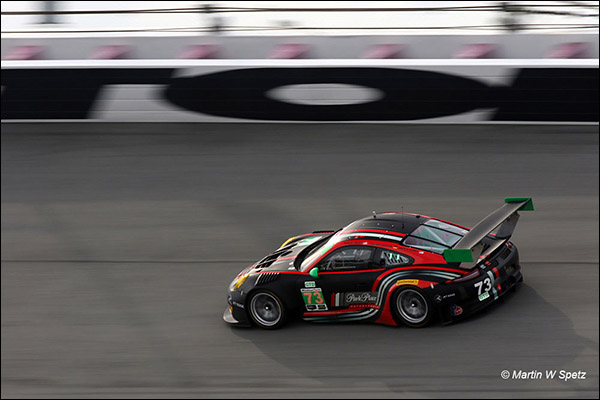
So what is it about racing here in the States that is so unique? “So many of the tracks in Europe are now sanitized to F-1 standards. Very similar characteristics as well as in location and specific climate. The tracks here are more of a throw back to old school road racing, back when the racing was actually on the roads. I really like that and appreciate that.”
Hartmut started with Porsche in marketing in the early ‘80’s, then moved to the company today known as Porsche Cars North America before taking over as the Head of Customer Racing and GT cars in 1994. “When I took over, the Dauer 962 project had already started, so I really had nothing to do with that. We weren’t doing all that well at Porsche at that time, so Wendelin Wiedking, then the CEO of Porsche stated ‘we’ve won Le Mans, we’ll make it work’, so we pretty much retreated from competing for the overall wins at Le Mans. We needed to step back and we did.”
Out of that stepping back came the Porsche 911 (type-993) based GT2. And the timing was spectacular, especially with the introduction of the BPR series. “It was late in 1994 that we got the go ahead and in early ’95 we had a race car. That was only 5 months from go ahead to racing at Daytona. That would be unheard of now.” That 911 GT2 entered by Jochen Rohr finished 4th overall in that 24 hour race and second in the GTS-1 class.
“What we did with that car was very important to the well being of Porsche. We sold quite a few of those cars and it sustained not just us but road racing for quite a length of time. The engine output wasn’t all that different than stock, but we added funny fender flares and attached a wing off of the engine cover. Back then, development was possible on a racing car and we continued to develop that car, as did the customers. Now everything is homologated and you can’t develop like that. Times have changed and you move on…”
Below one of the very last times we saw the 911 GT2 compete in contemporary competition, 2003 and a one-off appearance in the season finale of the British GT Championship at Brands Hatch. The car led the race in the hands of ex Le Mans C2 class winner Mike Youles.
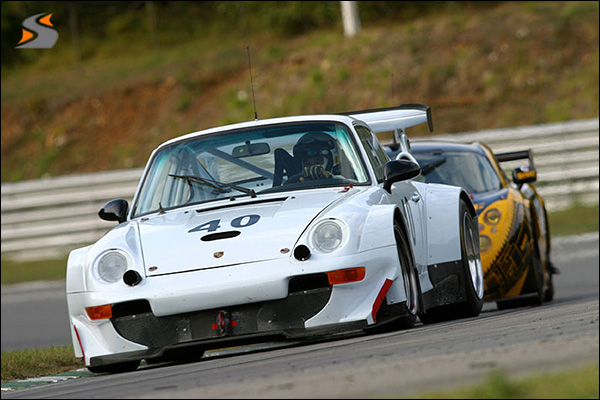
It is here that the business genius of Hartmut comes across. How did a successful customer racing car get built in that short amount of time? “Simple. Decisions were made. To be successful, you have to take a risk and we did. We had a small team with all working towards the same dream. It didn’t take hour long meetings to come to an understanding. You had to move fast to get anything accomplished. This is industry standard, and not just Porsche specific. You need to treat some projects like a start-up, even in a large corporation. It can be a real challenge to find that right spirit and then when you get that, you can’t be afraid to take chances.”
Hartmut also emphasizes that you must be open minded. Take the manual gearbox as an example. “The manual gearbox is very much like a fine watch in that it is in vogue now. People are willing to spend a premium price for a watch that is a work of art, when it is quite easy to find a cheaper alternative that will likely do a better job. A manual gearbox is quite similar in many ways. For outright performance, a manual gearbox is no longer the best way to go, but certain cars just seem to need that manual gearbox. Plus customers are willing to pay a premium for the old way of shifting, there isn’t anything wrong with that at all. In fact I’m still a fan myself and yes I do own my own “Save the Manual” shirt.”
Sort of the opposite of a manual gearbox was PDK, the dual clutch that Porsche started racing in the 962 Group C cars in the mid-80’s. “That is one that we were way ahead of the times with. Maybe 20 years ahead. We simply were not set up to make it or make it affordable at the time. We knew we needed a partner and we approached many other auto manufacturers at the time to see if anyone would work with us on producing in volume. Obviously we had no takers, but now the PDK is well established in our line of cars and the dual clutch is quite common across the industry now.”
After the success of the GT2, Porsche started on another project that ultimately led them to more success and even an outright win at Le Mans. For a little over 3 seasons, the GT1 Porsche became a poster car of race cars. While it doesn’t look there was much time that went by between the GT2 and the appearance of the GT1, there was sufficient time in order for Porsche to approve a race program. “It wasn’t that difficult of a sell to the board, so we jumped in. Part of the regulations at the time was that 25 street cars had to be produced in order to race.” Note that the statement says produced, not sold.
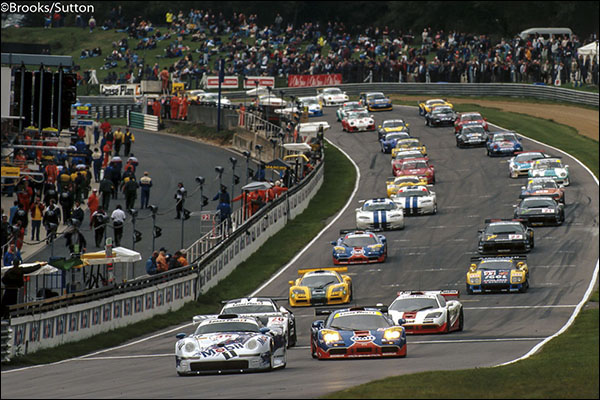
At this point, Hartmut was the Director of Sales and Marketing Race Cars and these cars fell under his jurisdiction. “The road cars were a tough sell. You wouldn’t think they would be, but with a price tag of 1.25 million D.M. back then, they were a bit costly and it took us a year to sell all of them.”
As far as the race versions, the factory didn’t have too much difficulty in selling them. “We made 8-10 of them and there were 4 running in the FIA Series, besides the factory entries. In 18 months we cleared 50m D.M. in turnover, including parts.” Let’s just say that Porsche, thanks in no small part to the efforts of Hartmut and his staff, found a way to make money racing.
While the 1996 and 1997 GT1 cars were conventional cars, as in the tub, the 98 version was something completely different. It was with this car that Porsche first introduced a carbon fiber tub to the mix. They had to, in order to keep pace in the rapidly evolving and escalating arms race that was the FIA Series in the late 90’s. Unfortunately the series imploded at the end of the 1998 season, leaving Porsche with only a single win for the car, which just happened to be the big one, Le Mans.
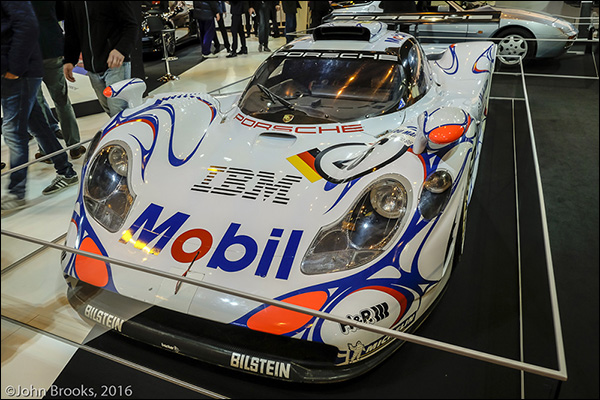
But it was this car that started the ball rolling in another direction – back to the frontline prototype battles. This effort, shrouded in mystery through the years was known as the LMP2000 and was supposed to represent Porsche at the highest level of the sport once again. (pic below with thanks to www.mulsannes corner.com, highly reccomended for the most complete history of this fascinating car there is)

Unfortunately it never happened and nary a word has been mentioned about this car by Porsche. But here was Hartmut, simply stating that, “the evolution of the 98 GT1, led to the LMP2000, which rolled out in 1999. Unfortunately that car never happened because strategic discussions within the boardroom steered us towards what were called super-sportscars. After all, we were “the” sportscar manufacturer, so out of the ashes of the LMP2000 came the Carrera GT. Coming over from the LMP was a carbon fiber tub, as well as the V-10 motor.”
“One important thing about the carbon tub for the Carrera was that because it was a street car, it needed to be crash tested to meet mandated safety requirements. What we learned from the crash testing of the Carrera GT was eventually applied towards the development of the RS Spyder tub. We simulated the crash test of our final design of the tub and if the simulation and the real tub were displayed side by side on a split screen, you would have had a difficult time knowing which one was which.” It is typically racing that improves the breed, but here for once you can say that the development of the street car helped improve the race car.
By 2004, Hartmut was elevated to the position of VP of Motorsport and was under his watch that the above mentioned RS Spyder project came into being. It must be remembered that by this time, it had been 6 years since Porsche had competed at the top level of sportscar racing, so they had a lot to catch up in a short amount of time. “When we presented this project to the Porsche Board we knew we had some work to do. First of all, it was obvious that it would not be possible to convince the board to jump into P1 after so many years away, plus we’d be going up against Audi. So we did some deep looking at the regulations and decided that we would be able to compete for overall wins by running a P2 car in the ALMS, but still not compete against Audi directly.”

Obviously the board signed off on the project. Peter Schwarzenbauer, President and CEO of Porsche Cars North America found funding for the car to compete in ALMS competition and it was announced that the car would be made available to customers, which also helped influence the design and materials used. And of course it was announced that none other than Team Penske Racing would be fielding a 2-car effort.
The rest is history. Debuting at Mazda Raceway Laguna Seca in the 2005 ALMS season finale, Sascha Maassen and Lucas Luhr combined to finish 5th overall and first in the LMP2 class.
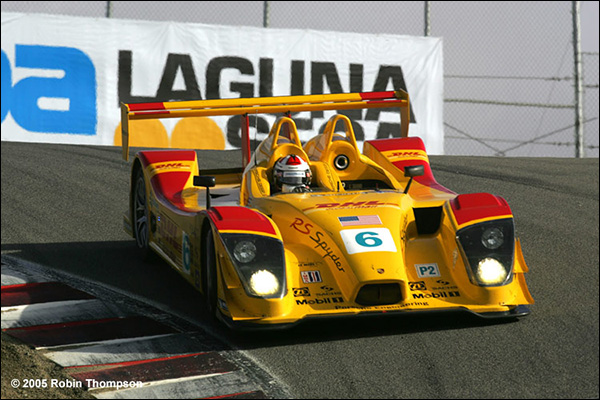
That set the tone for many successes to come, including 11 overall wins and a further 12 class wins from 2006 through 2008 for Penske, followed up by 2 more overall victories and a single class win for Greg Pickett’s Cytosport team. The Spyder also saw action in the ELMS where it took 7 class wins as well as featuring for LMP2 class wins at Le Mans in 2008 (below) and 2009.
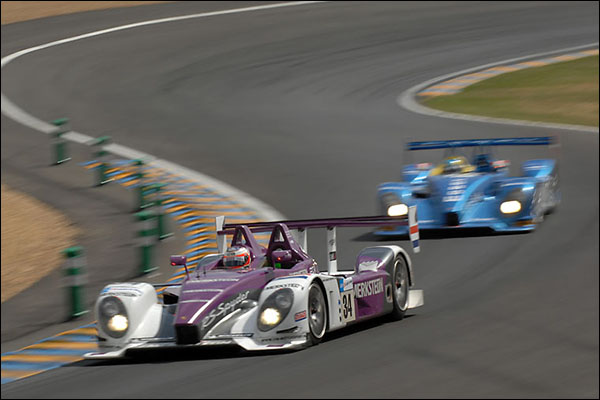
Looking back at the project, Hartmut quite justifiably proud of the accomplishments of that car. “We were able to show what we as a company were capable of, and we did it with a car that was capable of being truly run as a customer car. I look at this as the last of the truly customer compatible top line prototypes. You didn’t need a crew of 100 to run this car. It was truly capable of racing within the normal constraints of a customer effort.”
One staggering and completely nonchalant comment that Hartmut made was concerning the cornering capabilities of that RS Spyder. “At Road Atlanta, turn 1, it was possible to drive this car flat out in 6th gear and the drivers were seeing about 7gs.” That has to be a special circumstance doesn’t it? “No, not really. It was pretty routine. Because of the pit exit blend in, we had a spotter for the drivers. As long as the spotters said the track was clear, the 7g figure was pretty routine. They were seeing 7gs at Lime Rock as well. In fact we were seeing values closer to 8gs later on in 2008.”
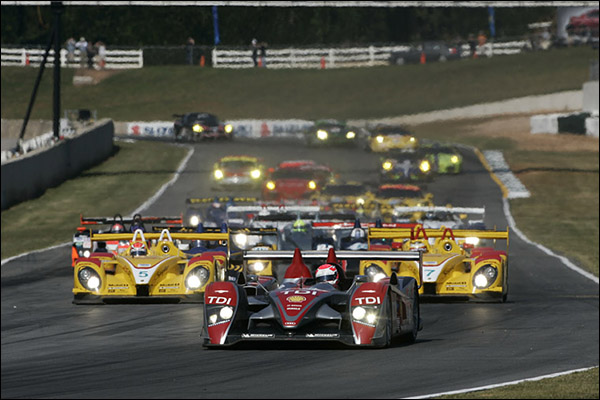
How does a driver do that? “You recalibrate your senses. I remember when I was racing, I was told a series of curves could be taken flat out. I didn’t believe it, but I worked up to it. I had to recalibrate and pretty soon it became routine. That is what you need to do. A driver needs to recalibrate their senses to their surroundings. Especially with high g forces. If it becomes tunnel vision, you still need to slightly move your head to take in the surroundings.” So applicable in so many ways.
But of all of his experiences, Hartmut rates the 911 GT3R Hybrid as “the experience of my professional life. We came out of the board meeting in which the project was approved with no limits other than we must do this in a 911. That was it. It was a clean sheet of paper. We had no initial experience and the learning curve was steep, but in little over a year we saw a 90% improvement. We went in steps, from 240, to 400 and then up to 800V. It wasn’t easy, but we made huge strides. Again we (as previously discussed) went about it in a very precise and focused manner. We focused not on increasing the speed of the car, but on getting the car up to top speed as quickly as possible. But in that we also had to make the car drivable and balanced. I think we achieved that.”

The car ran with an electric flywheel battery sitting where a passenger usually would in a 911, and that electric power was used to power two 82hp motors hooked up to the front wheels, effectively giving the driver an 8 second boost with the push of a button that could be used to power out of a corner or to pass an opposing car. And that power was effectively free.
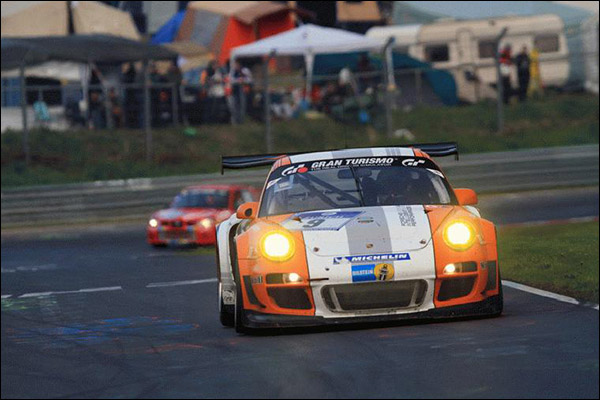
While the car was a rolling test bed, it didn’t stop Porsche from racing it. In 2010, the 911 GT3R Hybrid was entered in the Nurburgring 24 hour race. The stunning drive, where the car led for over 8 hours came to a halt with a rare engine failure with only an hour and 45 minutes to go. While that effort didn’t result in a conventional win, it contributed more to Porsche than can be measured. “What we most wanted to do with this car was learn. And we learned everyday with it.” That is the Porsche way, isn’t it?
While Hartmut may be retired, he still has a lot to offer and is still around as a consultant. That too is the Porsche way. For as quiet and unassuming he comes across, it has to be mentioned that he is one of the major players for Porsche that helped see Porsche through the dark days of the 90’s and emerge to be the powerhouse they are now, both on track and off.
My thanks to Tom Moore for suggesting and arranging this interview. I also would like to thank him for talking away from the ledge many times as I got a bit intimidated on this one. My sincere thank you to Hartmut for being so gracious with his time and so approachable. Dave? You missed it…
Gary Horrocks