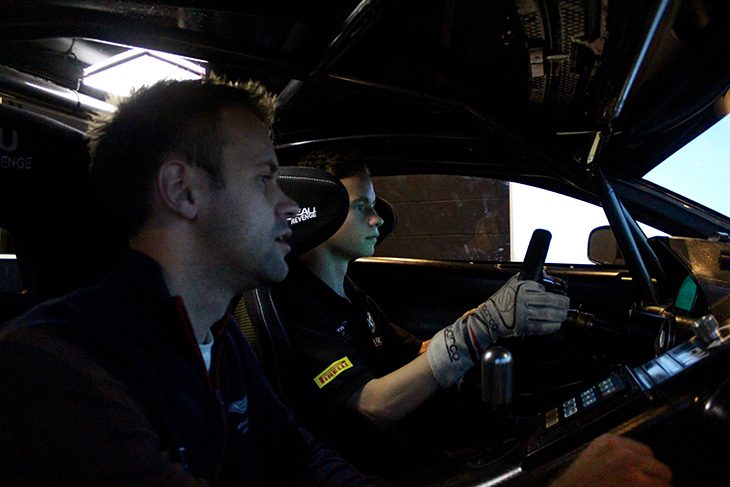

As well as improving skills with one of Base Performance Simulators’ skilled engineers, many drivers come in with their own personal driver coach, like young Scottish driver Sandy Mitchell, who regularly books sessions with his coach Jonny Adam.
DSC went along to one just before the Snetterton round of the British GT season earlier this year to get a flavour of what the benefits that can offer. Mitchell visited Base Performance Simulators before each round of the championship this year, which was a key part of his preparation.

Having a professional coach was even more necessary for Mitchell in 2016, which has turned out to be the most important of his young career. Mitchell didn’t have the luxury of just turning up and racing, as he and teammate Ciaran Haggerty helped develop the McLaren 570S GT4 during the year, and in conjunction raced it in the British GT Championship. It was a successful campaign though, as the duo won two races at the end of the season, and coincidentally, the first came at Snetterton just days after DSC sat in on his preparation.
Maximising the time
Adam has been coaching young drivers for 10 years now, and has a well versed system in how he runs his sessions. At Base Performance Simulators, he has the ability to get very hands on with his drivers, talking to them over in-car radio and even sitting inside the GT Simulator with them in the passenger seat to get a feel for their techniques. His sessions are not very data or setup heavy, and instead focus on technique and circuit memorisation.
The key is preparation, you need to do as much as possible
“The key is preparation, you need to do as much as possible,” said Adam. “That’s what I do before each race, I look at footage and I get more time in the sim. If I’m not here with Sandy I’m here with Derek Johnston, my teammate.
“Doing your homework is key, you want to be ready when you get to the circuit for a race weekend.”
That, and giving feedback from his personal experience builds up a relationship with his clients like Mitchell which means they can effectively use and manage the time they have together prior to a race weekend.
Adam has known Mitchell for years through his dad Steve Mitchell who he competed against in the Seat Cupra Championship almost 10 years ago, but only started coaching Sandy this season.
“Where’d I go wrong?”
“What I’ll do is I’ll let him have a run, find his feet, then we’ll look over some video and I’ll tell him where he’s going wrong,” he said “It’s brilliant because I can jump in after seven or eight laps and give him pointers. He’ll do two hours before each race in the simulator.
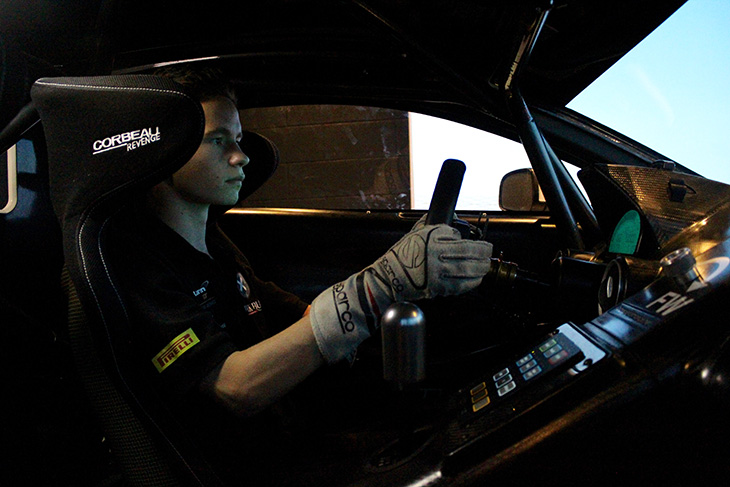
“It’s little things like when you prepare for weather conditions if you think it will rain. Before Sandy raced at Silverstone we did an hour on the simulator in the dry and an hour in the wet, and it’s really realistic. It teaches you the lines, which are so different at a place like Silverstone.”
It means that Mitchell will arrive at a circuit having had a true training session before he went out, which at Snetterton allowed him to focus on set up rather than getting to grips with the small details of the circuit.
“I like to use Base Performance Simulators because they have a purpose built GT Simulator which is such a great tool, you don’t waste time, you feel like you’re in a real cockpit and don’t need to compromise on the basics.
You don’t waste time, you feel like you’re in a real cockpit and don’t need to compromise on the basics
“Then we’ll look at the data a little bit afterwards to round off the session. But you don’t want too much data work, I see so many pros and ams engulfed with data in free practice sessions, it’s too much to think about, it’s brain overload.
“When I look at data, if someone I’m coaching is losing a tenth, I wont even talk about it, if they’re losing seven, then there’s a problem. Sandy has come from pure data in MSA Formula so he understands it, but you don’t ned much.”
Settling in
When Mitchell had completed his runs, he sat down at length with Adam to discuss his performance and where he needed to improve on the weekend. They also watched on-board footage of other drivers tackling Snetterton to give him something to compare to.

Adam will look at his lap times and try and get him to run to within a tenth or two for a longer stint.
“He likes to debrief after a longer run, because he still isn’t used to driving cars for a long time. Coming from MSA Formula he was only in the car for 20 minutes at a time. When we do work now, he’ll drive for a long time, it teaches him to stay consistent, and stay mentally focused for an hour.
He’ll drive for a long time, it teaches him to stay consistent, and stay mentally focused for an hour
“He was getting quicker throughout his time driving at Snetterton, so I’ll compare his best lap with one of his average one, to see where he is gaining the time, and get him to have in his head which corners he needs to focus on.
“I can look at specific corners with him, and compare what I’m used to seeing from his style,” Adam added.
But it works both ways, Adam doesn’t coach young drivers purely for financial game, he sees it as a very important part of his career as a driver. He enjoys it, and still finds it useful for his own ability.
If I can find someone four or five tenths then that’s so satisfying
“I enjoy coaching,” he concluded. “If I can find someone four or five tenths then that’s so satisfying. It’s a big part of my career, I like taking people and improving their skills, it makes you feel a part of something different when someone wins a race or a title. It’s a big part of motorsport now, simulator coaching, and there are so few spots with factory, because there’s such a small talent pool.
“Coaching is great for a younger driver, and for me it’s great for my confidence, and I learn from the people I coach and watching them.”