


Here’s the details of Porsche’s 2017 GTE challenger, yesterday’s flight times conspired against us:
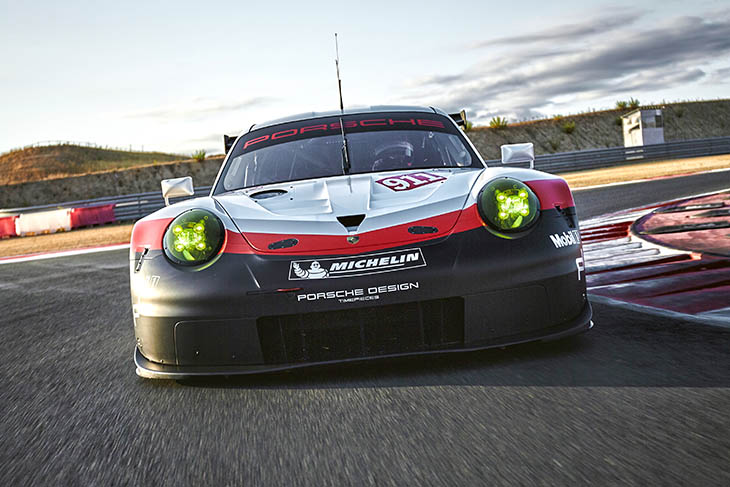
Porsche revealed its all-new 911 GTE RSR which will tackle the 2017 racing season with two factory entries set to run in the 2017 FIA World Endurance Championship and IMSA WeatherTech Championship. It will make its competitive debut at next year’s Rolex 24 Hours at Daytona.
The new 911 RSR makes full use of the breadth of the Le Mans 24 Hours GT regulations, and in addition to systematic lightweight design, features the ultra-modern, flat-six unit positioned in front of the rear axle. The four-litre, extremely light aggregate features direct fuel injection as well as a rigid valve drive and is characterised by outstanding efficiency.

“While retaining the typical 911 design, this is the biggest evolution by now in the history of our top GT model,” says Head of Porsche Motorsport Dr Frank-Steffen Walliser. The new 911 RSR is a completely new development: the suspension, body structure, aerodynamic concept, engine and transmission have all been designed from scratch. The engine concept has enabled the designers to install a particularly large rear diffuser. Combined with a top-mounted rear wing adopted from the LMP1 race car, the 919 Hybrid, the level of downforce and the aerodynamic efficiency were significantly improved.
“For the 911 RSR, we deliberately focussed on a particularly modern and light normally-aspirated engine, as this gave our engineers immense latitude in developing the vehicle,” explains Dr Walliser. “Apart from that, in principle, the LM-GTE regulations stipulate the absolute equality of various drive concepts, as the torque characteristics of turbo and normally aspirated engines are aligned.”
Depending on the size of the restrictor, the new normally-aspirated unit puts out around 375 kW (510 hp). Shift paddles on the steering wheel actuate the sequential six-speed gearbox with a magnesium housing, which delivers power to the 31-centimentre-wide rear wheels. The changeover to the new engine generation is now complete. After the 911 GT3 R and the 911 GT3 Cup, the spearhead of Porsche GT racing cars is now also powered by the same cutting-edge six-cylinder boxer engine family.
For the first time in a Porsche GT race car, the 911 RSR GTE will feature a state-of-the-art assistance systems: the new 911 RSR is equipped with a radar-supported collision warning system, the so-called “Collision Avoid System”. Even in the dark, the faster LMP prototypes are detected early enough and misunderstandings can be avoided. A new safety cage concept and a new, rigidly-mounted racing seat enhance driver safety. With the seat fixed to the chassis, the pedalry can now been moved and adjusted to fit the driver.
The new 911 RSR’s serviceability has also been significantly improved. Entire elements of the carbon-fibre body can be exchanged completely in a very short time thanks to clever quick-release fasteners. Moreover, changes to the suspension setup can be performed much more quickly and easily.
With the look of the body wrapping, the 911 RSR is striking out in a new direction: For the first time, the GT racer bears the new factory design that has further developed the clear and dynamic design language of Porsche Motorsport. From a bird’s eye view, a hint of the Porsche emblem silhouette can be seen. The basic colours remain white, red and black.
With its dual programme during the 2017 season, the factory is expected to run the new 911 RSR at 19 outings which equates to more than 140 hours of racing.
“We’re very well prepared for this,” says Marco Ujhasi, Head of GT Works Sport. “Since its first rollout in Weissach in March this year we’ve covered 35,000 test kilometres on racetracks in Europe and North America – that’s more than in the development of any other Porsche GT racer.”
Technical data
Concept
Single-seater race car for the LM-GTE category
Weight/dimensions
Weight ca. 1,243 kg (base weight per regulations)
Length 4,557 mm (without splitter, rear wing, diffuser)
Width 2,042 mm (front axle) / 2,048 mm (rear axle)
Wheelbase 2,516 mm
Engine
Water-cooled six cylinder boxer, positioned in front of the rear axle; 4,000 cm3, stroke 81.5 mm, bore 102 mm; ca. 375 kW (510 hp) depending on restrictor; four-valve technology; direct fuel injection; dry sump lubrication; single mass flywheel; power output limitation via restrictor; electronic throttle.
Transmission
Six-speed sequential constant-mesh gearbox; two-shaft longitudinal layout with bevel gear; shifting via electronic shift actuator; shift paddles on the steering wheel; magnesium gearbox casing; multi-disc self-locking differential with visco unit; three disc carbon race clutch.
Body
Weight-optimised chassis in combined aluminium steel design; removable roof hatch for cockpit access; lifting bushes integrated in the roof; FT3 fuel cell in front of the car; welded-in roll cage; seat pursuant to FIA 8862-2009; rigidly mounted to the chassis; six-point safety harness for use with HANS; longitudinally adjustable pedalry; bodywork made of CFRP, quick-change; rear wing with “swan neck” mounts; four-post air jack system with safety pressure valve; electronically activated fire extinguisher system; heated windscreen.
Suspension
Front axle: double wishbone front axle; four-way vibration damper; twin coil spring setup (main and helper spring); anti-roll bars, adjustable by blade positions; electro-hydraulic power steering
Rear axle: integrated rear axle subframe with double wishbone axle; four-way vibration damper; twin coil spring setup (main and helper spring); anti-roll bars, adjustable by blade positions; electro-hydraulic power steering; tripod drive shafts.
Brakes
Two independent brake circuits for front and rear axle, adjustable via balance bar.
Front axle: One piece aluminium six-piston racing callipers with quick coupling; internally ventilated steel brake discs, 390 mm diameter; race brake pads; optimised brake cooling ducts.
Rear axle: One piece aluminium four-piston racing callipers with quick coupling; internally ventilated steel brake discs, 355 mm diameter; race brake pads; optimised brake cooling ducts.
Wheels/tyres
Front axle: One piece forged light alloy wheels, 12.5Jx18 offset 25 with centre lock nut; Michelin slick 30/68-18.
Rear axle: One piece forged light alloy wheels, 13Jx18 offset 37 with centre lock nut; Michelin slick 31/71-18.
Electrics
Cosworth Central Logger Unit; CFRP multi-functional steering wheel with integrated display; shift paddles and quick release; Collision Avoidance System; controlled alternator in connection with LiFePo4 battery; LED headlights; LED taillights plus rain light; illuminated car number and leader light system; black light inside cockpit; electric adjustable wing mirrors with memory function; tyre pressure monitoring system (TPMS); drink system; air conditioning system; membrane switch panel on centre console with fluorescent labelling.


