In nearly every major racing championship, there is one race that stands out as the crown jewel of the annual calendar. The WEC has Le Mans. IMSA has Daytona. And in Super GT, there is the International Suzuka 1000 Kilometers.
The Suzuka 1000km, first run in 1966, has spanned over a century of sports car racing, and all the changes that it has seen over the years. The list of former champions reads off as a list of hall-of-fame drivers and cars, both domestic and foreign.
Production cars, prototypes from Groups 5, 6, and 7, the mighty Group C racers of the ‘80s, the first generation of GT1 in the ‘90s, and, since 1999, the fastest GT racers ever, the GT500 class of the Super GT series, have all fought for the overall victory. From Takahashi to Pescarolo, from Hoshino and Sekiya to Tréluyer and Lotterer, the honour roll of former winners are forever a part of racing immortality.
It is the only true endurance race in a series comprised entirely of all-out sprints, and as the oldest and most prestigious race in the Super GT calendar, it is truly a one-of-a-kind event that every team and every driver in both classes wants to win above all others.
But nothing is forever, and as 2017 has proven, it is especially true in motorsport. This year will be the final running of the Suzuka 1000km, at least, as we know it today.
Next year, a new 10-hour endurance event will be held at Suzuka Circuit on the traditional date of the last weekend of August. Different cars will take center stage. It will be a part of a different championship. A brand new story will be written in 2018, but not before the final sentence of this final chapter is written for all time, this weekend, on August 27, 2017, in the final Suzuka 1000km.
A brand new story will be written in 2018, but not before the final sentence of this final chapter is written for all time, this weekend, on August 27, 2017 – in the final Suzuka 1000km
For this reason alone, the 46th International Suzuka 1000km will be a memorable race. And that was even before factoring in the two biggest X-factors of the race, two former F1 heroes making their one-off Super GT debuts: The 2009 F1 World Drivers’ Champion, Jenson Button, and Toyota LMP1 superstar, Kamui Kobayashi.
Button, in his very first sports car endurance race, will pilot Team Mugen’s #16 Motul Mugen Honda NSX-GT alongside current track record holder Hideki Mutoh, and second-generation driver Daisuke Nakajima. As he did for eight of his 17 F1 campaigns, Button will help to carry Honda fans’ hopes of an eighth Suzuka 1000km victory on his shoulders, at Honda’s traditional home venue.
That said, it would be foolish to suggest that Mugen is a one-man effort – certainly not when Mutoh, last year’s record-setting polesitter, a former IndyCar Rookie of the Year, and a former GT300 Drivers’ Champion, is Team Mugen’s full-time ace. For Mugen, who won this race way back in 1999, they’ll need all three of their drivers to be at their best for 173 grueling laps.
And it’s the same at Lexus Team WedsSport Bandoh, who’ve drafted Kobayashi, five years removed from an iconic podium finish in the Japanese Grand Prix at Suzuka – to co-pilot the #19 WedsSport Advan Lexus LC500, with their flambouyant and tenacious lead driver Yuhi Sekiguchi, and the reigning Super Formula champion Yuji Kunimoto.
Between the three drivers, Sekiguchi, Kunimoto, and Kobayashi, there is a near-perfect balance of tempered aggression and metronomic precision. Kobayashi will garner the headlines, especially after his unfulfilled performance at Le Mans two months ago. But as is the case with Team Mugen, the WedsSport team need all three of their drivers to be at their best in order to win – and extend Toyota Motor Corporation’s record with a 14th Suzuka 1000km victory between the Toyota and Lexus badges.
They are two of eight teams on the GT500 field carrying less than 50 kilograms of ballast, which is crucial, considering that in the Super GT era (since 2006), no team has ever won the Suzuka 1000km carrying more than 48kg of ballast.
No team has ever won the Suzuka 1000km carrying more than 48kg of ballast
In that group, there are also a number of heavy sentimental favorites to win. The #100 Raybrig NSX-GT (Naoki Yamamoto/Takuya Izawa), owned by four-time winner Kunimitsu Takahashi, who’s yet to win this race as a team owner. Real Racing’s #17 Keihin NSX-GT (Koudai Tsukakoshi/Takashi Kogure), which has infamously suffered one misfortune after another, nearly every year at this race over the past decade.
From Nissan, there is the #46 S Road Craftsports GT-R of Satoshi Motoyama and Katsumasa Chiyo. At age 46, this will likely be the legendary three-time GT500 champion Motoyama’s last chance to finally win the Suzuka summer enduro in his 13th try, while Chiyo hopes to atone for missing this race one year ago with a back injury. The #12 Calsonic Impul GT-R (Hironobu Yasuda/Jann Mardenborough) and the #24 Forum Engineering Advan GT-R (Daiki Sasaki/João Paulo de Oliveira) also have little ballast to contend with, hoping to reinvigorate their frustrating seasons with a win at the biggest race of the year.
The points payout for this race is also crucial for both GT500 and GT300 classes: 25 points for the winning team, 18 points for second place, 15 for third place, down to 10, 8, 6, 5, 4, 3, and 2 for the rest of the top ten. Even one of those extra points could prove to be the difference in winning a championship at the finale at Twin Ring Motegi this November.
And while history isn’t on the side of the teams at the head of the championship fight, those teams heavy on ballast and fuel-flow restrictions have still taken podium finishes and even challenged for the overall victory in the last decade.
That includes last year’s winners, the #38 ZENT Cerumo LC500 of Yuji Tachikawa and Hiroaki Ishiura, two of four drivers looking for their third overall win at the Suzuka 1000km. The others are Ronnie Quintarelli, in the #23 Motul Autech NISMO GT-R (with Tsugio Matsuda) – which was the fastest car in the mid-season tests in June – and James Rossiter, aboard the #36 au TOM’s LC500 with Kazuki Nakajima, one of two cars fielded by the four-time Suzuka 1000km winners at TOM’s.
The #8 ARTA NSX-GT (Tomoki Nojiri/Takashi Kobayashi), just removed from a landmark victory at the Fuji 300km, could also cap off their incredible run through the “Mid-Summer Triple” with a podium, or even a victory that could put them right at the top of the table.
As GT500 prepares for its swansong at the Suzuka summer endurance race, the ultra-competitive GT300 class prepares to take center stage for next year’s new event.

With the Suzuka 10 Hours being open to FIA GT3 and JAF-GT300 cars, and hoping to attract the top teams from Super GT, Super Taikyu, and many other series around the world, it could be logically reasoned that whoever wins the GT300 class in the 46th Suzuka 1000km will enter the inaugural Suzuka 10h as it’s defending champion, in a sense.
And no GT300 team has had the run of dominance at this event quite like Subaru and R&D Sport, winners of four of the last seven Suzuka 1000kms.
The #61 Subaru BRZ R&D Sport of Takuto Iguchi and Hideki Yamauchi enters 2017 as the defending GT300 winners, and they definitely look poised to win it all again aboard the mighty Blue Boxer. 50 kilograms of Success Ballast isn’t ideal, but history has shown that the ballast isn’t as big a factor in GT300 – it’s been won before at a whopping 88 kilograms, just two years ago.
It also helps that Suzuka traditionally favours the high-downforce JAF-GT cars like the Subaru, particularly through the fast sweeping S-Curves of the first sector.
Suzuka traditionally favours the high-downforce JAF-GT cars like the Subaru, particularly through the fast sweeping S-Curves of the first sector
The two Toyota Prius apr GTs will try and take apr Racing’s first Suzuka 1000km victory, led by the #31 Prius (Koki Saga/Rintaro Kubo) that has finished second in two of the last three years. Certainly don’t overlook the Mother Chassis cars, and in particular, an intriguing dark horse pick in the form of the #2 Syntium Apple Lotus Evora (Kazuho Takahashi/Hiroki Katoh/Hiroshi Hamaguchi) which has had the pace to win in each of the last two years, fielded by a Cars Tokai Dream28 squad that has already won this race twice before.
Out of the FIA GT3 contingent, there are a few teams that can immediately be factored in for the victory, including two of the three active drivers who’ve won the class a record three times.
Kazuki Hoshino, who also won it overall in 2006 in addition to his sub-class victories in ‘08, ‘09 and ‘12, would love nothing more than to win this race for legendary team owner Masahiro Hasemi in the #3 B-Max NDDP Nissan GT-R, which he’ll share with Mitsunori Takaboshi – a dynamo in his last-minute GT500 debut last year.
Hiroki Yoshimoto, who’s already won in a BMW, an Aston Martin, and the infamous Mooncraft Shiden, will go for his fourth victory with as many manufacturers in the #60 Syntium LM Corsa Lexus RC F GT3 with co-driver Akira Iida. Both those cars are light on ballast as well.
BMW Team Studie, who didn’t even take the start of the race in 2016, are back for revenge in 2017 with their all-star trio of Jörg Müller, Seiji Ara, and guest driver Augusto Farfus aboard the #7 Studie BMW M6. The #33 D’station Porsche 911 GT3-R (Tomonobu Fujii/Sven Müller) leads the way for Porsche, who haven’t won in GT300 for a long time, and even longer still since the last time they won this race in GT300.
Audi, Bentley, Ferrari, Lamborghini, and Mercedes-AMG are also trying to win GT300 at Suzuka for the very first time. Of those manufacturers, Mercedes are once again the favourites, with their best hopes likely resting with the #65 LEON Cvstos AMG (Haruki Kurosawa/Naoya Gamou), the outright fastest car over the last two rounds.
Audi, Bentley, Ferrari, Lamborghini, and Mercedes-AMG are trying to win GT300 at Suzuka for the very first time
As mentioned earlier, the end-game for the current title contenders is to score as many points as possible with their current ballast on board. But that doesn’t mean that the likes of the championship-leading #4 Goodsmile Hatsune Miku AMG (Nobuteru Taniguchi/Tatsuya Kataoka), the #25 VivaC Toyota 86 MC (Takamitsu Matsui/Kenta Yamashita/Tsubasa Kondo), or the #55 ARTA BMW M6 GT3 (Shinichi Takagi/Sean Walkinshaw) won’t be going for it.
Certainly not when Taniguchi, Takagi, and even Morio Nitta in the #50 INGING & Arnage Racing Ferrari 488 GT3, the three winningest GT300 drivers ever, are all still hungry for their first Suzuka 1000km victories.
The Suzuka 1000km has a few unique idiosyncrasies for newcomers. The race won’t finish under nightfall, with a 6:28 PM curfew leading up to the iconic post-race fireworks ceremony. There are a minimum five mandatory pit stops for fuel and driver changes, but no compulsory tyre change rules, and no minimum drive time limits – in fact, a number of winning teams of years’ past have only used two of their three enrolled drivers during the race itself.
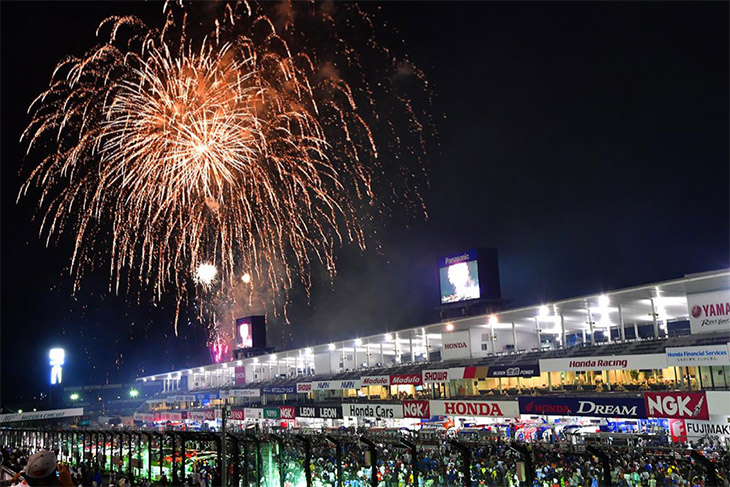
The historic final chapter in the history of Japan’s great race, the International Suzuka 1000km, will be written this weekend – and it is truly shaping up to be a must-see classic.
The 46th International Suzuka 1000km goes green on Sunday, August 27 at 12:30 PM JST (local) / 4:30 AM BST / 5:30 AM CEST / 11:30 PM EDT / 1:30 PM AEST, and will be broadcast internationally live and free on NISMO TV, and in Japan on J Sports 4.
Images courtesy of Suzuka Circuit, Toyota, and the GT Association