There is no shortage of opinion flying following the release this morning of the detail available thus far of the proposals in play for the 2020 LMP1 regulations
here are just three of the voices in the room after the announcement:
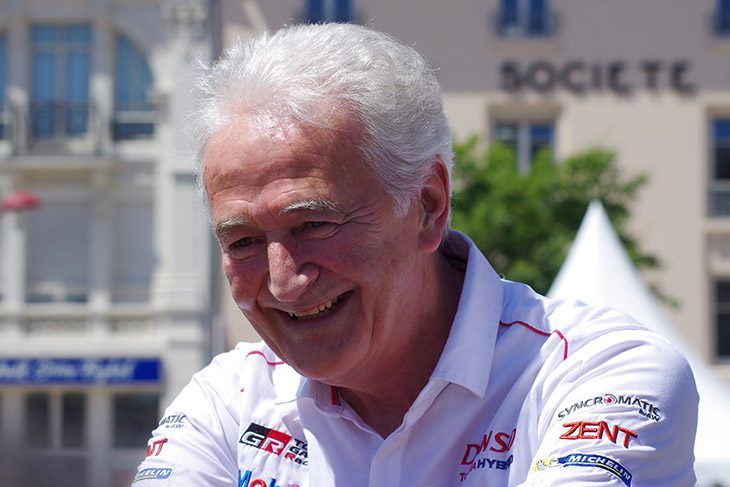
Hugues de Chaunac – founder and owner of ORECA, long-time privateer chassis constructor in LMP1, and service provider to the current Toyota Gazoo Racing LMP1 effort:
Your initial reaction Hugues?
”It’s a very good future vision for the category. Cost limitation was always the first item on the list for me and this goes a long way to deliver that.
“The success of DPi is that they have been able to control cost effectively, and now it’s part of the ACO’s approach to the future regulations for their top class.
They have learned some lessons?
“Yes, absolutely!
“The second key point is that the regulations are kept simple, relatively easy to produce cars so you do not need to do a lot of research and development.
“The new regulations will allow big teams, or a small manufacturer, to be competitive against a big OEM and we know that the fans like it when they have the big guys vs the small guys and when they have the opportunity, or the possibility, to win!”
Your team at ORECA have already been involved in the marketing of your chassis technology and wider services in the North American marketplace to OEM manufacturers – isn’t this just an expansion of that process into a global marketplace?
“ Absolutely, it helps us to get involved with a manufacturer, or to work, as we are doing now with Rebellion to design and build a complete car to fight with an OEM.”
Are the budgets that are proposed here at a level where a well resourced privateer could realistically go head to head with an OEM?
“The budget target for that market has to be 15-20 (million euro) as a top range – That is the realistic level that must be aimed for if the privateer market is to be involved.”
Wolfgang Ullrich – ex Head of Audi Sport and now special consultant to the ACO
With a huge career behind you of having the debates, and winning them, with a major manufacturer over getting the budgets required for factory motorsport programmes and for reassuring them of their relevance and marketability, how happy are you that this is a concept that will make a breakthrough with manufacturers?

“I’m very happy, because the key points of this rule book are exactly what is required for the future in all of those regards.
“It is great that the working groups could bring things together with FIA and ACO talking to manufacturers for what I think is a very nice future-orientated rulebook with all of the general ideas included.”
You said in a previous press briefing that “Hypercars are not hyper-cheap” This looks to be designed to draw a middle line between those cars and a pure racing prototype – with relevant technology but with visual relevance to road car brands?
“It’s important that we keep it on the basis of a racing prototype – It is always easier to keep it on a more controllable cost basis in that way than by converting an existing road car
“This concept gives the sustainability of the chassis, plus the bonus of adding a recognisable shape.
“I think that is very likely to bring more of a connection between the look of the cars and the spectators, that’s important for the manufacturers and, despite the fact that we have discussed it for many years, I believe we are now closer than ever before in delivering it.
“In some eras, if the teams hadn’t put different paint colours on them it would have been really difficult to see the differences between them. “Which is the Porsche, the Toyota, the Audi?”
“This rulebook should be on a completely different level.”
What about the debate about Globalisation of the new formula – is that still a realistic opportunity?
“There are constant meetings still going on, and I think there is common agreement on both sides that finding a solution on this basis that works well would be good for both parts of the discussion – I don’t think we have had a better rulebook before to have a chance of achieving that. ”
ACO Sporting Director Vincent Beaumesnil – responsible for leading the process of discussion and development of the new ruleset:
These discussions have taken 9 months so far?

“Yes, that seems like a convenient time to bring something to life!
“A lot of meetings, groups, a lot of time invested, to reach a point where we feel we have the right concept to take forward, that suits the maximum number of people to become involved.
“For me, honestly, in September last year, I though – Where can we go, what can we do? and today this has got to a point which is way beyond my expectations in the time available, and the positivity that we are seeing and hearing. I am very satisfied with this.
“I will be truly happy though only when we have a lot of cars on the grid in two years.”
And from what we are hearing there may some current LMP teams and manufacturers, some other stepping up from GT perhaps, and some new friends for the top LMP category?
“Yes, I think one of the best points of these rules for me is that it opens up many possibilities from those where the current formula would have been much more difficult.
“It is now open for OEMs, hypercar manufacturers, smaller volume manufacturers. It means too that we can say to specialist race car manufacturers like Hugues de Chaunac, “Now you can just make your new car, you can design it as you like, it can be a crazy futuristic concept”, with the fixed aero targets we are looking at it is possible – it gives the guys freedom to be more design-orientated and a little bit less to aero and performance, performance performance!
“The aero controls apply to the complete car, that definition is an upper limit (of values) which means that you don’t spend money on it beyond initial design, because there is no performance benefit from doing so!.”