It’s been over a month since the Autobacs Super GT Series has been in action. Through the first three rounds of the 2018 season, we’ve been treated to three incredibly frenetic races, with exciting action in both the GT500 and GT300 classes.
With the traditional spring break wrapped up and the 24 Hours of Le Mans now in the rear view mirror, the teams and drivers of Super GT are ready to get back into their groove, and kick off the start of the traditional “Summer Series” a three-race stretch in the middle of the summer which now looks a little different for 2018 than it did last year.
This time, the Summer Series begins with Super GT’s only flyaway event: For the fifth consecutive year, Super GT returns to the Kingdom of Thailand and the city of Buriram for their annual pilgrimage to the Chang International Circuit, which has moved from its previous date in October to a new date of 30 June – 1 July for 2018.
From the inaugural running in 2014, which was effectively Chang International Circuit’s “grand opening”, to last October’s frenetic wet/dry race, we have now started to see trends and patterns emerging from this 300 kilometer, 66-lap race. The layout of this 4.5 kilometer circuit may come across as uninspired, a “run of the mill” Grade 1 FIA circuit. But in driving it, Chang International Circuit is fast and flowing, with several long flat-out runs and high-speed corners, including the daunting, near-flatout left-handed Turn 4 that evokes memories of Suzuka’s 130R.
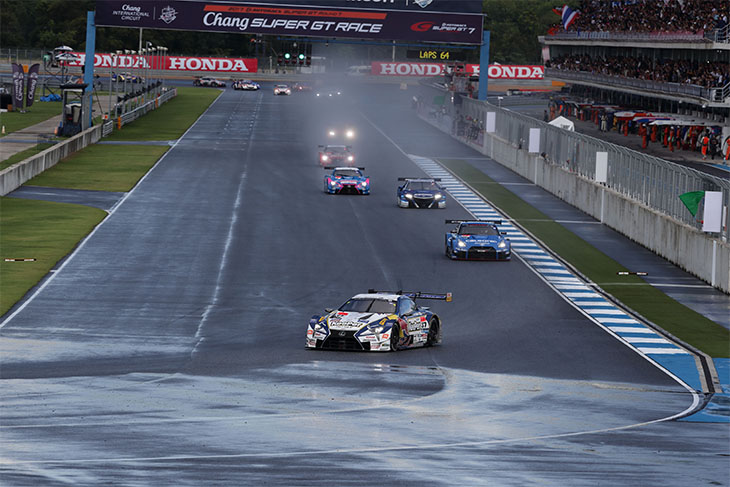
And then there’s the unique challenge of Buriram’s extreme climates. The punishing mid-summer heat will see air temperatures push 35°C and above, track temperatures well above 50°C. The only reprieve from the heat would come from the other extreme, as it is monsoon season in Thailand – so a sudden downpour as we saw before the start of the 2017 race is an element that the teams must plan for.
All of this makes Chang International Circuit a unique challenge, the one venue on the calendar that stands out as Super GT’s true “wildcard” race, where the teams and drivers do not regularly test or compete on as they do in the other six circuits in Japan.
Through three races this season, Honda have won two: The #17 Keihin NSX-GT (Koudai Tsukakoshi/Takashi Kogure) won at Okayama, and the #8 ARTA NSX-GT (Tomoki Nojiri/Takuya Izawa) won at Suzuka. A far cry from where they were two years ago, unable to win a single race with their midship NSX-GTs.

And through three rounds, it’s Team Kunimitsu’s #100 Raybrig NSX-GT of Naoki Yamamoto and Jenson Button that leads the standings, yet to win this year but heading the standings on the strength of two second-place finishes at Okayama and Suzuka.
Button’s immediate success in Super GT has been a big boost for the series on an international stage, but it’s Yamamoto who’s truly been the team’s ace this year, shouldering the big stints at the end and executing Team Kunimitsu’s brave strategic calls to near-perfection. They’re carrying a big Success Ballast handicap with their championship position: In addition to 47 kilos of extra weight, they’re also fuel flow limited, from the standard 95 kilograms/hour to 91.8 kg/h – one of three cars in the field carrying the “Stage 1” fuel flow restrictor.
Honda have yet to win at Buriram, but they’re always competitive. In the last three years, they’ve gotten an NSX on the podium. Twice, that’s been in the form of the #17 Keihin NSX, which finished 3rd in 2015 and 2017. This was also the site of Honda’s closest brush with victory in 2016, anchored by 19-year-old phenom Tadasuke Makino who finished 2nd in his GT500 race debut.
From a position of ballast, Buriram could be a race for either the #16 Motul Mugen NSX-GT (Hideki Mutoh/Daisuke Nakajima) or the #64 Epson Modulo NSX-GT (Bertrand Baguette/Kosuke Matsuura) to improve on their lacklustre form to start the season – just 2kg of ballast for each, and Mutoh in the Mugen NSX has had two podiums here, in 2015 and 2016.
The only time that the Buriram race wasn’t held in October was in 2015. And that was the only time that Nissan have won the race outright.

Thanks to victory at the Fuji 500km and a gusty drive from 15th to 6th at Suzuka, the #23 Motul Autech NISMO GT-R of Tsugio Matsuda and Ronnie Quintarelli is just a point out of the championship lead, but they too will carry the “Stage 1” fuel flow limiter and an additional 45 kilos of ballast.
Perhaps the change of dates might be refreshing for Matsuda, Quintarelli, and the “Red Car” which has had some awful luck the last two years at Buriram, including last year’s gamble to start the race on slicks which didn’t pay off, and arguably, cost them the requisite points to win the championship last season.
Look also to the #12 Calsonic Impul GT-R (Daiki Sasaki/Jann Mardenborough) which almost won, at least would have finished on the podium, were it not for a fuel system failure in the final laps. Mardenborough is still hungry for his breakthrough GT500 podium, and Sasaki scored his first GT500 podium here in 2014 with an incredible rally in the closing stint.
The other Michelin-clad Nissan, the #3 CraftSports Motul GT-R (Satoshi Motoyama/Katsumasa Chiyo), is operated by the NDDP Racing with B-Max team that won the GT300 class in 2014 and 2015. Motoyama won in GT500 in 2015, and Chiyo is still searching for that elusive first GT500 win of his own. The #24 Forum Engineering Advan GT-R (João Paulo de Oliveira/Mitsunori Takaboshi) has very little ballast, 14 kilos, and Takaboshi scored his first GT300 class win in 2015 at this event.
But through four previous races, Chang International Circuit has been dominated by Toyota and Lexus. And after the early season dominance of 2017, 2018 has seen Lexus as the odd manufacturer out, still yet to win through three races. So the sextet of LC500s will look to Buriram as the venue to get back on track, just days removed from Toyota’s greatest international racing triumph.

There is a heroes’ welcome incoming for Kazuki Nakajima, who won the 24 Hours of Le Mans for Toyota with Sébastien Buemi and Fernando Alonso, becoming the third Japanese driver (and 11th current or former Super GT driver) to win the great race, and exorcise Toyota’s 33-year hex at Le Mans in doing so.
And in his first race since that Le Mans triumph, Nakajima returns to Chang International Circuit, where he won the inaugural Chang Super GT Race in October 2014. With Lexus Team TOM’s not changing tyres on their pit stop, Nakajima and James Rossiter had the track position in hand to claim the victory that day.
This year, his co-driver in the #36 au TOM’s LC500 is Yuhi Sekiguchi, who scored his first GT500 victory in 2016 at Buriram from the pole position. Carrying only 28kg of ballast, Nakajima and Sekiguchi are solidly in the mix for the victory in Thailand.
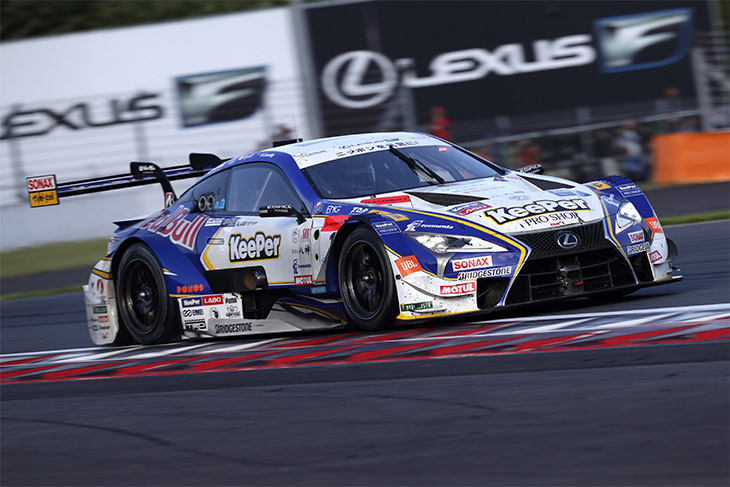
There are other strong contenders throughout the Lexus stable. Even though they’re also carrying the “Stage 1” fuel flow limiter this weekend, the #1 KeePer TOM’s LC500 of Ryo Hirakawa and Nick Cassidy won last October in a season-defining moment that would ultimately propel the young lions to the title – they’ve been consistently strong all year, looking for their first win of 2018.
Lexus Team LeMans Wako’s have finished 2nd, 3rd, and 2nd the last three years running at Buriram, and now they regain the services of Felix Rosenqvist in the #6 Wako’s 4CR LC500 alongside Kazuya Oshima. Rosenqvist may be out of the Formula E title picture, but he’s still eligible to win the GT500 title with Oshima despite missing the last race at Suzuka.
And the #19 WedsSport Advan LC500 (Yuji Kunimoto/Kenta Yamashita) carries only a slim 4 kilos of ballast heading into Buriram, where Lexus Team WedsSport Bandoh claimed their emotional first GT500 victory in 2016.

GT300 is also, as expected, a fierce competition near the top of the championship tables – and the frenetic battle for 2nd position at Suzuka that saw as many as 7 cars running tail-to-nose was a testament to the competitiveness of the “super sanbyaku” class.
Though Buriram has seen FIA GT3 class cars win three out of the first four races, the fast sweeping corners do put the JAF-GT/Mother Chassis runners on an even playing field in terms of one-lap pace, despite the supreme top speed of the GT3s down the long straightaway on the west end of the circuit into Turn 3.
After 3 races, the top 3 cars are separated by a single point. With their Fuji 500km win, the #55 ARTA BMW M6 GT3 (Shinichi Takagi/Sean Walkinshaw) owns a tiebreaker over the #25 Hoppy Toyota 86 MC (Takamitsu Matsui/Sho Tsuboi), the car that won in 2016, and drivers that have won the last two years – Matsui in ‘16, Tsuboi in ‘17. The #18 UPGarage 86 MC (Yuhki Nakayama/Takashi Kobayashi) sits one point back of them, already a winner this year at Okayama.
Meanwhile, the #0 Goodsmile Hatsune Miku Mercedes-AMG GT3 (Nobuteru Taniguchi/Tatsuya Kataoka) hasn’t enjoyed the start to their title defense that they would have hoped – just a single top-5 finish through 3 races leaves them 14 points out of first place.
Nissan won the first two races (and nearly won again in 2016) with the previous-generation GT-R NISMO GT3, this year the new 2018 model looks to claim its first Super GT win with the two Gainer team entries – the #10 co-driven by Kazuki Hoshino, who was part of those victories in 2014-15, and the #11 co-driven by Hironobu Yasuda, who was unlucky not to win the GT500 class here nine months ago.

Lexus won here last year with the car that is now the #96 K-Tunes RC F GT3 (Morio Nitta/Yuichi Nakayama), who won at Suzuka last time the Super GT series was in action. And now the Lexus customer racing presence has one of two Thai-based teams in the field: The #35 arto RC F GT3 of Nattavude Charoensukhawatana and Nattapong Horthongkum.
This has been another tough full season campaign for arto-Panther Team Thailand, but now that they’re back home, they’ll be inspired to breakthrough with a strong finish in front of their home crowd.
23 cars on the grid in GT300 this time out, but while seven of the smaller Japanese-based teams have elected to sit out due to the travel expenses, there is an additional team from Thailand on the grid this weekend.
Do not overlook the est Cola by AAS Motorsports entry (above, from the GT Asia Series), the #32 Bentley Continental GT3 of Frenchman Maxime Jousse, and young Thai rising star Kantadhee Kusiri. Their drivers are young and already have championships on their CVs, Jousse a Porsche Carrera Cup champion in France and a title contender in the Asia region, while Kusiri is the reigning TCR Asia Series champion.

The last time AAS Motorsports entered a Super GT race in Thailand, in 2014, they took a stunning pole position and were leading with less than 15 laps to go when a late puncture robbed them, potentially, of an incredible upset victory on home soil. That was with a much different car and two different drivers, but one element from that 2014 effort remains their biggest potential ace up the sleeve: The est Cola Bentley will be the only GT300 car on Michelin tyres.
There’s another welcome surprise in the GT300 grid as Super GT welcomes back Andrea Caldarelli, now a Lamborghini Squadra Corse driver through and through, to drive the #88 ManePa Huracán GT3 alongside Kazuki Hiramine – Caldarelli, who raced for Lexus in GT500 from 2012 to 2017, is replacing the absent Marco Mapelli for this round.
The action kicks off at 15:00 local time – a later start for the rest of the world, 9 AM in the UK & Ireland, / 10 AM in Continental Europe / 4 AM US Eastern time / 6 PM Australian Eastern time.
GT500 ENTRY LIST >>>
GT300 ENTRY LIST >>>
Images courtesy of Toyota, Nissan, Honda, Bentley, Goodsmile Racing, and the GT Association