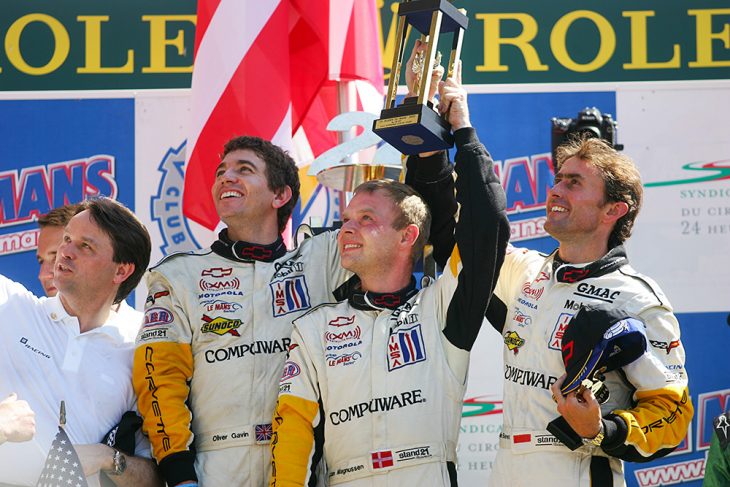
Corvette Racing contests its 20th consecutive Le Mans 24 Hours this year, but not far behind that number in terms of appearances for Corvette are Oliver Gavin (18th appearance) and Jan Magnussen (16th appearance).
Gavin’s campaigns began with the C5-R GT1 car; progressed through the C6.R GT1 car; the C6.R GT2 (as it then was, then GTE); and onto his current mount, the C7.R, with which he has contested the last five Le Mans.
The C5-R has proved the most profitable ‘Vette for Gavin, taking him to three victories and a second place in four consecutive races, but it is not the one that Gavin holds the most affection for.

“It is like picking a favourite child really and I know I am lucky to have driven lots of fantastic cars. The one I have the most rose-tinted glasses for is the C6.R GT1 car.
“It had great power, strong brakes and good downforce and it was at the time when our partnership with Michelin, although still relatively new was going from strength to strength. It felt like we were making big strides every year and making big gains.
“That car was the closest I have experienced to driving a prototype around Le Mans. Every sense that you had, it touched. The noise of that motor went right through you, the vibrations shook you, even the smell of the car and the occasional taste of carbon dust that came into the car, it was a full experience.
“The fans felt most of them too and that is one of the reasons this car and brand have been taken to the fans’ hearts, it is a ‘full-on’ sports car.

There were other significant areas of development which have been pivotal during Gavin’s tenure at Corvette racing too.
“In the 2005-2006 time when we had the extreme battles with the Aston Martin guys, it was a very hot race weekend and to be honest we were only just starting to understand the effects that high cockpit temperatures were having on us as drivers.
“That was when [the organisers] realised they needed to do something. All of the drivers in the Corvettes and Aston Martins were struggling with loss of fluids, high body temperatures and a certain amount of confusion – sometimes in the car, sometimes out of the car. But all of these things have led us to where we are today with regulation, monitoring and air conditioning. We had a side window that opened to try to get some air in and it took time to develop the solution.

“I think one of the reasons that we beat Aston Martin in 2006 is that we had a better handle on the issues than them and also their aluminium chassis transferred more heat into the car than our chassis, although we still struggled with burns to our feet! It wasn’t until the last year of the C6.R GT1 that we went fully enclosed.
“We worked closely with the road car guys to see what they had and look at how it worked.
“Then we developed and applied an air-conditioning system that was optimised for the race car and worked in the most efficient way without taking too much power from the engine.

“We have done quite a lot of work even since then and we now know that running a high body temperature is particularly nasty. We now know, from tests we have carried out, how each driver reacts to high temperatures and strategies for controlling it and recovering. Each driver has different characteristics, but if we know them and all the relevant people in the team know them and understand them, we can take appropriate action.
“Another innovation we are really proud of is the rear camera system that we brought in. I remember when we went from GT1 to GT2 regulations with the Corvette. We went from 600hp to around 500hp and it was the time when the Audi and Peugeot battles were on, so we had these prototypes flying by us and the speed difference was extraordinary. It was quite a big shock for us. All of a sudden our rearview camera system was really useful, we pretty much drove with one eye on it. It was developed with Bosch, they provided the hardware but Corvette Racing did all of the coding and now everyone has picked up on it
“One of the great things about Corvette Racing is the way that they look at each problem and how to solve it from a scientific and engineering standpoint.”
So what does 17 years of Le Mans’ experience with Corvette point to for the 2019 edition of the race?

“Last night didn’t go to plan,” said Gavin. “We had some issues and I ran over some debris and picked up a tyre failure. That upset the rest of our session and we were working hard to get back out there and achieve our night laps so we didn’t get a qualifying run.
“The weather looks set fair for today and we’ll get a chance. It is tight and close, ultimately you never really know where you are until the evening/night of Saturday. We’d like things to be a little bit warmer than it looks like it is going to be, so these temperatures could throw up the odd challenge, but we will find the solutions.”
Jan Magnussen is the experienced Dane in the sister #63 car and he had a broad perspective on his own highs and lows.
“The best thing on joining Corvette Racing is that I’ve always gone to Le Mans with a chance of winning,” explained Magnussen. “It is so much more exciting to be part of a chance of something great. But the highlights are the four wins, each of them is a highlight and the podiums are good too.
“One of the biggest lows was the podium in 2017 though, we were leading on the last lap, then got a puncture and ended up finishing third. It was absolutely heart-breaking at the time.

“Me and Antonio [Garcia] were stood in the garage with everyone else, thinking about what it was going to be like on top of the podium looking out over the crowd and then we saw what was happening and we just stood there in disbelief. I was almost hoping we would drop to fourth place so we didn’t have to go up there onto the podium at all.
“But afterwards, OK, it was a podium and that is good and whatever happens: a crash; a failure; a puncture, they make you want to come back and do it again. Le Mans really is an incredible challenge. You can be as prepared as we feel now and suddenly something happens that nobody expects.
“One thing about racing for Corvette Racing is that we have no World Championships to think about, getting points doesn’t matter, we are here purely to try to win. This is the sixth year with this car but we are still making steps every day.
“We are spending so much more time and getting so much more out of the simulator that we are perfecting the set-up changes, so we are getting the maximum out of the car. We have so much data that we know where to go with the car if the temperatures increase or if the track rubbers up a bit more.
“We just need to get the car into the middle of a window where we can make easy changes through the race that won’t lose us any time in pitstops.”