We have joined the fundraising effort to help one of the all-time greats of our sport – Vic Elford in his time of need – to support that we’re re-running two multi-part interviews with Vic – first up a three parter from our very first year, 2002 with Malcolm Cracknell, our Founding Editor sitting down with one of his all-time heroes.
Vic Elford has an unmatched record at the Nurburgring – one even better than the Editor thought. Here he explains how he came to be a Ringmeister, and provides an unmatched insight into that daunting track and the secrets it gave up to him.
And I thought his first win there was in 1968…….
“The first time I drove on the Nordschleife was in either 1964 or ’65, in a Ford Cortina. We were using it as a Special Stage on a rally. I forget which rally. It was simply one lap of the Nurburgring. John Davenport was my co-driver then and he sat back in the SportHotel and wrote up the notes, while my job was to learn it – I did about 25 laps round it in my recce car, so that was a good way to start learning it.
“Have you heard of the Liège – Sofia – Liège Rally? Also, known as the Marathon de le Route? It became impossible to run it as a rally any more, for safety reasons, so someone at the Royal Motor Union of Liège had the bright idea of running an event around the Nurburgring instead. That was the Marathon de la Route, four nights and three days, using the whole track – the Nord- and the Sudschleife.
“In ’66, Jochen Nerpasch and I led for 72 hours in an Alan Mann Lotus Cortina, until the head gasket went. We drove alternate seven and a half hour stints, starting the event at 10 pm and just driving and driving. But it was even better the following year!
“Then Hans Herrmann, Neerpasch and I shared a Porsche 911 R, the one with the Sportomatic transmission. They effectively said, “Well, Elford, you’re the rally driver, so you drive the nights and we’ll do the rest”. And that’s how we did it. I drove four consecutive night shifts of seven and a half hours, and by the end of that, I knew my way around the Nurburgring. Oh, and we won it, that was my first victory there.
“Just to give you an idea of what the circuit was like.. on the fast descent to Adenau Bridge, there was one left and three rights. It was virtually flat downhill, and I literally used to tuck the nose into the hedge, which grew right to the edge of the track. They eventually cut the hedges back to improve the visibility, so you had a stretch of grass next to the edge of the tarmac, but in the Cortina and Porsches, the idea was to use as much circuit as you could, even if that meant touching the hedges.
“In ’68, Jo Siffert and I won the 1000 Kilometres in a 908 Coupé, then the following year Kurt Ahrens and I were third.
“’70 and ’71 were the years though. I won four times in two years, taking both the 1000 Kilometre race and the 500 Kilometre one each year. I won the longer races in the 908 / 3, the first time with Kurt Ahrens, then with Gerard Larrousse in ’71. The 500 Ks were for the European 2-litre sportscars, and in 1970 I won in the Chevron B16 Coupé, which had been Brian Redman’s car. He moved up to the new B19, which broke and I won in the B16. The following year it was in the Lola T212 (below). Both times I drove alone, no co-driver.

“Perhaps you can see why it always was my favourite track, absolutely top of the list.
“Nowadays, Gilles Panizzi proves time and again that he is not just the fastest rally driver in the world, but the fastest driver on asphalt, in the world. The man is phenomenal – he regularly pulls out half a second a mile on the rest, which is an amazing difference. Rather like a F1 pole sitter being over two seconds ahead of the next man! 30 years ago, I believe I was the fastest driver in the world, and my performances on tarmac rallies back that up. I felt that I was the Panizzi of that era.
“On the ’67 Tulip Rally, I believe I was fastest on every Special Stage – or perhaps it was every stage bar one. I was in a 911 and I even beat Timo Makinen on a downhill test, which should have been perfect for his Mini.
“But, we’ve got off the subject a little. There were strong links between rallies like that and racing around the Nurburgring and the Targa Florio. I’ve done so many laps around the ‘Ring, I can still picture it now. You just don’t forget it, even 30 years on. Some corners and other features are part of the legend of the place…
“The Flügplatz is fairly early on in the lap. Cars used to get totally light there, but the trick wasn’t to just control it on landing, the art was to get it set up for the next flat out right hander, which comes the moment you get the car back down onto the track.
“At the Foxhole, you go left-right, left-right before it, never able to see the next curve coming, then you went into the huge compression, and then back up the other side. But once you got back up to the top of the ridge, there was a left hander, right there. Many cars would get to the top and go straight on, so the organizers were going to modify it, but that brought complaints from a local bodyshop owner, a Mr. Martini, who insisted that this would be changing the character of the track! Of course, with the track the way it was, it was pretty good for his business.
“After the bridge at Adenau, there’s a long fast run uphill toward the Karussell. There’s a slight left-hander, taken in fifth, and then you take off. But you don’t ever get further than about nine inches off the track. Because of the shape of the land, you stay nine inches up for about 40 metres, effectively following the contours.
“First year there with the 908 and I found out that the aerodynamics weren’t quite right. I took off, and the car just kept going up. I passed the edge of the track three feet up, passed over Reiner Schlegelmilch, who was lying there taking photographs, and piled into the bushes. They were very effective at stopping you, actually.
“That same year, again in testing, Siffert and I were in 908s, approaching Brünchen which means literally “little hump back bridge”. We used to take that at about 60 mph, with a little ‘whoop’ into the air. But because of the aerodynamics, we both took off, the cars went almost vertical and both landed on the rear jacking points. We both dropped back down on our wheels and made it back to the pits. The engineers didn’t believe us at first, until they saw the bent jacking points! They fitted some flaps at the front after that.
“In 1969, Gardner and Piper drove a 917 in the 1000 Ks, and although they were really treating it as a long distance test, they got to the finish. The car was evil then, but by the following year, Porsche had made massive progress with it. But they had been developing the 908 / 3 too.
“Jo and I did a lot of the testing, and we there at the ‘Ring in 1970, testing the new 908 / 3 against a 917, just to be sure that the 908 was the right way to go. They’d just held an F2 race, so work was going on to tidy up afterwards. We were told we could only go testing until midday, so we started very early. We would do a couple of slow laps making as much noise as possible to make sure the wildlife knew we were there, then we’d go to work. I was in the 917 and got to Pflanzgarten, where the road is a series of little humps, each one stopping you seeing what’s ahead until you get there. I came over one brow at about 160 or 170 mph and there was an eagle in the road. It started flapping, but there was no way he was going to get up and out of the way quickly enough. He’d got about 12 inches off the road, flapping furiously, when I hit him. It totally destroyed the front of the car, and shattered the windscreen.
”’I hit a bird,’ I said, when I limped back to the pits. The Germans fell about laughing, because the front was such a mess. We had to go out to Pflanzgarten and show them the bird before they believed me.
“The 917 was just too big and bulky for the Nurburgring (and the Targa Florio), so we went to the Targa with the 908 / 3, which was so nimble and light. I was driving for the Austrian team that year, and John Wyer thought that he had first refusal on any development work. He thought he was going to have 908 / 3s and I wouldn’t have one.
“But Piech said that I was the Targa man and had to have one, which we also used in Germany. As an aside, when we were in Sicily for the Targa in 1970, Porsche wheeled out a 917. I was asked to do one lap in it, just to see what it would do. I set the third fastest time…but afterwards I was a total wreck, physically and mentally. It lurched and leapt everywhere, bouncing all over the place. It was totally unsuitable.
“So Ahrens and I won the ‘Ring in 1970, but by ’71 Ickx had the 312P and we were well down on power compared to the Ferrari. We had a weight advantage of course, because those 908 / 3s were very light, but we had maybe 375 bhp compared to the Ferrari’s 450. But we made it to the finish (and won! – three images below) and the Ferrari blew up or something.

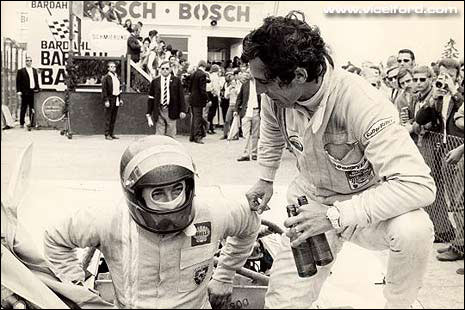
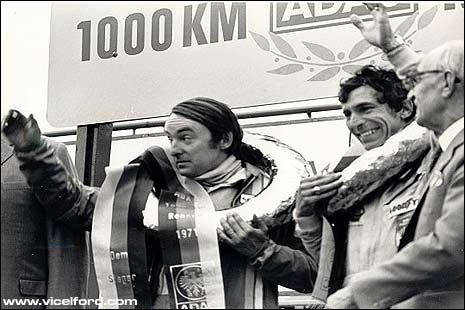
“Throughout that period, we would lap the Nurburgring each year in more or less F1 times from each previous year.
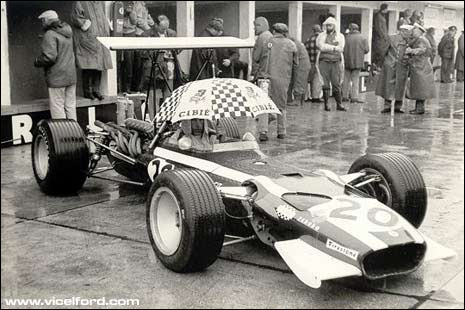
“My first F1 race was with the Cooper in ’68, starting last, but finishing fourth at Rouen in the rain. At the Nurburgring (above), it absolutely pissed with rain, the conditions were just dreadful. I was sixth or seventh, trying to pass Jack Brabham, when I made a mistake approaching the little Karussell and crashed.

“The next year was with the Antique Automobiles McLaren (above, at Zandvoort), and I started fifth on the grid. But I made a lousy start and was passed by Andretti and Beltoise. Mario was in the 4WD Lotus, and they’d had such a hard time in practice, they’d never run the car on full tanks. Just before Brünchen, at about 90 mph through a long sweeping corner, Mario bottomed out and he went off, ripping two wheels off in the process, against the fence posts.
“One wheel rolled back across the track, and Beltoise just squeezed through. I was right behind him and had no choice but to hit it with my left front, which made the car leap into the air…..I took off, 30 feet up, and did a long, lazy roll into the trees.
“I ended up upside down, jammed in the cockpit, scrambling about to find the fire extinguisher button with my right hand, because I could smell fuel. But I couldn’t get my right hand to work, so I tried reaching across with my left, but couldn’t reach far enough. There was no longer a fire extinguisher there, it had been ripped off – only two wires waiting to make a short circuit – so thank goodness I couldn’t reach the button!
“Eventually the marshals came and found me, but my right arm had been almost ripped off. The arm is held in place by all sorts of ligaments and tendons, and it was a right old mess. It took me weeks of physiotherapy to recover from that. And I still cannot lift my right hand far above my head.
“Did the Nurburgring frighten me? Absolutely not. I was fascinated by the place. In those ‘Marathon’ days I just said to myself that I’m going to learn this road and I’m going to be the best driver around here. I couldn’t wait to go back, every year, I was so thrilled to be racing there.
“’71 was my last win there (of the six) and I ended up doing other types of racing, but it was (is) the greatest challenge of them all.”
All archive photos from the excellent www.vicelford.com
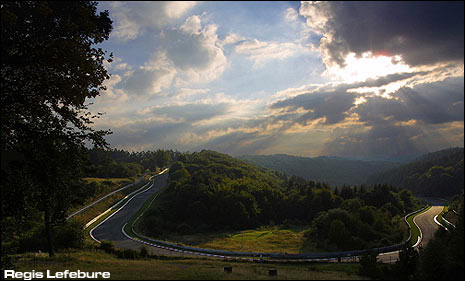
The final image is by Regis Lefebure – “the photo is from near the Steilstrecke, above Klostertal, showing the big horseshoe bend and the climb to the Karussell.” A photograph that does justice to the full splendour of the Nurburgring.
If you enjoyed this story please take a look at the Go Fund Me page established to help Vic with his current medical expenses