Peugeot Design Director, Matthias Hossann, has been given some free reign with the brand’s 9X8 Hypercar to show off its startling design.
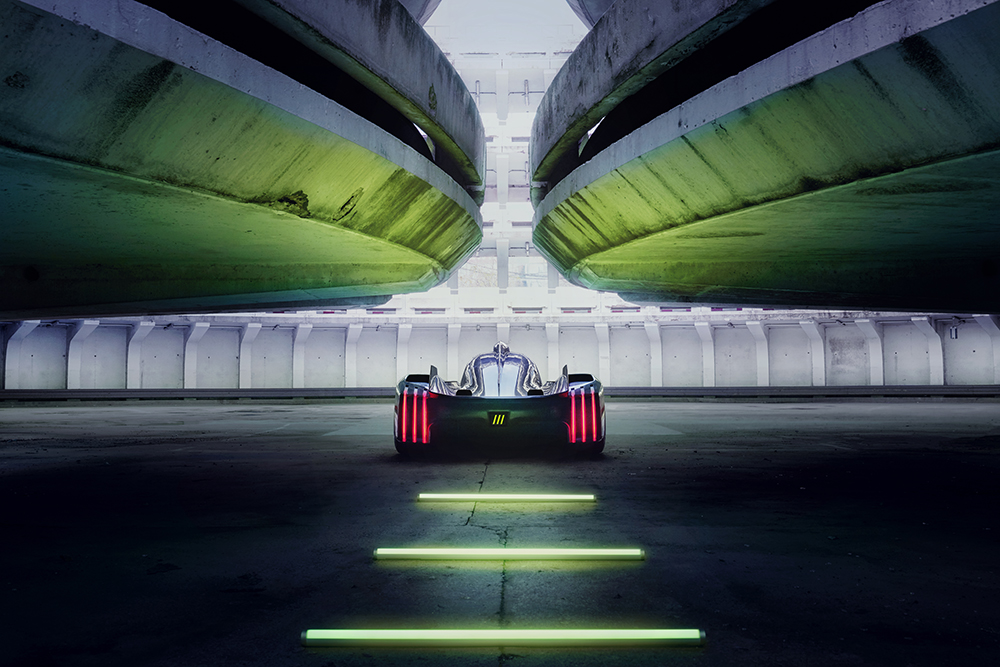
A series of images, placing the 9X8 amongst brutalist architecture have been created by fashion and supercar photographer Agnieszka Doroszewicz.
For the 9X8, engineers and designers worked very closely together to achieve a convergence between style and technology to create a competition vehicle. “The level of discussion was absolutely unprecedented”, said Matthias Hossann. “We worked hand in hand with the PEUGEOT Sport team.”
“To identify the theme for our future race car, we first launched a competition between the designers. We received a lot of submissions as this project aroused massive enthusiasm, with the prospect of one day seeing our creation compete against the world’s most prestigious brands on the most historic tracks.”
“We developed the theme in collaboration with Peugeot Sport engineers, and set to work. The Peugeot 9X8 was born with the DNA of the new Hypercar regulations (LMH) set by the Automobile Club de l’Ouest, the organiser of the 24 Hours of Le Mans, and the FIA. The new regulations, and the fundamental traits of PEUGEOT, mean that this car will stand as a milestone in the history of Endurance racing.”
The 9X8 was also the literal launch vehicle for a new iteration of the brand’s roaring Lion badge, prior to its appearance on the PEUGEOT 308. The badge will be found on all future PEUGEOT models.
The 9X8’s cabin breaks new ground in recent sportscar cabin design, based on the marque’s i-Cockpit road car concept, the entire cockpit of the Peugeot 9X8 was designed to provide the highest level of ergonomics and intuitiveness for drivers.
“On the walls of the design studio where the Peugeot 9X8 was born, we had posted three key words: iconic, efficient, emotional,” says Matthias Hossann. “This way, the whole team embraced these concepts, regardless of each individual’s involvement across the various development stages. I had put the word ICONIC in everyone’s mind, because I wanted a car that was both immediately recognisable and that marked a breakthrough, a fundamental generational shift.”
“Despite the quality of the many proposals that came out of our internal design competition, one was quickly established as the chosen theme. It broke the codes of the previous generation of endurance cars. The idea posited was that this would be less of a previous generation race car and more identifiable as a Peugeot. It needed to bring together more than just fans of motorsport, as this would be a sports car that could in theory be driven on the road as well as the race track.”
The most striking feature of this conceptmis the absence of a rear wing, which gives it its unique profile.

The rear wing first appeared in endurance racing at Le Mans in 1967 and has since become the prevailing standard. No car has won without a rear wing for over 50 years, in 1971.
When the 9X8 was created, a huge amount of effort was put into the rear end. Following the original sketch of a somewhat pouncing car, a pointed cabin appeared, along with the very particular wrap that we see today over the rear wheel.
Peugeot has already won at Le Mans with two cars of two different generations: the 905 with a V10 petrol engine in 1992 and 1993, and the 908 with a V12 HDi-FAP engine in 2009. Whilst corporate priorities prevented a tilt at the title with a hybrid in the LMP1 era, they are now ready to challenge in the HyperCar field.
It combines a V6 2.6-litre twin-turbocharged 500 kW (680 HP) internal combustion engine at the rear with a 200 kW (270 HP) electric motor/generator in the front.
Olivier Jansonnie says, “With the 9X8, PEUGEOT is starting a new chapter in hybrid sports cars. Performance is becoming more electric and more virtuous, without sacrificing anything in terms of competitiveness.”
“We wanted to signify this technological and cultural shift with a new colour signature, which we have called Kryptonite,” adds Matthias Hossann. “We had already launched it shortly before our Hybrid Hypercar 9X8 on our new series model, also a hybrid: the 508 PSE (Peugeot Sport Engineering). It shares its colour and many technology features with the Peugeot 9X8. Within a few weeks of each other, both have brought the brand into the era of electric high-performance.”
Luminosity!
“Our design team includes fans of the 24 Hours of Le Mans. Having been there as spectators, they know that at night, trackside, the cars have few distinctive signs. Some cars can be recognised by the sound of their engines, but in many places, the cars’ visual presence is mostly limited to bright lines fading away into the night.”
“To ensure that the Peugeot 9X8 is unlike any other and can be easily identified day and night by everyone, we added luminous components to our work on the silhouette. For the light signature, the three claws – present on all our current production cars – was the obvious choice. Integrating them into the design at the front was much easier than doing so at the rear. We’ve integrated the three light claws in separate composite components creating gaps through which air is extracted. We can’t wait to see their effect on the track.”
Agnieszka Doroszewicz immediately recognised the potential of the Peugeot 9X8’s light signatures: “We really wanted to spread our shoot over a long day, and extend it late into the night,” she says. “I was able to achieve a perfect evocation of the Le Mans 24 Hours in my photos. Daylight, artificial lighting and the bright illumination of the headlights combine with the powerful pattern of the car’s light claws. Of course, we are not in Le Mans at all, but it is the whole atmosphere of Le Mans that we have here.”
Based in Hamburg, Germany, Agnieszka graduated from the University of Applied Sciences in Photographic Design and has been freelancing since 2007, she is involved in both photo shoots and post-production.
“I have often been invited to work at Le Mans and other 24-hour races, such as Nürburgring (Germany) and Spa (Belgium). But Le Mans is historically the most compelling and my absolute favourite. The atmosphere, the excitement and the tension are palpable, and of course you feel the history of this race in every pore. You can’t escape it. Le Mans is one of the purest and most ultimate forms of motor racing.”
“Each photoshoot has its own anecdotes. Here, with the 9X8, it was terribly cold. But nothing could cool Matthias and his team’s passion in being part in the whole shoot. Their presence was highly motivating, as we took advantage of the opportunity to engage in a real discussion. The shoot was absolutely fantastic, the contrast between the pure aesthetics of the Peugeot 9X8 and the brutalist architecture was impressive, and the rough patina of the concrete’s texture was perfectly evocative of the world of race tracks.”