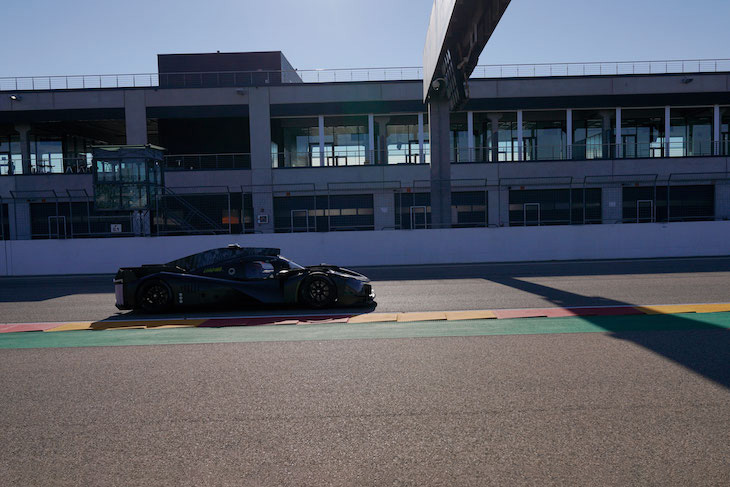
Peugeot Sport’s Team Peugeot TotalEnergies’ programme with the PEUGEOT 9X8 is back on track this month with a resumption of testing after last month’s roll-out.
The team have though confirmed that the cars will not race at the 2022 FIA WEC season opener at Sebring in March though they have not yet confirmed where and when the car will first race, that decision will be made based on progress with testing and development of the car.
“Team PEUGEOT TotalEnergies will not attend the first of the six rounds that make up the 2022 calendar which kicks off at Sebring in Florida,” notes Stellantis Motorsport Director Jean-Marc Finot. “The 9X8 will make its race debut based on its level of readiness, reliability and competitiveness as agreed with the championship’s organisers who we will keep regularly updated as our development programme progresses. We could have opted for attending selected races only without committing to the season. That would have been possible but less coherent. Instead, we have chosen an approach that will enable the team to be fully immersed in the discipline, resulting in much closer collaboration with the organisers even if the 9X8 doesn’t contest every race as our development work and the homologation process continue.”

Beyond that open question the other big ‘unknown’, prompted in no small part by the publicity from the team of the 9X8 rollout, is whether the car is set to race, as it was presented in concept form, with no rear wing?

“This configuration is permitted by the ACO/FIA hypercar regulations,” says Olivier Jansonnie, the Technical Director of PEUGEOT Sport’s WEC programme.“ Our calculations and wind tunnel work have confirmed the pertinence of our decision to run without a rear wing. Along with the developments and settings this option calls for, we expect it to be validated as we test at different circuits with differing characteristics.”

The test and development programme to validate that sim data, as well as all other key performance aspects of the cars design is programmed towards the team’s application for the PEUGEOT 9X8’s homologation being submitted to the sport’s governing body.
She made you talk as a prototype… Watch her evolve into a race car.#Peugeot9X8 | #PioneeringPerformanceAgain | @TotalEnergiesRC | @Michelin_Sport | @FIAWEC | @24hoursoflemans https://t.co/CQUMrURv4v pic.twitter.com/dz1htX7P4o
— Peugeot Sport (@peugeotsport) January 18, 2022
As with Toyota and Glickenhaus before them, Peugeot is very aware that once locked in the homologation is applied until 2025, presenting a car that is in the performance window for the BoP process that will apply, is an ex=ssential part of the testing process.
Peugeot have confirmed too the reasoning for the selection of race numbers #93 and 94, “the figure ‘9’ has long been associated with the brand’s most radical cars, while ‘93’ recalls the year the 905 claimed a landmark one-two-three triumph at Le Mans, and that number is obviously followed by ‘94’”.

Finally, there is a clarification of the programme’s progress thus far:
April 2021: first dyno test of the bi turbo V6 engine,
November 2021: first bench test of the 9X8’s 200kW motor-generator unit,
December 2021: assembly and bench test of the complete powertrain in four-wheel drive mode,
Late-December 2021: maiden track run.
Peugeot’s selection of the LMH ruleset for the FIA WEC’s Hypercar class reflects the company’s priority to highlight a commitment to sustainable mobility. Designed and developed entirely by Peugeot Sport, the 9X8 powertrain combines a rear-mounted 2.6-litre bi-turbo petrol V6 that delivers more than 500kW (680hp), a front-mounted 200kW motor-generator unit, all-wheel drive transmission and a high-density battery developed jointly by Peugeot Sport, TotalEnergies and its subsidiary Saft.