The ‘reveal’ yesterday of the Dutch ‘Forze IX’ Hydrogen fuel cell racer makes this feature, prepared a little while ago, even more relevant!
The adoption of the LMP3 formula as an entry-point to international sports prototype racing was a game changer for many teams and drivers, the cost-capped package proving to be an opportunity for car owners and teams to get a foot onto the ladder that was simply impossible previously.
The LMP3 formula is based around a spec. powertrain package, matched with a closed market of choice of chassis, the entire package, and several elements of it, cost-capped by regulation.
And it’s that component cost-capping that has seen this entry-level tech prove to be an astonishing platform for some of the most cutting edge technology every to be seen on a race track, as a variety of teams and institutions look at the most accessible platform to build experimental cars that could change the racing world as we know it.
The chassis are available, since the revised 2020 regulations, from four licensed suppliers – Ligier, Duqueine, Addess and Ginetta.
All follow the regulatory-defined structure of a carbon fibre tub with a steel roll cage providing excellent crash protection as well as valuable cockpit space (an LMP3 has space for a second seat or, very valuably for some of the experimental applications that the chassis have seen, additional equipment and instrumentation!).
Ginetta’s initial 2015 design was utilised almost from the start by the UK-based manufacturer as a basis for spin-off products including the G57 P2 with more advanced aerodynamics and a more powerful Chevrolet V8. The car was later developed into the successor G58 with a Ginetta built V8.
Ligier’s major spin-off went in the other direction in performance terms, the JS P4 designed as a club-level racer and now seeing service on the international front as one of two classes in Ligier’s single make Ligier European Series, which runs on the ELMS support bill across Europe.
One other notable application for the Ginetta chassis with a conventionally powered car was a test mule for an abortive Bentley IMSA DPi programme.
The programme progressed to outline design and engine proving stages, the Ginetta chassis tested a number of times with a development of the brand’s V8 Turbo power plant as used in the Bentley Continental GT3. After the programme was curtailed the car sat in the Ginetta factory for a significant period – The whereabouts of the car are unknown.
Beyond those test duties though there are a number of other, very different applications that have turned to the basis of an LMP3 chassis to literally get on track – and these have included some truly cutting edge projects utilising Hydrogen Fuel Cell, Full EV, and even autonomous vehicle technologies.
H24 – Hydrogen Electric – Adess
Probably the best known is the ACO-backed H24 project, pulling together a partnership of technical know-how to prove the concept of Hydrogen fuel-cell technology in a racing environment – tackling the technical challenges of weight, cooling, and fuelling/ filling infrastructure ahead of the proposed introduction of a set of regulations that should see at least one OEM effort fielded to run at race leading pace at the Le Mans 24 Hours by 2025.

For now though the targets are significantly more modest, trying to get an LMP3-chassied vehicle to reach BOPed GT3 pace.
The first, 2018, demonstration vehicles were based on the Adess LMP3 chassis, dubbed the LMPH2G. Two cars were built as technology demonstrators with input from project partners GreenGT, Michelin Symbil, TOTAL, Plastic Omnium, Richard Mille, and Dietsmann.
Weighing in at over 1400 kilos in their first iteration, they proved an effective starting point to prove and develop the necessary technologies.

1. Electric motors: Four electric motors on the rear wheels (two on each) provide propulsion.
2. Three hydrogen reservoirs: The dihydrogen (H2) is stored in three pressurized (700 bars) carbon filament tanks used to fuel the cell. The first two are placed either side of the cockpit and the third just behind the driver – Total Hydrogen capacity is 8.6 kg.
3. Hydrogen fuel-cell: Comprises four stacks, at the core of which molecules of dihydrogen (H2, stored in the tanks) and oxygen atoms combine to form water molecules (H2O). This reaction produces heat, and electricity, which powers the car’s electric motor.
4. The stack A layered pile of 230 cells, bipolar plates and hydrogen porous membranes.
5. Air Intake: The ambient air used to produce the reaction within the stacks enters through this vent. It is filtered, propelled towards the compressor, then the humidifier, before entering the stacks.
6. Buffer batteries: Excess electricity produced by the hydrogen fuel-cell and by the KERS system (when braking) feeds into high-performance cells. The driver can therefore double the car’s acceleration potential (250–480 kw, the equivalent of 653 hp).
7. Transmission: A special, clutchless one-gear gearbox manages rear wheels independently and is designed to reduce grinding with an electronic torque management system.
8. Compressor: Compresses and accelerates the air that enters via the vent (up to 300g per second). It operates at up to 100000 revolutions per minute. The modulation of the air flow injected in the stacks alters the reaction and therefore determines the amount of electric power produced.
9. Humidifier: Humidified air improves the interaction between oxygen atoms and dihydrogen molecules. The humidifier ensures the level of humidity of the air injected in the stacks remains constant.
10. Radiators and cooling system
11. Exhaust: The only emission produced by the GreenGT LMPH2G is water (H2O). Steam escapes through four vents (one per stack) to the rear of the car, in the middle of the aerodynamic diffuser
Le Mans in 2020 saw a new car revealed, now dubbed the H24.

The new car is again based on the Adess chassis but with more power, lighter weight (c.150 kilos lighter), improved ‘Saft’ developed battery cells, and more advanced cooling and aero. The 4 motor powertrain of the earlier LMPH2 has been replaced by an improved 2 motor system, still providing drive to the rear axle.
The pandemic slowed the intended programme but the new car was running in Free Practice sessions for the Michelin Le Mans Cup towards the end of the 2021 season accompanied on its travels by the road transportable filling station developed by TOTALEnergies.
Forze – Hydrogen Electric – Adess
Remarkably there is a second, completely unrelated, hydrogen-electric sports prototype development programme, perhaps even more remarkable that team too has opted to base the most recent versions of their technology demonstrating racer on an Adess LMP3 chassis!
Evolved from a Formula Student effort, the team, based at the Dutch Delft University of Technology have been steadily improving their cars over several years.
Their initially single-seater-based designs gave way to utilising the Adess when the lack of an FIA license for their ‘Forze VI’ car prevented them from taking the step to entering their cars against more conventional machinery in real races.
That was solved by building the successor vehicle around a crash-tested and homologated Adess chassis tub.

The new ‘Forze VII’ would then become the first hydrogen race car ever to compete against fossil fuelled combustion vehicles in an official race, running in a 45 minute Supercar Challenge race in 2017 during the Gamma Racing Days on the TT Circuit Assen, though only able to sustain running for 30 minutes due to fuel capacity restrictions.
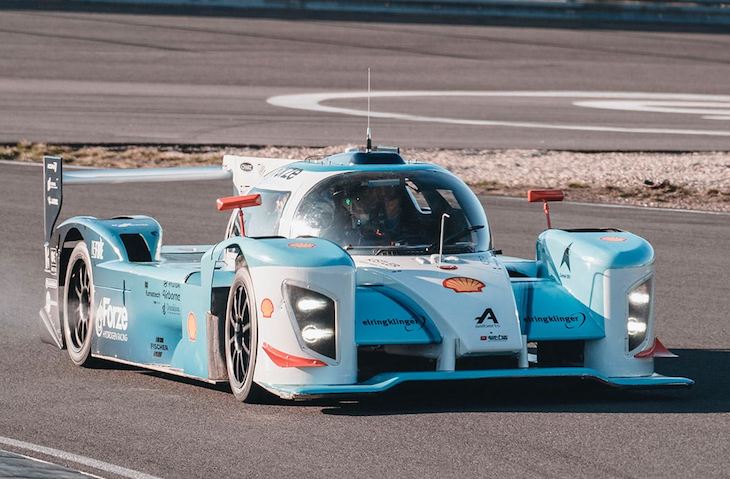
In 2018 though a further evolution, the Forze VIII drove a full 60-minute race at the same meeting. With even further development the same car returned in In August 2019 and came in second place in class.

That progress caught the eye of Hyundai, heavily tipped to be the OEM most likely to adopt the forthcoming Le Mans Hydrogen regulations, the South Korean manufacturer, through the Hyundai Motor Europe Technical Center (HMETC), located in Rüsselsheim, Germany, now partners the Forze team to help develop their latest Adess LMP3 chassised Forze racer, the Forze IX. They join an impressive industry ad business alliance in supporting the Dutch team’s efforts.

Revealed just yesterday, The Forze IX has two fuel cell systems in the 1,500 kg four wheel drive car with a total combined power of 240 kW. The car has a top speed of 300 km/h and accelerates from 0-100 km/h in less than 3 seconds.
InMotion – Fast Charging Full EV – Ginetta
Another high tech effort based in The Netherlands, the InMotion team are targeting an early opportunity to run at the Le Mans 24 Hours in the Innovative Car slot, previously known as ‘Garage 56’.

The team, based at Eindhoven University of Technology, has been using a Ginetta chassis as the basis of its technology demonstrator, dubbed the ‘Revolution’ though the effort plans a more advanced chassis ahead of commitment to the Le Mans project.
The major technological step that InMotion are targeting is reliable and safe fast EV charging. The team claims it will be able to fully charge a vehicle in two minutes using a two 600kW chargers within the next two years.
As a yardstick to the uninformed on EV capabilities in the marketplace at present – that’s more than 14 times the speed of a standard rapid charger and almost six times the speed of a current, state-of-the-art 120kW Tesla Supercharger.
At present their Ginetta-based test vehicle can charge from 20-80% in seven and a half minutes using one 350kW charger.

The team’s proposed ‘Vision’ racer is aiming for lap times faster than the current pace in GTE Pro and stint lengths of around 45 minutes, if the 2 minute charging window can be reached, their pit stops should be close to those achieved with a full service elsewhere on the grid!
There are significant technical hurdles to be conquered before the project can reliably, and safely, meet its performance targets. Once again though the LMP3 chassis is providing a firm basis for a hard pressed test mule.
Robocar DevBot – Autonomous Vehicle Tech – Ginetta
The Robocar programme has been pushing the boundaries of autonomous vehicle technology for several years and is yet another high tech operation to base its technology demonstrator efforts on LMP3 chassis.
Indeed the Roborace operation have obtained quite a number of Ginetta chassis for their full EV ‘DevBot’ cars which have garnered a huge amount of media and academic attention as the team work hard to prove the viability and attractiveness of autonomous vehicle tech.

Development started in early 2016, with a first outing of a Ginetta-based test vehicle, the ‘DevBot’, coming during the pre-season tests for Formula E at Donington Park in August 2016.
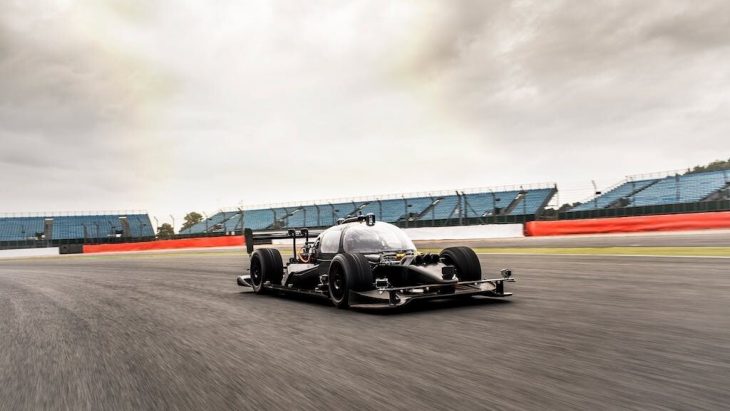
The programme has had ups and downs, a very public failure in Hong Kong during the Formula E meeting was followed by successful runs at Marrakesh.
Into 2017 and the team staged a partially successful test race between two DevBots ahead of the 2017 Buenos Aires ePrix, one of the pair though crashed out.
The team is moving forward with more advanced chassis but the Ginetta-based cars are still very much the workhorses of the technology’s development for the programme with the ‘DevBot 2.0’ still looking very much the LMP3 part (pictured Top!!)