

When Japanese constructor apr first unveiled their GT300 class Toyota Prius race car prior to the 2012 Autobacs SUPER GT Series, they had written the first sentence in the story of modern SUPER GT’s most fascinating race car.

apr had won multiple championships in SUPER GT using the third-generation Toyota MR-S (MR2) in 2002, 2005, and 2007. When the MR-S was retired, the Corolla Axio sedan became their new flagship GT300 car, and won several races in its own right.
The new Prius made history, as the first hybrid vehicle ever to race in SUPER GT, when it debuted in time for the start of the 2012 season.

The first iteration of the GT300 Prius was built upon the third-generation ZVW30 model. As a JAF-GT300 (now GTA-GT300, or simply GT300) specification racer, only the cabin bulkhead of the five-door Prius sedan remained as a sophisticated racing car was built around it. It was a mid-engined, rear-wheel drive vehicle just like the MR-S and Corolla Axio which preceded it.

The hybrid system was derived from components found in civilian Toyota models, the motor from the Aqua subcompact, the lithium-ion battery from the Prius Alpha MPV, and the ECU from the Camry sedan.
It was coupled to Toyota’s dependable 3.4 litre RV8K engine, a detuned version of the V8 engine which was already powering their fleet of Lexus SC GT500s, the Rebellion Lola B12/60, and the new Toyota TS030 LMP1 Hybrid in the WEC.
Three-time GT300 champion, Morio Nitta, joined third-year GT300 driver Koki Saga as the two drivers who would run full-time in the No.31 Toyota Prius.

After capturing a first pole and podium at Fuji in 2012, the duo of Nitta and Saga captured a come-from-behind victory in SUPER GT’s annual Golden Week classic, the Fuji 500km, in 2013.
This was the first win for a hybrid vehicle in SUPER GT/JGTC history – a memorable win after an early spin dropped them to as low as 18th in the running order, before coming back to take the lead with nine laps remaining after an issue for the rival Honda CR-Z GT300 of Team Mugen, with its bespoke racing hybrid system.

In those first three seasons, Nitta and Saga combined for five podiums – including their breakthrough Fuji 500km win, and a runner-up finish in the 2014 Suzuka 1000km endurance race – and two pole positions. They ranked eighth in the GT300 Drivers’ championship twice in 2013 and 2014, as unfortunate reliability issues hampered them from making a more serious title push.
Changes to the programme were made in advance of the 2015 season.
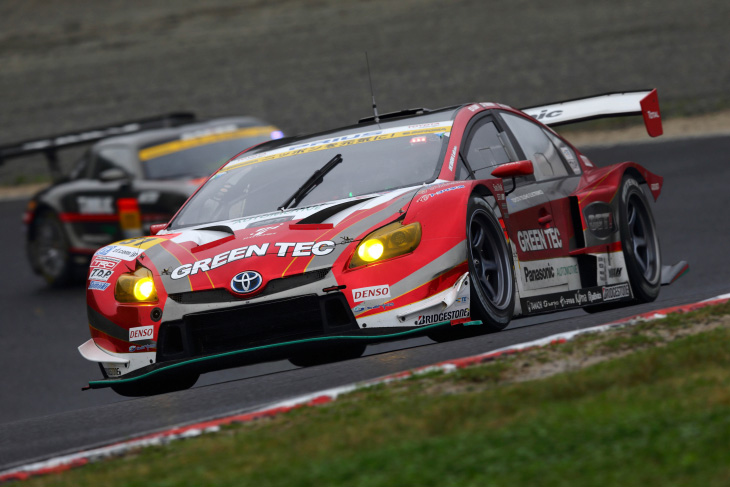
While the base vehicle remained the same, the team switched tyre suppliers from Yokohama to Bridgestone. Nitta left the team, promoting Saga to the role of “lead driver” and opening a spot for Toyota Young Driver Program (TDP) prospect Yuichi Nakayama, previously the team’s third driver for the Suzuka 1000km, to run full-time.

The season was bookended with victories in the first and last races of the season: The combination of the hybrid Prius’ downforce and Bridgestone wet weather tyres helped them dominate the opening race at Okayama. At Motegi, they converted pole to victory even after an ill-timed Safety Car disrupted their pit strategy.
In between, were a memorable three-way scrap for second in the Fuji 500km, where the Prius finished fourth after a last-lap spin, and a runner-up finish at Sportsland SUGO.
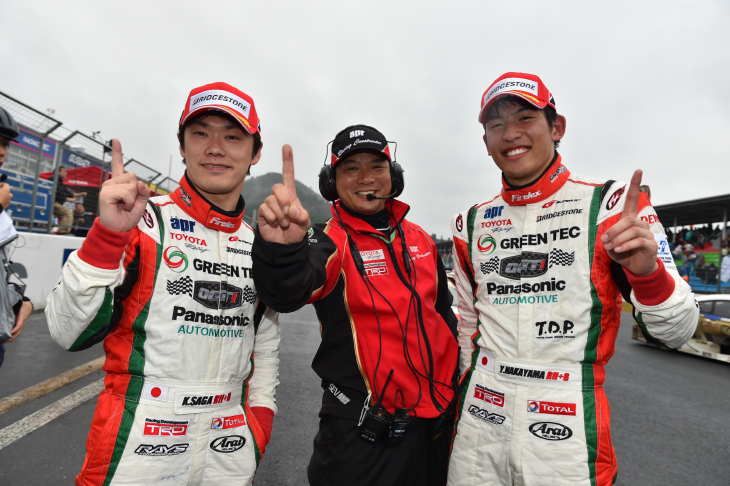
Saga and Nakayama finished the season joint-third in the drivers’ standings, behind champion André Couto and runner-up Katsumasa Chiyo. The No.31 apr team finished second in the teams’ table, trailing only the No.10 Gainer Nissan GT-R of Couto, Chiyo, and Ryuichiro Tomita.
Following the season, apr announced the ZVW30 Prius would be retired. New regulations for 2016 would require new JAF-GT300 vehicles to have the same drivetrain layout as their production counterparts, which meant that a new Prius had to be built as a front-engine vehicle.
apr had their second-generation Prius GT300 built and homologated on 30 December 2015, two days before the new rule would have gone into effect – which meant that the ZVW50-derived Prius GT could retain its midship layout.
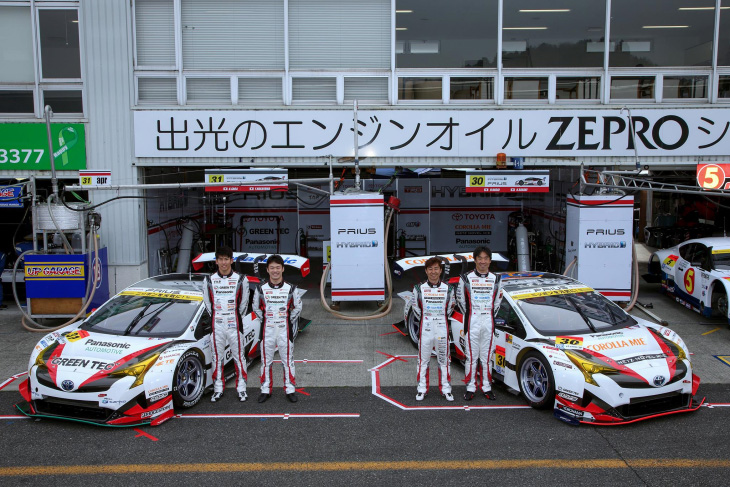
The launch of the second racing Prius also saw the addition of a second entry, a Pro-Am car driven by 2005 GT300 champion Kota Sasaki, and Toyota Corolla Mie dealership president, Hiroaki Nagai.
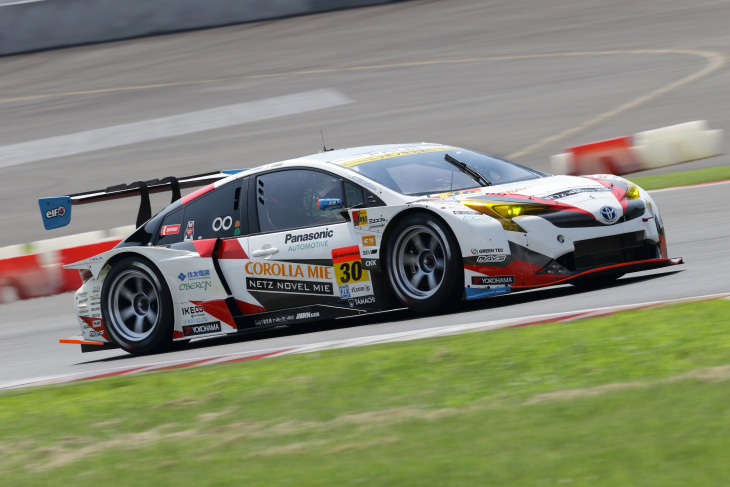
The No.30 Prius, which used the lithium-ion battery hybrid system and ran with Yokohama tyres, finished ninth at the Fuji 500km in just its second race. Nagai and Sasaki ended the season 24th in the Drivers’ standings, and the No.30 apr crew finished 18th in the Teams’ championship.

Saga and Nakayama returned to drive the Bridgestone-clad No.31 Prius, which not only had a new body and chassis, but a new, more advanced supercapacitor hybrid system derived from the ones used in Toyota’s TS030 and TS040 Hybrid prototypes. This change also allowed the Prius to run as a hybrid vehicle when the series traveled outside Japan, something which wasn’t possible with the li-on battery setup.
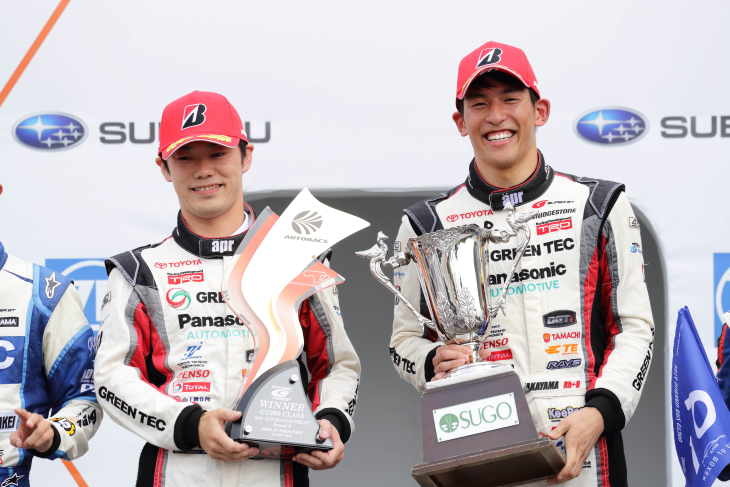
The new and improved No.31 Prius claimed victory in an accident-shortened race at Sugo, the third win for the duo of Saga and Nakayama. They finished second in the Suzuka 1000km, and again in the second leg of the doubleheader finale at Motegi.
Those results would add up to Saga and Nakayama finishing runner-up in the GT300 Drivers’ championship behind Takeshi Tsuchiya and Takamitsu Matsui, of Tsuchiya Engineering. apr finished second in the Teams’ championship for a second consecutive season.
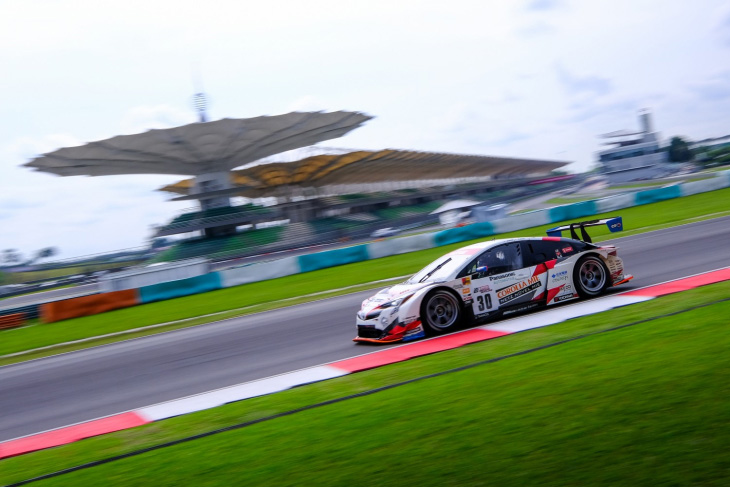
apr also took the No.30 car to the 2016 Sepang 12 Hours, with Nagai, Saga, and Sasaki sharing driving duties. This marked apr’s only appearance in the Intercontinental GT Challenge with the GT300 Prius, entered in the GT3 Pro category – and the only appearance in a non-SUPER GT event.

With Nakayama’s departure in 2017, sophomore Rintaro Kubo joined Saga in the No.31 Prius. A frustrating season limited the flagship car to just one podium finish.
apr sought a more experienced driver for the next season – they found one, in two-time GT500 champion Kohei Hirate, recently displaced from Toyota’s factory ranks.
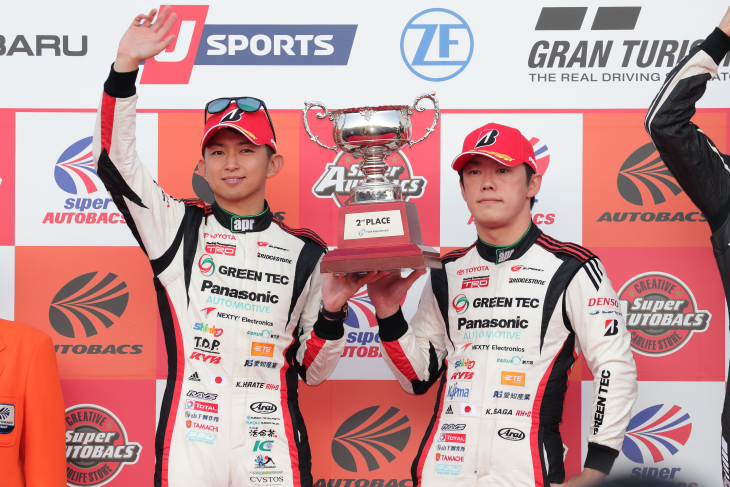
Hirate immediately led a resurgence in form for the No.31 Prius, taking four podium finishes – three second places, and one third place – as they finished third in the Drivers’ and Teams’ championships.
It was at this stage that Saga, the son of former Toyota motorsport executive Koei Saga, began to achieve cult status within SUPER GT – performing elaborate and humorous costumed skits during the pre-race driver introduction ceremonies.
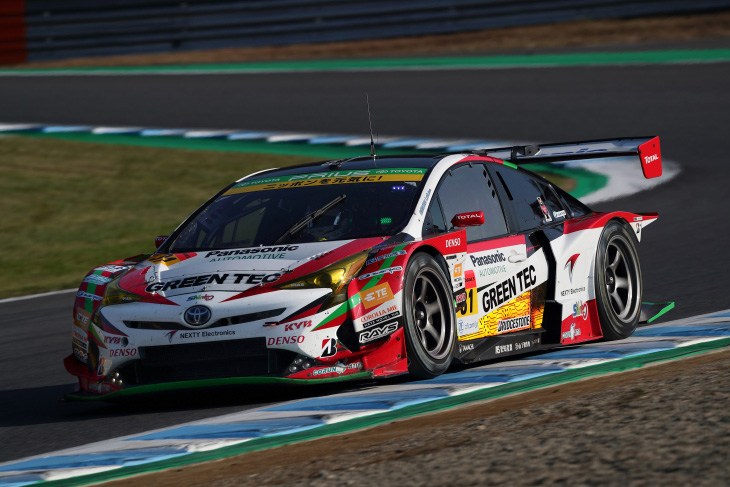
The No.30 car made two significant changes during the 2018 season.
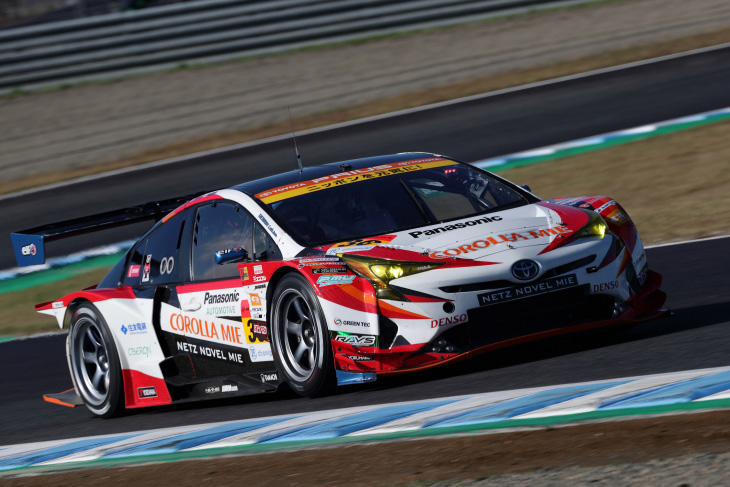
The hybrid system was converted from the Li-on battery hybrid, to the supercapacitor hybrid used in the No.31. Two-time GT300 champion Manabu Orido was also added to the lineup, replacing Sasaki by the middle of the season. Unfortunately, the team failed to finish inside the top ten for a second straight year.
2018 was the final year for the second-generation Prius, and the final season for a sports car with a Toyota RV8K engine mounted within. The drivetrain layout mandate was now well in effect – and for the first time, apr would build an original GT300 vehicle from scratch with a front-engine layout.
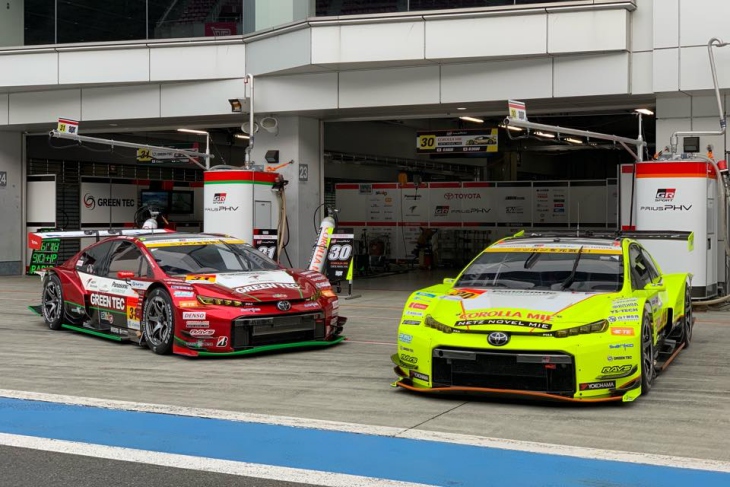
The third GT300 Prius debuted in 2019. The new base model was the Prius PHV (plug-in hybrid) GR Sport which had a unique fascia to the other Prius models.
Replacing the RV8K was the 5.4 litre Toyota 2UR-GSE V8 engine, already proven in racing as the powerplant to the Lexus RC F GT3.
Saga had a fourth different team mate in the cherry red No.31 for the fourth time in as many seasons, as 2013 GT300 champion Yuhki Nakayama replaced Hirate for the new era to come.
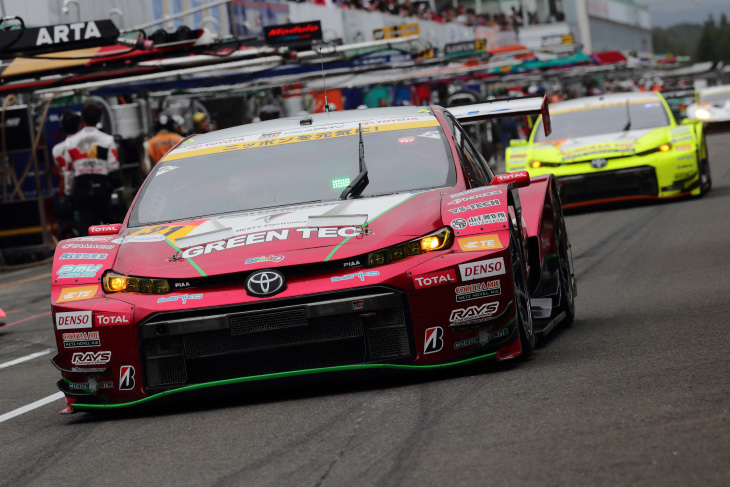
Unfortunately, the new front-engine Prius couldn’t have had much more of a difficult first season: Neither the 30 or 31 cars scored a point towards the drivers’ championship, and neither team finished inside the top 20 in the teams’ championships. It was the first time in apr’s history that they’d failed to record a top-ten finish with any of their entries.

Improvements did come in the COVID-affected 2020 season, thanks to some Balance of Performance adjustments and a year of knowledge. The No.31 Prius of Saga and Nakayama actually won the pole for the August race at Suzuka, and went on to finish seventh, the first of three top-ten finishes – better than before, but still behind apr’s usual standard.
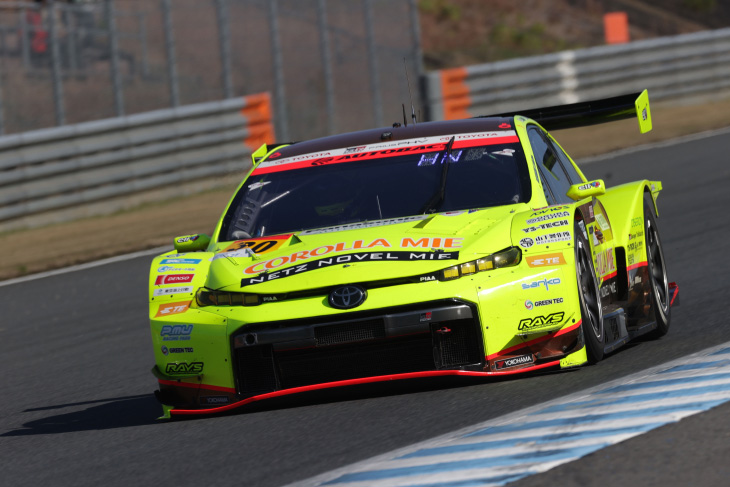
In the November race at Motegi, the No.30 Prius of Nagai and Orido – which had been running without a hybrid since its introduction in 2019 – finished tenth, giving Nagai his first points since 2016.
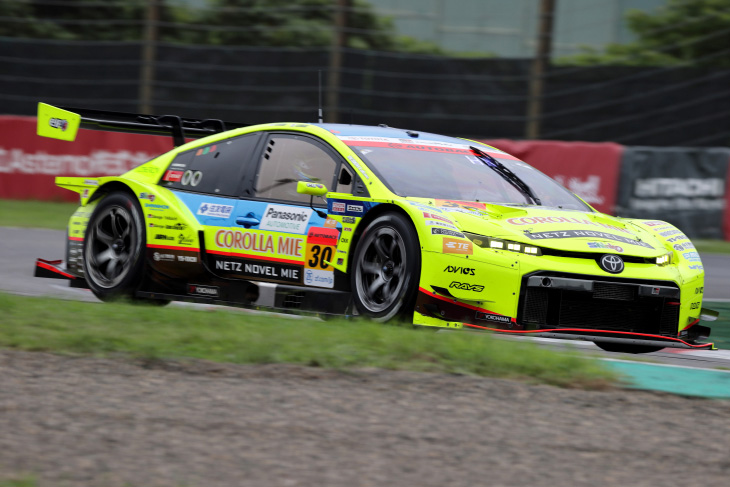
The non-hybrid Prius fared even better in 2021: Eighth at Motegi in July, and a sensational sixth at Suzuka in August where gentleman driver Nagai successfully defended his position against professional drivers approaching!

A new blue and white livery adorned the No.31 Prius in 2021. Saga and Nakayama struggled through most of the season, failing to score a single top-ten finish – that was, until a fateful weekend in Autopolis. A friendly BoP adjustment helped apr’s ace team get the most of their car for the first time.
Saga won the pole, just as he’d done at Suzuka the year before, and he and Nakayama linked together for a sensational pole-to-win victory.
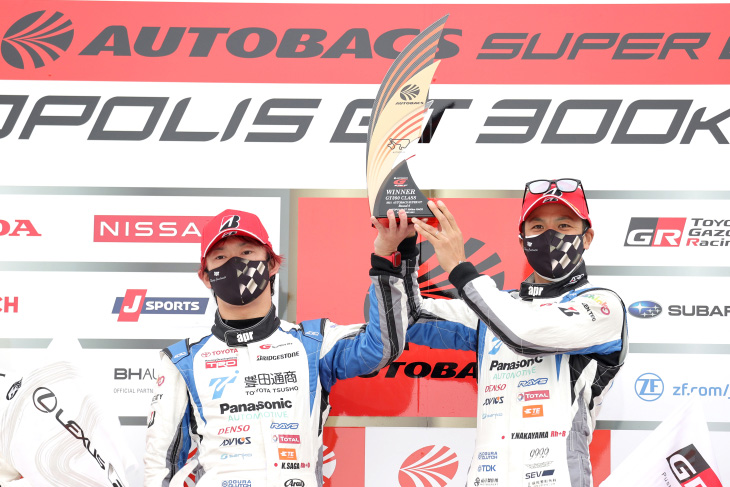
All of the pain of the previous two seasons washed away in that moment.
The Prius PHV, with its heavier engine mounted in front of the cockpit, and based on a four-door sedan when a new, more successful batch GT300 originals were based on two-door sports cars, was flawed. But it was no less of a unique attraction than the two models which preceded it.
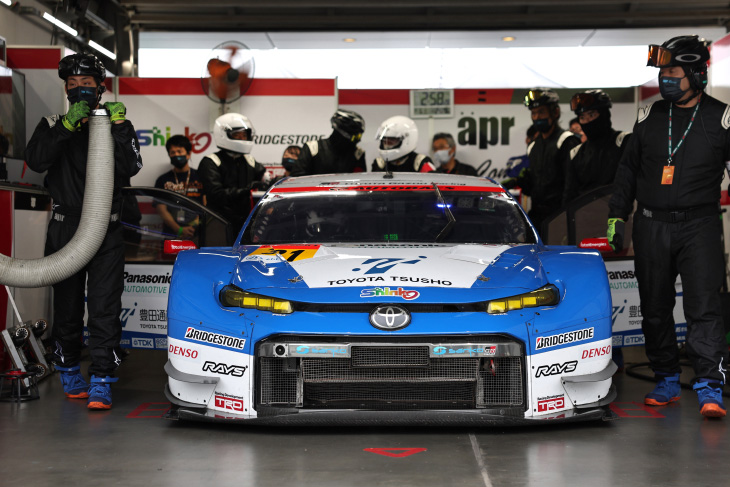
The No.30 entry was replaced with apr’s new, more capable GR86 for the 2022 season, leaving just the No.31 left to contest a final campaign whose results did not reflect the total legacy of the racing Prius.
When Hiroto Kaneso, president of apr, first indicated that 2022 would be the Prius’ swansong, it was understandable – but no less sad.
GT300 originals became somewhat of an endangered species within the past decade, thanks to the arrival of GT3 customer cars. apr helped ensure these cars would still have a place in SUPER GT, and would still be competitive.
Moreover, they had done so with a base vehicle that – in no small part thanks to the influence of certain automotive TV show pundits and other influential figures in car culture – had been cast as the ultimate villain of enthusiast driving and all that it stood for: Ruthlessly efficient at the cost of anything pleasurable, driven only by the most insufferably self-righteous.
That’s what made the racing Prius by apr such a fascinating and beloved presence in SUPER GT. It had transformed a terribly ordinary civilian vehicle into a swift, roaring, and capable thoroughbred racing machine.
Images courtesy of Toyota, apr Racing, the GT Association (GTA), and SRO / Dirk Bogaerts Photography


