written by R.J. O’Connell
For nearly a quarter of a century, Paulo Carcasci has enjoyed his life’s calling, teaching the skills that he’d learned and perfected as a professional racing driver to anyone with the time and inclination to learn.
When he first began this endeavour, he taught drivers who were mostly young, fearless drivers with serious ambitions of racing in Formula One. The number of drivers who successfully achieved their dream of racing in F1, the Indianapolis 500, and the 24 Hours of Le Mans established his reputation as one of the very best driving coaches ever to come out of Brazil.
But since moving to Miami three years ago, Carcasci, now 59 years of age, has found himself teaching his skills to a different crowd: Predominantly wealthy, middle-aged, amateur drivers who race cars as a hobby to supplement their busy lives in other lines of work.
It’s adult education, except the classroom is the garage, and tests are administered in a high-performance supercar travelling more than 150 miles per hour.

At first, Carcasci’s skills as a coach were requested by individual clients, like Chilean Osvaldo Gaio, who competes in the Ferrari Challenge North America series against other like-minded sportsman drivers from similar backgrounds.
Then in 2021, The Concours Club, a private playground for enthusiastic petrolheads, opened the doors of its campus in Miami to members. Club president, Aaron Weiss, hired Carcasci as a driving instructor at the recommendation of Daytona 24 Hour race winner, and Carcasci’s childhood friend, Oswaldo Negri Jnr.
It didn’t take long for Carcasci to foster a strong reputation within the club as a trusted coach, one of their very best.

See, Carcasci used to race for a living for over nearly twenty years of his life, and he was very good at it. When a career which included successful stints and championships in the UK and Japan hit a dead end after 1996, he was content with closing that chapter in his life. Missing out on an F1 chance with the infamously ill-fated Life Racing Engines, and then coming up empty on the chance to run the Indianapolis 500 even when Brazil’s television broadcaster would have footed the bill, are funny anecdotes instead of fodder for bitter resentment.
But 26 years later, Carcasci found his way back to racing thanks to his work as a coach, and specifically, thanks to his current star pupil. His name is Custódio Toledo – born and raised in Brazil like Carcasci, a passionate F1 fan in his youth who vividly recalls seeing the legendary Ayrton Senna’s famous two grand prix victories at Interlagos.
Toledo made his living as an executive in the world of financial technologies. But Toledo’s love of racing never faded over those years, it just needed an outlet. Not long after The Concours Club began accepting members two years ago, Toledo joined, and began working with Carcasci. The two soon developed a strong bond as friends, and in 2022, Toledo wanted to go racing.

With his enthusiasm, Toledo also convinced Carcasci to come out of racing retirement and be his co-driver in the Pirelli GT4 America series, sharing a Mercedes-AMG GT4 sports car. As the season went on, not only did Toledo continue to improve, but Carcasci began rolling back the years and showed glimpses of the driver that he was in his heyday. They nearly won their class in a thrilling race at the Indianapolis Motor Speedway road course in October, driving for Eric Bachelart’s Conquest Racing team.
At Sebring, “Coach Paulo” and his pupil are preparing for 2023. It starts the way most basketball and football coaches prepare their players for their next match: Film study.
In the Sebring hotel lobby, they’re watching Carcasci’s friend, Negri, drive around Sebring in a Ferrari Challenge car. They’re carefully observing where Negri applies the brakes, the line he takes through the corners, and where he gets back on the throttle. Toledo is laser-focused, taking notes on pen and paper that will be used as references when he drives the track tomorrow in the same car, then relaying what Carcasci said back to him for understanding.
It also helps that Toledo knows the Ferrari Challenge car through his first season of racing in the North American series and has raced around Sebring in the Mercedes two months ago.
“There are two important things I learn from Paulo,” Toledo tells me. “The first, is what I am learning now that I can use later in the session? This is studying video, studying the telemetry, and so on.”
“The second, is in the long term, how can I develop as a driver? This is why I like to go karting, to develop my skills.”
“He wants me to find an approach that I can repeat very easily,” he adds. “And also, he wants me not to make any silly mistakes at the beginning of a stint. So, for instance, he’ll have me turn the traction control higher when the tires are cold, that way I don’t spin on my first lap.”
The next morning, I find myself riding in the back seat as Carcasci and Toledo run sighting laps around the three and three-quarter mile circuit, looking for visual references around the circuit. Sebring’s brutal bumps don’t seem terrible in the plush, leather seat of a Volkswagen Jetta limited to 55 miles per hour. But in a race car with rigid suspension and a stiff carbon fiber seat, it’ll rattle the fillings out of one’s teeth.

When the track has dried after overnight rain showers, AF Corse’s fleet of Ferrari Challenge cars are ready to run – including Toledo’s Ferrari Challenge car, untouched since the end of the past season.
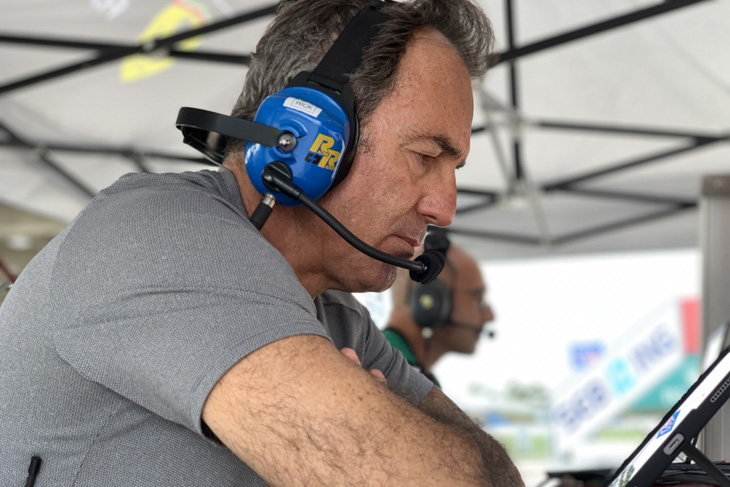
Over the course of the day, Toledo gets meaningful time on track in the Challenge car – first on worn tyres, before switching to new sets. When I observe Carcasci on the pit wall, with his radio headset on his head and his eyes watching the camera feed from inside Toledo’s car, he is very quiet because he is confident that his driver doesn’t need to have his coach in his ear telling him instructions at every single point in the track. Carcasci is less bothered when his driver spins than when he is trying to get the picture-in-picture function to work on his iPad, and that’s a compliment.
Before the sun sets and the first day is over, Toledo sets a best lap time that’s just one-tenth of a second from the target time Carcasci set from him. Carcasci is pleasantly surprised that it took just one day to make that sort of progress and get that close to the target, where many drivers would have needed two days, if they ever got there at all.
He then goes in the next morning, and smashes that target time in just a few laps. It means that Carcasci is setting a new target for Toledo – and rewarding him with his primary target for the two-day test.
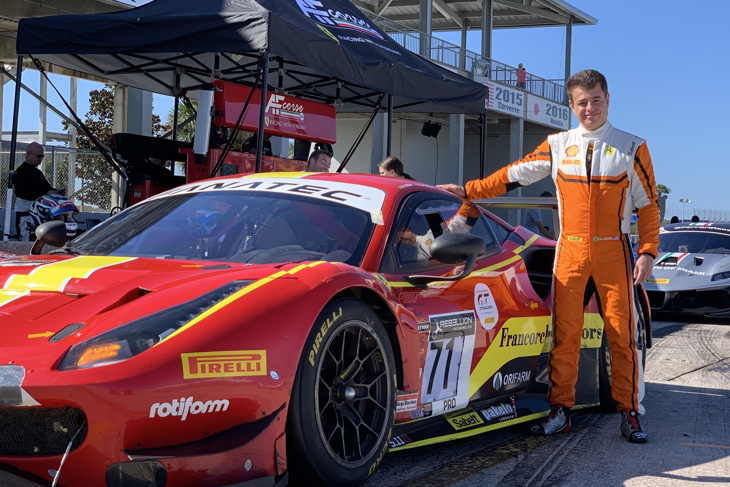
A chance to drive a top-of-the-line Ferrari 488 GT3 sports car. It makes more downforce, has better suspension, better brakes, bigger tyres, and it all adds up to a proper racing machine that’s significantly faster than the Challenge car or the GT4 Mercedes which Toledo had previously driven.
Toledo only gets four laps in before he spins, but it’s enough for him to appreciate the increase in speed and agility. It’s also enough for Carcasci to give his driver some crucial feedback, where he stresses that this faster car requires more precise actions. The steering must be quicker; the application of throttle and brake must be more pronounced with less wasteful overlay
But at the same time, it’s also a more refined car that Toledo can drive with more confidence, more consistently. When he gets back in the car later that afternoon, he uses that feedback from his coach and improves dramatically. He improves his best time of the day by nearly two seconds from the first time he drove the car.
He finishes with a time of 2:02.7 – to put that into perspective, if Toledo had entered the Sebring round of GT World Challenge America, the all-GT3 championship that sits at the top of SRO America’s pyramid, and set that time in qualifying for the first race of the weekend, where the teams’ amateur drivers typically qualify the car, it would have put Toledo 11th on a grid of 16 cars.

The on-track application of Carcasci’s coaching is just part of what he does. He provides career, and life guidance, to drivers like Toledo. He’s stepped in to be an impartial mentor to Negri’s son, who has just begun his own racing career.
Carcasci knows that his driver is eager to climb the ladder of endurance racing as quickly as possible, but strongly advises against taking on too much at once before establishing a solid foundation as a safe, reliable driver, because he knows Toledo’s instinct is to go as fast as possible whenever he steps into the car.
But after the two-day test, Carcasci has confidence that his driver can take the next step. And that’s exactly what the plan is for 2023.
Toledo and Carcasci will once again share a Mercedes-AMG GT4 for another season in GT4 America, aiming for wins in their class during their second season at Conquest Racing.
Then, later in the year, the plan is for them to step up to GT World Challenge America, and race GT3 cars, where they’re already in talks with AF Corse USA to put together a program. By the end of the year, they want to go endurance racing, and compete at the Indianapolis 8 Hour race, GT World Challenge America’s signature event.
And if all that goes according to plan, then by 2024, Toledo and Carcasci will be racing in the 24 Hours of Daytona, America’s longest, most demanding, and most prestigious endurance race. It would be the culmination of Toledo’s racing dream, and for Carcasci, it would be the unexpected summit of his second life as a professional racing driver.
It’s hard for adults to learn a new musical instrument in the same way that children can. Likewise, it’s hard for older amateur drivers to commit themselves to one of the most dangerous sports in existence while also balancing busy professional lives, and most importantly, caring for their families, the way that a young driver with no fears would attack it.
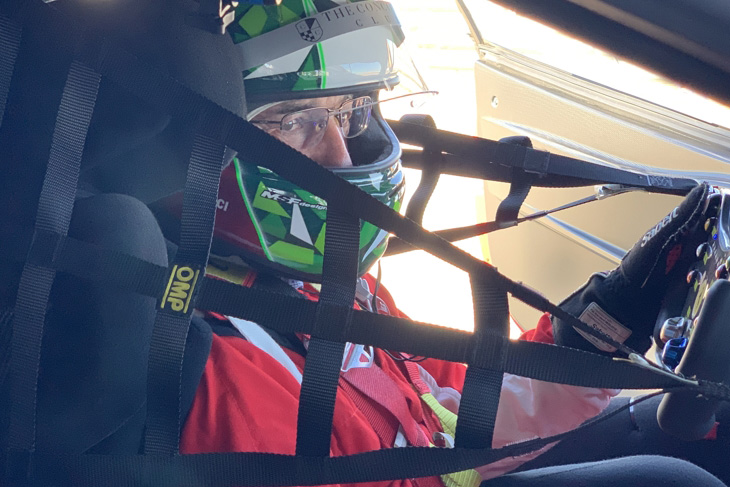
But if Paulo Carcasci can continue to teach his skills to those who are willing to learn them, and if these students continue to grow into the most dependable gentleman racers in the world – that, to him, is his greatest achievement in motorsport.
Getting another chance to prove his own worth as a driver is just a sweet bonus on top of it all.
Photos taken by RJ O’Connell