


It is finally here. After years of waiting, and multiple transitional seasons, the promise of a strong, well-supported Hypercar class is coming to fruition.
The 11 cars present at Sebring will soon be joined by further Hypercars this season, with more still to come in 2024 and beyond. For now, though, we can sit back and enjoy what is arguably the most highly-anticipated season opener in the FIA WEC’s history.
Last weekend’s Prologue test gave us a few hints of what to expect from the seven teams involved, and reigning champion Toyota clearly looks like the team to beat. Several of the new and returning opposition appear close enough on pace to ensure that the first race of the season isn’t another walk in the park for Toyota’s team.
Even if Toyota does demonstrate superior pace and reliability, the opposition looks close enough to each other to deliver some memorable on-track action.
It must be noted before we go any further that if there is a clear gap between Toyota and the rest, or even the major programmes and the smaller efforts from Glickenhaus and Vanwall, we shouldn’t a BoP change anytime soon.
The formula is set for Sebring, with no changes anticipated between the Prologue and race. Beyond that, an anticipatory BoP has been made for Portimao, Spa and Le Mans.
Only the Platform BoP system is likely to be tweaked with any level of frequency, meaning the changes made are to all cars of the same type (LMDh and LMH), rather than specific cars. This, in theory, should eliminate the incentive to sandbag.
With that in mind, here’s a rundown of where things stand for all the Hypercar runners as we count down to Friday’s 1000 Miles.
Cadillac Racing
Cadillac Racing had a good Prologue and heads into race week full of enthusiasm. The #2 was the only car to get in amongst the Toyotas, the Ganassi squad clearly profiting from its race experience at the Rolex 24 with the V-Series.R.

All three drivers were quick, the car thus far has been completely reliable, and it could be the combination of pace and reliability that makes them the closest rival to Toyota on Friday.
During the Prologue, Cadillac completed 218 laps and topped a session.
AF Corse Ferrari
On speed alone, it was a positive Prologue for the AF Corse Ferrari crew, which found pace at a track that it had previous testing experience. But, its plans suffered a significant dent, quite literally, after James Calado’s ill-advised pass on a GTE car on cold tyres left the #51 in the wall, eventually leading to a chassis change.

The shunt cost the team around 25 per cent of its available track time. This is a very new car that is yet to race, and whilst hopes and expectations are high, the competition here is not only stiff but well-drilled and with plenty of experience.
Glickenhaus Racing
Untested since the end of its 2022 campaign at Monza, the Glickenhaus SCG 007 really struggled at the Prologue.

Jim Glickenhaus reported to DSC that the team was working hard to find performance with the new-for-2023 Michelin tyres. The #708 car struggled more than its competitors on cold rubber, and may or may not have been running with traction control at the test.
The team finished in amongst the leading LMP2 group. There is a lot of work to be done if its form from 2022 is to be repeated this year.
Peugeot Sport
The French factory squad, on its Sebring debut with the 9X8, spent much of the Prologue adapting to a new circuit, new aero and in common with all the other teams, starting with cold tyres.

It appeared to struggle more than most and also suffered the most significant mechanical dramas of any of the competition in Hypercar. Details on this were not made clear by the somewhat uncommunicative team.
Both 9X8s had on-track incidents, the #93 the worse of the two when Jean-Eric Vergne collided with the Vector Sport ORECA. The car then ended up losing further time to mechanical issues. All of the above cost the team valuable time and will leave it still playing catch up in the race event proper.
Porsche Penske Motorsport
Many observers were surprised and disappointed by the lack of ultimate pace from the two Porsche 963s last weekend. The German marque had tested earlier in the year at the IMSA-sanctioned test with its IMSA crew and posted times that were a couple of seconds faster than the times achieved during the WEC Prologue.

The pace from the Prologue however, needs to be viewed in the context of the track conditions, which was very different from the IMSA test, and with a WEC Penske squad that has had precious little time to test with the new car together.
On a positive note, the Penske team will be pleased to have come away from the test having completed 433 laps. This was significantly more than everyone bar Toyota, and with no apparent mechanical or electrical issues, which were the bugbear of the sister team at Daytona.
Toyota Gazoo Racing
Toyota topped the times convincingly throughout the two days of running with its two significantly-revised GR010 HYBRIDs, separated by just eight-thousandths of a second after 2,195 miles of testing.
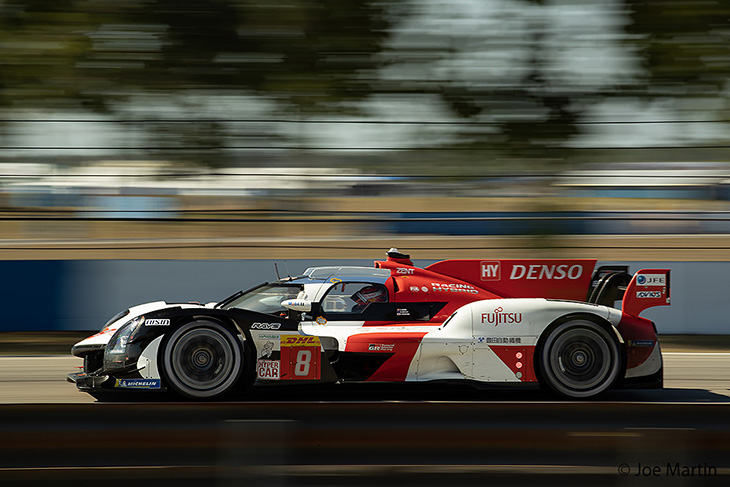
The team delivered a clear message to its competition at the Prologue: the reigning and multiple World Champions will be a very tough nut to crack in this new era.
Ahead of the track action, the team was keen to point out that most of its competitors had been through a more intensive winter test programme. But this does not look like a team that is in any way on the back foot. It completed the most laps of anyone in the class during the test and will be staying on at Sebring next week to put a spare chassis through a pre-Le Mans endurance test.
However, Toyota will be very well aware that in addition to its speed, it will need to show iron-clad reliability against a much stronger and deeper opposition than it has faced since 2017.
Floyd Vanwall Racing
Vanwall’s Prologue was similar to that of Glickenhaus Racing. It too has a car which is lagging far behind the front runners on pace, something which should come as no surprise. The gap in the level of resources between the boutique manufacturers and the major OEMs has seldom been this clear in years gone by.

The positive for the team is that in the hands of Tom Dillman, the car can achieve respectable lap times, the Frenchman managed a time quicker than three of the Peugeot drivers.
With 1997 F1 world champion Jacques Villeneuve at the wheel, though, it was a different story. The Canadian was far off the pace — so far off, in fact, that he was seconds off the slowest of the LMP2 drivers. He, and the team, have a lot of work to do.
PROLOGUE FASTEST TIMES BY DRIVER >>>
For future reading, take a look at DSC’s full Sebring Hypercar class preview HERE >>>


