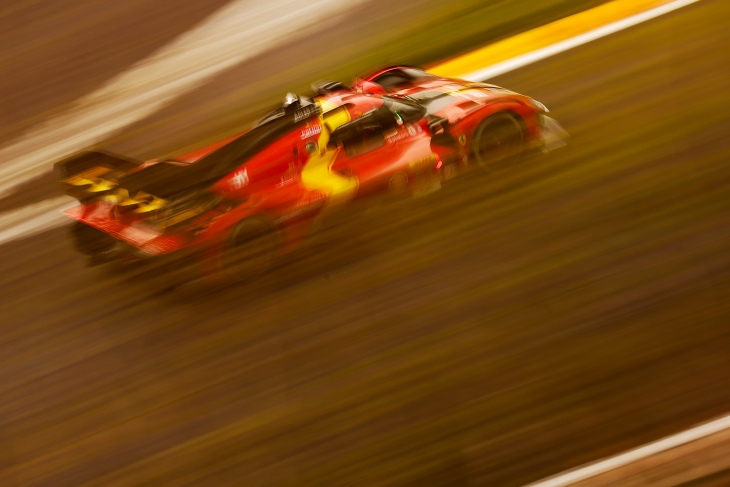
Ferrari bosses Antonello Coletta (head of Attiva Sportive GT) and Giuliano Salvi (the Ferrari endurance race cars track operations manager) have spoken out on the FIA WEC’s decision to ban tyre warmers for this season, in the wake of the series of incidents caused by cold tyres throughout the race meeting at Spa.
The new-for-2023 policy, which was introduced to reduce the FIA WEC’s environmental impact, has been a topic of discussion in the paddock and press room since the championship arrived in Sebring back in March. However, the spotlight wasn’t fully on the matter until this past week in Belgium, when colder trackside temperatures in Belgium saw a number of significant incidents.
Drivers in each of the three classes were seen clearly struggling to heat up their tyres every time they left the pits. While there were many to touch on, the two most high-profile involved front-running factory drivers: Toyota’s Brendon Hartley and Ferrari’s Antonio Fuoco, the former crashing out of Hypercar qualifying, the latter crashing out of the race.
For Hartley, the off at Raidillon meant he and his teammates in the #8 GR010 HYBRID had to start at the very back of the grid. Not only did the team have to deal with the consequences of not setting a time, but it further disrupted the team’s race strategy as it also lost a set of tyres that were needed for the race.
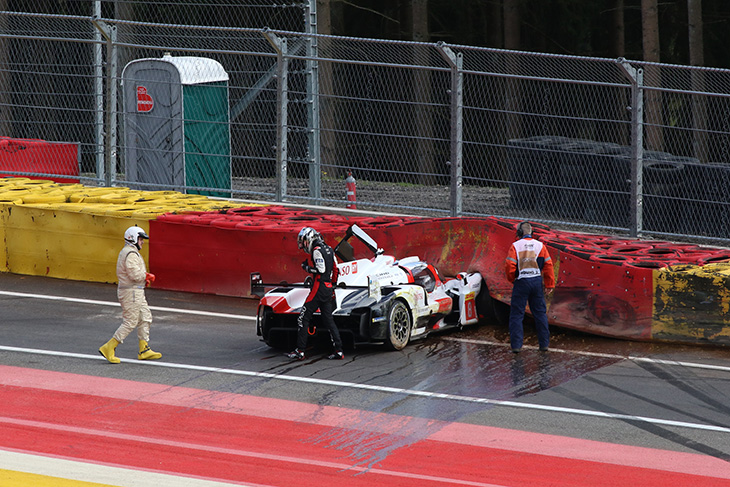
A day later, Fuoco’s accident in the #50 Ferrari 499P during the race was more concerning. The Italian, driving in a straight line out of the pits, was sent sliding into the armco barriers on the run down to Eau Rouge after the car’s rear snapped. It came after Fuoco’s teammate Miguel Molina suffered major understeer at pit out earlier in the race with the same issue, narrowly avoiding the concrete divider between the pit lane and the exit of La Source. Thankfully the Spaniard missed it, but he was later penalised for crossing the pit exit white line.
These incidents prompted Coletta to release a post-race statement which was openly critical of the new regulation, branding it “dangerous”.
“Starting from the assumption that the rules are the same for everyone and that we abide by them, I think we need to reflect on the ban on tyre warmers,” he said.
“It’s a common opinion in the paddock and among professionals, not to mention the drivers, that this situation has become dangerous. At Spa, there have been many accidents and extreme episodes due to cold temperatures and changeable weather, and it’s time to do some serious thinking on the matter because it has major ramifications for safety.
“We are on the eve of a decisive race like the 24 Hours of Le Mans where, overnight, temperatures are low and speeds very high. It’s not just an issue for us. The accidents involved different cars, from different classes, driven at the time by both professional and gentleman drivers, and this situation had already been predicted some time ago.”
Salvi also gave his thoughts on the matter, in a post-race technical briefing, reiterating that concerns about cold tyres at Spa were raised long before the race meeting.
“This (Fuoco’s) kind of incident comes from regulations without blankets. We saw the same with Toyota. We saw a lot of crashes. We said many times Spa could be tricky, but it’s the same for everybody. Fortunately, nobody was injured,” Salvi said.
It’s not just members of the Ferrari team that have been vocal on this issue since yesterday’s race. Toyota driver Mike Conway, who went on to win the 6 Hours of Spa, told DSC he would welcome the reintroduction of tyre warmers.
“Yeah,” he said when asked directly if it was time for a change. “There are some people pushing for it. We saw Brendon yesterday in Qualifying. When you leave the pits you are on ice and just surviving.”
There has been further endorsement of the concerns from others too including Cadillac’s Jack Aitken and Seb Bourdais.
However, Conway did question whether such a change in regulations would be smart, or even feasible in the short term, with Le Mans closing in fast.
“I wouldn’t be against it, but I don’t know if they do such a big change going into Le Mans,” he continued. “Does everyone have the capacity to do it?
“We also don’t know what effect it will have on the tyres by warming them a bit quicker. Maybe something could be done? It could avoid these incidents. In colder temperatures, on a high energy track like here, you’re forced into a situation where you have got to take a tyre that’s a bit harder and harder to warm up.”
Is Conway concerned about the risks posed by cold tyres during the Le Mans 24 Hours?
“Yes,” he responded when asked by DSC. “Not so much at the exit of pit lane, but when you come down that hill (after the Dunlop Bridge), I know already what it will feel like.”
Whilst rule makers have repeatedly stated that there is no intention to change or even review the new policy, on-track incidents and now public reaction from key partners in the championship, inevitably add pressure to look again at the initial problem, the chosen solution, and any available alternatives.
DSC will offer further thoughts on the issue tomorrow…