The 2023 6 Hours of Spa-Francorchamps, across all classes, was one of the most entertaining and hard-fought WEC races in years. The factors that contributed to that, need to be recognised, and many areas celebrated. Including, the strong green shoots of confidence, interest in and performance of the Hypercar class.
However, whilst we can celebrate the progress, we should never ignore the challenges, and plenty remains as we edge closer to the Le Mans 24 Hours.
Cold tyre incidents have sparked real concern
The most obvious, for many, is the decision to introduce an environmentally based policy of removing tyre warmers, alongside rapid growth in the new top class. It is not a simple debate to unpick.

Spa, with its traditionally changeable weather conditions, almost predictably, produced incidents that could be attributed to the outturn of this new policy, including Brendon Hartley’s accident in Qualifying and most particularly Antonio Fuoco’s dramatic exit for the race immediately after leaving the pits in the #50 Ferrari 499P. There were other incidents of a somewhat less dramatic nature too, including multiple spinners on the formation laps and the sighting lap en route to the grid, which added to a list that grew throughout the weekend.
Ask the policymakers, and the answer will be that the decision is soundly based, and supported by a tyre ‘roadmap’. Said ‘roadmap’ has been drawn up to support a current and future public policy agenda, that is correctly and inevitably aligned with the wider political debate on climate.
That includes a challenge to the championship’s tyre suppliers, to produce product that is more sustainable and supports the change in tyre warming policy.
Ask Michelin, and it will pretty conclusively support the direction of the policy and the specifics of its implementation. That included at Spa, race organisers offering the opportunity for teams to select any of the three available slick options, rather than asking Michelin to pre-select two as has been the case in the opening pair of races this season.
So far, so good, but any policy designed to respond to public debate must also be dynamic enough to anticipate where the next challenges might be coming from. And it’s clear that the rapid implementation of this policy holds current and future risks.
Motorsport, in the career cycle of both of these writers, has been defined as much by an astonishingly effective drive for safety as it has by the continuation of the pursuit of excellence in competition.
Even if you leave aside the blindingly obvious arguments about the ‘whole product’, and the environmental impact of the cold tyres policy, you ignore at your peril, the risks and the optics of repeated high-profile accidents where a lack of grip was patently, a major contributory cause.
The next race on the calendar is the Le Mans 24 Hours, and not just any Le Mans 24 Hours, the centenary edition, with an extraordinary grid. Surely the events at Spa, in the coldest conditions we have seen all season, will prompt the teams and organisers to come together in May and discuss the potential for a shift back to allowing tyre warmers?
What message are you sending to fans old and new, the teams and drivers and the wider motorsport industry?
More eyes than ever will be on the Le Mans 24 Hours, and therefore the FIA WEC, in June. If over the course of race week, there are further incidents linked to drivers struggling on cold tyres, and it becomes even more of a concern during this once-in-a-lifetime event, then the question must be asked: what message are you sending to fans old and new, the teams and drivers and the wider motorsport industry?
The WEC has more eyes on it than ever before
After traditionally large crowds at Sebring, it was good to see a more than reasonable crowd at Portimao, which is never an easy circuit to build attendance at. That raised hopes and expectations for what we might see at a more traditional and accessible endurance racing venue.
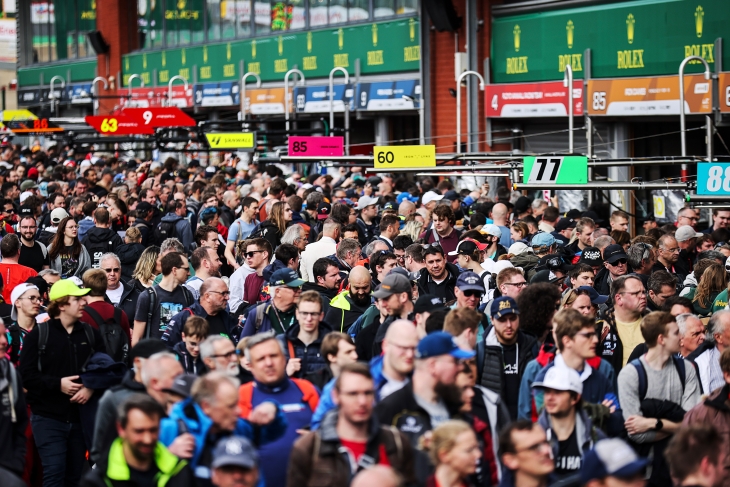
We got that answer, very conclusively, at Spa Francorchamps. Grandstands were well occupied on Friday and were full on Saturday, with thousands of additional spectators taking advantage of the Belgian circuit’s myriad of trackside vantage points. The official attendance figure was just over 72,000, and for once we can report that it is an entirely believable figure that bodes well for the future in this new era for the FIA WEC.
It is worth noting too, that the level of media interest in the FIA WEC is clearly on an uptick too. Spa’s capacious media room was packed throughout the weekend, with writers, photographers and content creators clearly finding more than enough to fill their pages, memory cards, posts and programmes. It’s a very good sign for the Le Mans 24 Hours and beyond.
Wadoux is a history maker
It’s very rare that the achievement of a single driver prompts a unanimous round of applause, from media and competitors alike, in a post-race press conference. Lilou Wadoux was deservedly recognised by both onlookers and her peers on Saturday, after another standout performance in the #83 Richard Mille AF Corse Ferrari, which this time netted the first-ever class win by a female driver in FIA WEC history.

Better still, Lilou’s achievement does not stand alone in the increasingly vibrant WEC paddock. The 22-year-old Frenchwoman won not only the race at Spa, but a real-world race with her peers in the Iron Dames Porsche and with Doriane Pin in the Prema Racing ORECA to earn her moment in history.
Even within her own class, despite its junior status in the FIA WEC, nobody should be under any illusions that this win came against world-class opposition. The other silver-ranked drivers in the class have both high-level experience and elite talent to draw from, so to stand out from that pack during the race, and come away with a victory, bodes well for Wadoux, who looks set to be a star on the world stage for a long time to come.
Toyota’s challengers are closing the gap
‘Toyota wins again’ will be the headline and sentiment of many after the 6 Hours of Spa-Francorchamps. And while that would be correct, it would also be lazy. It ignores massive progress made by several of the FIA WEC’s most experienced top-class competitor’s peers.

Cadillac, Porsche and most particularly Ferrari, are visibly bridging the performance gap that was cavernous at Sebring, but now appears to be within reasonable reach ahead of Le Mans.
Porsche’s reliability woes are still a concern, though Porsche Penske Motorsport now has a new yardstick with its first (of several) privateer competitors in equal machinery. But there too, there were signs that the 963 is beginning to find its feet.
Cadillac again looked quick though its effort will be remembered for the wrong reasons, after Renger van der Zande was fortunate to walk away (and bow) after a huge incident, apparently caused by malfunctioning power steering. The US manufacturer though, should be happy that it measured up well to Porsche, and at times to Ferrari, with a car that is becoming firmly established as a real fan favourite.
Whilst it was a surprise to many that the platform BoP wasn’t changed for Spa, DSC believes it was the correct decision. Teams need to know where they stand without effective outside assistance if this new class is to be regarded as a meritocracy. The time for tweaking may yet come, but this is too early and with too much uncertainty as to the root cause of any issues and tactics.
Porsche’s reliability woes are still a concern
Ferrari has what looks set to become the fastest car in the field, and would have nailed that honour without errors from both drivers in Qualifying. The 499P’s raw speed though was on display for all to see during Qualifying and the race.
The car has one gaping hole in its armour, and only Ferrari truly knows how big a problem that is. It was utterly terrible on cold tyres, to the point where the effort lost a lap early in the race, the #50 car later incurring a penalty and later still eliminated itself from the race, with cold rubber behaviour that could best be described as ‘tricky’.
Without that issue, and the decision, taken by the drivers, to start the race on wets, the Italian team would almost certainly have been more of a threat to Toyota. It will surely be reflecting that a split strategy at the start of the race, could have produced a very different result.
Finally, Peugeot showed that its reliability has come on in leaps and bounds, with just one hiccup with the #94 on pit lane requiring a power recycle during the race. There are though still major question marks on performance, which DSC understands, the team will hope to address prior to Le Mans when it heads to Magny Cours for what is believed to be a performance test.
Don’t bet against Corvette
Corvette Racing failed to win for the first time this season in the FIA WEC, in a race defined for the #33 car by two key factors: an early gamble on wet tyres which proved to be wrong and for the second consecutive race, a defensive drive late on by Nicky Catsburg that kept a significant position and subsequent points haul in the glove box of the C8.R.

This time something was different about the team’s performance. Because of the initial tyre choice and the out-of-sequence change, the team could not run at the front thanks to the class-leading pace of Bronze driver Ben Keating. While the #33 recovered some of the lost ground, much more of the plaudits this time must go to Nico Varrone and Catsburg.
Even with 45 kilos of success ballast, the #33 heads to Le Mans with almost double the points of its nearest competitor. A win at La Sarthe, where all ballast is wiped clean, could put the title almost out of reach.
JOTA proved that privateers have a future in Hypercar
It’s always better to overachieve than overpromise. The dawn of another important aspect of the new Hypercar era certainly did that. The performance of the #38 HERTZ Team JOTA Porsche 963 may not have been challenging for overall honours, but it most certainly gave Porsche Penske Motorsport some important and searching questions.

Those who have followed the progress of the Tunbridge Wells-based team will not be surprised at its level of preparation, though its opportunity to prepare was somewhat restricted by the fact that the car was delivered just days before the Spa meeting, and had never been driven by any of the team’s three drivers.
JOTA’s sixth-place finish will be a massive encouragement for them and any other team with active plans and aspirations to join the top class. There are surely more challenging days to come, but what a way to start this story…
Images courtesy of Paul Mousley & Jakob Ebrey Photography