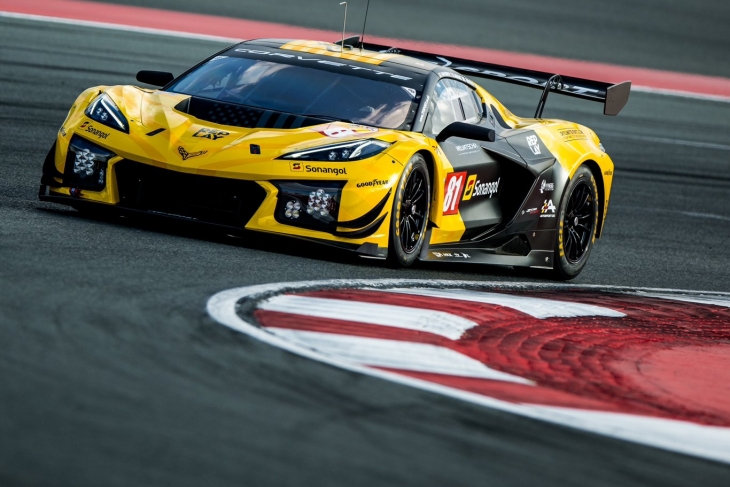
Upon arrival in Qatar, the scale of the challenges ahead for the teams in the brand new LMGT3 class, beyond the freight issues which have delayed the start of the Prologue by 48 hours, have become clearer.
Certainly, the first race weekend may resemble an extended test session for the teams with brand-new cars, as they get to grips with the 2024 machinery from Aston Martin, Corvette and Ford.
But they won’t be the only teams ‘learning on the job’ over the next week, as come race time, all LMGT3 cars will race with a new ‘virtual energy tank’, as part of a new system being used to balance the number of laps each car completes per stint.
So what is the virtual tank, how does it work, and what does it achieve?
In the simplest terms, the ACO’s director of competition Thierry Bouvet told DSC, “It’s a fairer way to balance laps per stint, without the need to monitor fuel consumption. Before, we would monitor fuel tank size and fuel flow rates to balance the different GT cars in the championship. Now, we are managing the amount of energy used (measured in Megajoules).”
While the prospect of teams saving virtual energy, or ‘virtual fuel’ in effect, may sound complicated on the face of it, the ACO and FIA, as the governing bodies of the FIA World Endurance Championship, believe this is a simpler system, which will improve the balance of the field, without compromising any elements of strategy during a race.
“Before, drivers may have been actively trying to save fuel, now they are saving power. We would monitor litres used, now it’s energy,” Bouvet explained. “It is the same as the virtual energy tank system utilised in Hypercar.”

Essentially the virtual energy tank in LMGT3, which will be displayed during the races on broadcast graphics (see above), depletes gradually every time a driver puts the power down. There is no further complexity to the calculations stemming from energy being harvested by hybrid systems like there is in Hypercar, because all LMGT3 cars are non-hybrid.
Monitoring this has been made possible with the inclusion of torque sensors being mandated on all LMGT3 cars, which have been compulsory in the Hypercar class since the class’ introduction in 2021. Initially, the sensors were expected to be used simply to monitor in real-time the power output of each car, to help the organisers set the Balance of Performance values for future races and reduce the temptation to sandbag.
Adding a virtual tank that depletes when the teams use energy, increases the role of the torque sensors. It is now going to define the length of stints during the race but won’t detract from the strategy options teams have.
Bouvet was keen to stress that the wheel-to-wheel racing itself shouldn’t be affected by this change in the ruleset. Drivers and teams won’t be required to race conservatively to ensure they can eke out as many laps as possible from the virtual tank. However, “if they want to try and save energy to extend stints by a lap or two, by lifting for instance, they still can,” he pointed out.
It’s a fairer way to balance laps per stint
This virtual tank won’t affect the look or feel of pit stops either. It takes 40 seconds of fuel nozzle connection time to fill the virtual tank, but teams are not required to refill the virtual tank fully at each stop. This means they can still take splashes of real fuel and in this case, ‘virtual fuel’, to gain track position and ‘top up’.
Because of this change, each car’s fuel flow doesn’t need to be mandated any more as a result of this new regulation. Instead, it is up to the team to work out how much fuel they need in their tank to complete a stint.
The key is in racing within the boundaries of each stint via the parameters defined by the values in the “Maximum Stint Energy (MJ)” column of the BoP table. Each car is being handed varying levels of energy to use per stint, calculated by taking various attributes such as a car’s weight into consideration. It is not expected to change wildly from race to race, despite the differences in circuit characteristics, BoP and success ballast to come.

So, how are the stints measured? For the first stint, the energy will count from the start-finish line at the start of the race. Then it counts from pit-out to pit-in, before the last stint, when the energy calculation will stop on the finish line at the chequered flag.
Until we go racing, we won’t know exactly how long the LMGT3 cars will race before pitting, but the expectation is that stints may be shorter than we became used to in GTE.
“The stints should be shorter,” TF Sport owner Tom Ferrier said to DSC. “We reckon 45 minutes roughly. There will be some energy management stuff, but we need to use the Prologue to work out what the savings you can achieve are.”
Why is it vital for teams not to exceed the amount of energy permitted by the virtual tank? Because the penalties for over-running are severe. For the first offence, teams will receive a 100-second stop-go penalty. The length of the penalties will then increase by 100 seconds with each subsequent violation.
The stints should be shorter
What do the teams think about this? At this stage, there is a level of apprehension because everything about LMGT3 is so new. For all of them, there is a learning curve attached here, as they work out how many laps they can complete on a full tank of virtual energy.
“In theory, you won’t ever run out of fuel, you’ll run out of ‘energy’,” Ferrier explained.
“There are key changes here with the addition of torque sensors. Normally you’d get a boost level or a restrictor size. Now the manufacturers have had to declare power curves from 1 to 15, and then they give you a power curve you’re going to run that’s right for the BoP, and you have to stay within that curve within your torque axle sensors.”
Richard Dean, United Autosports’ co-owner, also spoke with DSC on this subject. While he admits that work needs to be done for the team to gain an understanding of how stints in races will pan out with the new system, he is positive and believes it will be a welcome change for the championship in the longer term.
“I think this is significant,” he said. “You have to figure out how to maximise that, and you don’t want to be on the wrong side of it. Though it’s too early to give predictions on how it will pan out.
“Everything we’ve been doing in testing has been geared to understanding and managing it.
“If what it achieves is preventing teams from wanting to sandbag and play political games ahead of a particular event, then brilliant. We need to get rid of all that. This solution should give the rule-makers a lot more visibility. And if it gives us as teams more clarity going into a race event, it should create closer racing.”
To help teams get to grips with the new LMGT3 ruleset at the start of the season, including the ramifications of the virtual energy tank being introduced, the organisers have allowed teams to bring an additional two staff members per car to races for the first three races of the season.
The season opener awaits…
Images courtesy of JEP, TF Sport & FIA