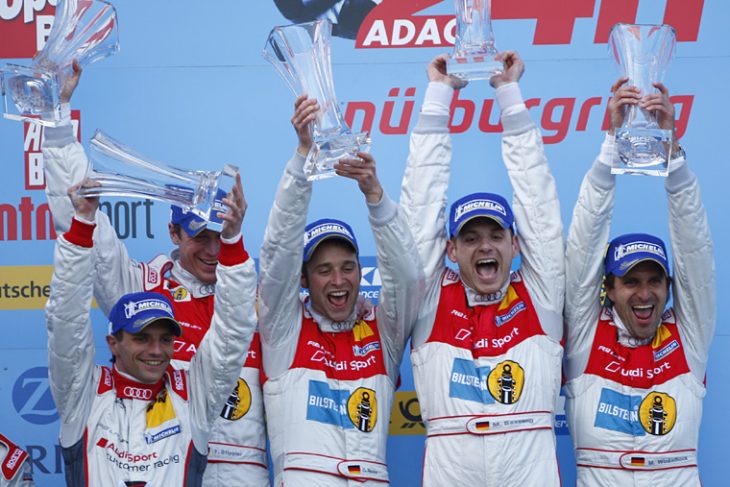
For many in the sportscar paddock, GT3 racing has been synonymous with Audi, and the R8 in its various guises. This weekend at the 24 Hours of Nürburgring, the presence of the ‘Four Rings’ in SP9 PRO has been reduced to just two cars, both run by Scherer Sport PHX.
However, even with Scherer’s attack morphing into a more traditional privateer effort, certainly does not lack quality: with multiple Audi Factory drivers signed up, including a few who have been with the brand for longer than some drivers’ whole careers.
Two of those drivers, Christopher Haase and Markus Winkelhock, are listed together in the #15 Scherer Sport PHX Audi, in a team that has an incredible history not just as an Audi customer team, but specifically at the Nürburgring.
Between Haase and Winkelhock, the pair boast five Nürburgring 24 titles between them. This includes Audi’s first victory at the event, with Phoenix Racing (which has since become Scherer Sport PHX), in 2012. Adding Frederic Vervisch, who himself has two further Nürburgring 24 race wins, both with Phoenix and Ricardo Feller, who has been making a name for himself as one of the best young GT3 drivers, the team presents a formidable challenge for success in 2024.

For both Haase and Winkelhock, who were here as Audi’s first challengers, and first eventual winners, the Nürburgring is a keystone in their careers and a place they hold in high regard.
“You can’t go out and play the hero,” says Haase. “To finish this race, it’s already a big achievement, but to win it, it’s something special.”
“To find the right risk management is really difficult – you cannot say, ‘Okay, I’ll take it really safe now.’ If you do, you usually lose so much pace that you’re not competitive anymore.
“Once you’re used to this environment, used to the track, used to this kind of racing, you start to love it. And you don’t want to miss it.”
Markus Winkelhock echoed his teammate’s thoughts.
“The risk of crashing the car is so high on the Nordschleife because it’s not like a normal race.
“Every year is different,” he adds. “If it’s dry, you have different targets to when it’s wet.
“But you need to find the perfect balance between trying to stay with the lead cars, and not taking too many risks, especially in the beginning.”
The impression that they give, with their experience in tow, is that the Nürburgring 24-hour is a race that must be approached with a calm, considered, and measured attack, balancing pace and risk as you weave through the over 100 other cars, ranging from other SP9 PRO competitors, all the way to the Dacia Logan. Similarly, both Christopher and Markus are measured, and considered in their responses.
They have a wealth of experience behind them, of course. The first success at ‘Green Hell’ for the ‘Four Rings’ came at both of their hands in 2012 – a 35-second win over another Audi, with the next-best car almost a full lap behind.
Haase’s eyes light up when he recalls the 2012 race.
“The first victory for Audi, and the first victory for myself… It’s something you never forget.
“Every victory will come after will never reach that emotion. That’s how it is!
“My other victory in 2014 was also a great victory – a distance record – but still, 2012, it’s just mind-blowing.”

It was a great performance for the Nürburgring-based Phoenix racing team, which has since won the N24 four times in the last 12 years, to become the event’s second most successful team – only behind Manthey Racing.
And it was Phoenix Racing that gave both Haase and Winkelhock their first shots at GT3 machinery on the Nordschleife.
“I hadn’t done one race at the Nurburgring before 2010, but [former Phoenix Racing team owner] Ernst Moser, he gave me the chance to race here,” explained Winkelhock. “He asked me if I would like to do the race to get some experience on the Nordschleife.
“Now I’ve been racing here for 14 years!” Winkelhock reflects.
“I started with Phoenix quite early in my career, and we stuck together for quite a bit,” adds Haase.
“When you start young, and you have success [with a team]…” Haase pauses for a moment. “You will always feel like they’re your family.
“If you’re in that family, you just enjoy what you do together.”
“They always had really good team spirits, always working together,” Winkelhock adds. “You could always feel it.
“That’s why I always like to race with Phoenix.”
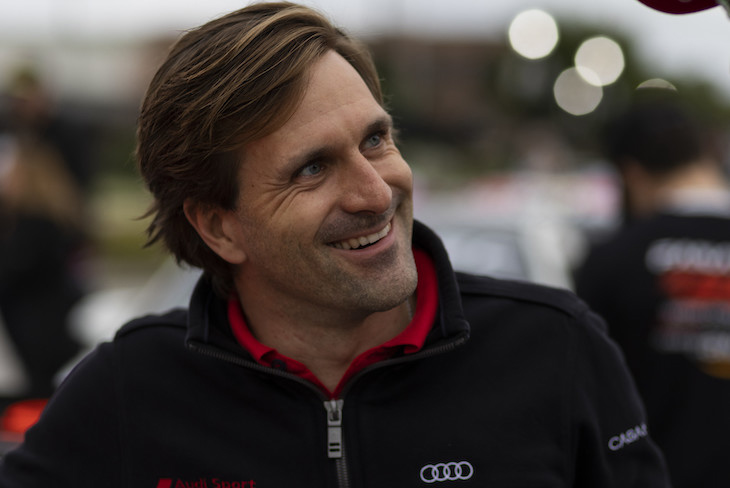
But by no means does the ‘family feeling’ of Phoenix discount their preparation or ability.
“Phoenix Racing – although I should say Scherer Sport! – is a legendary team,” says Winkelhock.
“There’s a reason why they’ve won here so many times,” elaborates Haase. “As a driver, you just feel that they know what they’re doing. How calm they are acting, and how they know the right choice most of the time.
“It gives me as a driver a lot of trust in the car. I only have to focus on my job. Just driving.”
“This year, we might have mixed conditions… It’ll be a proper team race,” comments Winkelhock. “The team has to do a lot of work, trying to manage [the conditions] as best as possible to make the best choice for you.
“With Scherer Sport, we’ve got a really strong team.”
And of course, the Audi R8’s capabilities shouldn’t be ignored. While the platform is reaching the end of its life, the R8 LMS GT3 Evo II is still as potent as it was in its original form.
“I love that car!” Winkelhock said. “And I remember, when we had the first year with the new R8 [The R8 LMS, in 2015], we were leading by half a lap, and then unfortunately one of my teammates crashed after midnight.
“So it could have been four wins!”

“The car got better and better, and I know the car very well. The Audi is a really good car. In the dry, in the wet, I’m happy to still be in it.”
Both drivers have been at the forefront of the glory days of Audi Sport Customer Racing, which dominated GT3 racing worldwide for a long period from the start of the 2010s. For Haase, being a part of the ‘benchmark’ team in GT racing has been an interesting experience.
“When we started, we were building the customer base,” Haase explained. “Audi spent a lot of effort to make the product reliable and fast all over the world and to have the best support for customers.
“Obviously, not everything went right in the beginning,” Haase clarifies. “But we kept working, and we reached a period, I would say from 2014, where I think they were the benchmark in how to handle customer GT3 cars.
“Audi developed the benchmark.”
Since Phoenix’s first win in 2012, GT3 racing has continued to evolve.
“GT3 racing is a lot more competitive now,” says Haase. “It comes down to every single half a tenth, what you can get on set up, or you can get on BoP, or whatever.
“The benchmark that Audi set…” Haase pauses to consider his words. “There are some brands now that are probably on the same level. But there are also other brands, that have different philosophies.
“I don’t want to say this is right or wrong,” Haase clarifies. “But on the benchmark, it’s maybe two or three more brands now. And I think others have a different philosophy.”
And it’s not just in customer support that GT3 racing has changed; the quality of entries, fields, and drivers has made winning a race like the Nürburgring 24 Hours a much harder challenge.

“In the early days, we used to say, ‘Okay, we have to survive the night. Maybe let’s be a little bit more careful when it’s foggy, or when it starts to drizzle or whatever,” continued Haase.
“But now, it’s completely changed. It’s a maximum sprint race.”
Haase’s assessment is confirmed by Winkelhock.
“I remember in 2010, we finished third overall with two amateurs in the car,” Winkelhock recalls. “Okay we were quite lucky, there were many crashes, but that would absolutely not be possible now.
“There were less strong cars in the past. Now there’s 15 cars that are able to win the race.
“Everything is getting closer to the limit. Every year you say, ‘It cannot get any better, or stronger.’ But it does. Every year.”
“Also, the traffic has gotten more competitive,” adds Haase. “When you get to a train of cars, sometimes they don’t let you pass straight away. There’s a risk for more accidents.”
“At the end of the day, if you can win a race like this, with this level of competition, it’s even more special,” says Winkelhock. “Everybody knows if you can win this race, it’s a big challenge, and a big achievement.”
“To be honest, when I started racing, I didn’t notice this race so much,” Haase responds sheepily. “But I realised, if you want to have a chance as a factory driver, then you have to be a part of this race.
“In the beginning, I struggled a lot. Every year, you get more used to it, you get more confidence, and now I arrive and I’m happy to drive!”
The ‘odd one out’ in the #15 line-up is 23-year-old Ricardo Feller, simply because of his age. But both Haase and Winkelhock had nothing but praise for their young teammate, who has already won championships in GT machinery and has been positively rapid in every major GT3 race he’s entered.
When asked if he remembered what it was like stepping into a factory race team as a young driver, Haase responded “In 2012, that was me.”
“I was a bit younger than Ricardo, and I learned a lot from my teammates at this time,” says Haase. “But nowadays, we are driving so much more. We have 20 races a year, or more. In the past, we only had around 12, or 14.
“I think in terms of confidence, and giving also feedback about the car, we don’t need to worry [about Ricardo’s relative inexperience].”
“I don’t think you have to help him because he’s damn fast!” adds Winkelhock. “In DTM, in the R8, everywhere. Even though he’s quite young, he’s very experienced already. He’s been driving for a few years in the R8.
“To be honest, I think we are all learning from each other.”
“I don’t see any disadvantages for Ricardo because he hasn’t won this race,” Haase elaborates.
“So, I think it’s time to make him be great.”
With the winding down of AudiSport Customer Racing, and the uncertainty over the next step for Scherer Sport PHX, the obvious question is what’s next for these two stalwart Audi drivers?

“Nothing to speak about yet,” Haase responds.
“What happens next year? I really don’t know yet,” adds Winkelhock.
But it’s clear that both Haase and Winkelhock still have ambitions in racing, and the drive to achieve success. That hasn’t changed.
“I’d love to go to Le Mans,” Haase says. “It’s great that GT3 cars are now at Le Mans. It’s not easy to get there – you need the right connections.
“But [Le Mans] is definitely something that I would like to do.”
For Winkelhock, he just wants to keep racing.
“I would like to continue GT3 racing. I still like racing, I’m still motivated,” says Winkelhock.
When pushed a bit more, Winkelhock adds “I always wanted to do the Indy 500 actually, but I think that may be over for this life!”
What certainly isn’t over is the competitiveness, passion, and motivation for Haase and Winkelhock, 15 years on from their first N24.