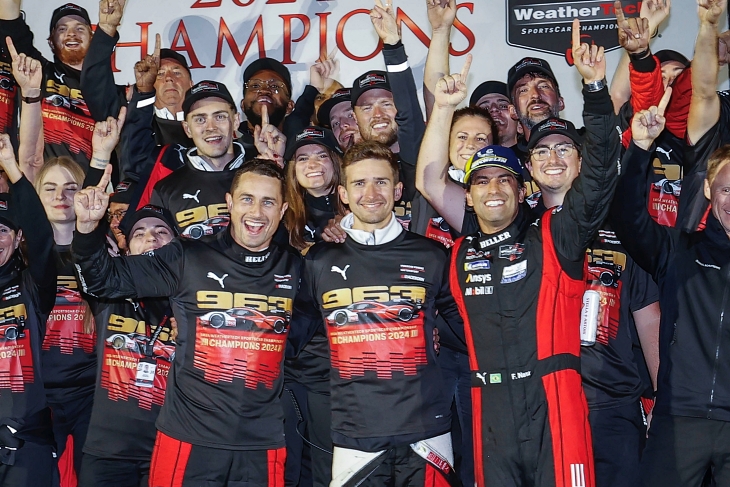

It felt inevitable from the drop of the green flag. But at the conclusion of Saturday’s Motul Petit Le Mans, it still felt sweet for everyone at Porsche Penske Motorsport to claim all of the IMSA WeatherTech SportsCar Championship’s GTP titles, and reassert the manufacturer’s place at the top of premier class prototype racing.
As expected, Porsche won the complete set of IMSA’s full-season and Michelin Endurance Cup championships for the manufacturer, the main drivers Dane Cameron and Felipe Nasr, and the #7 Penske Porsche 963 team. The #6 of Mathieu Jaminet and Nick Tandy made it a Porsche 1-2 in the full-season championships. And in three weeks, Porsche Penske can add another set of titles via the FIA World Endurance Championship finale in Bahrain.
Throughout the weekend – before and after Petit Le Mans – Cameron offered his thoughts on winning his fourth IMSA championship, his third premier-class title in the series, second with Team Penske – and first with Porsche after joining the marque ahead of the 963’s rigorous testing programme in 2022.
“It’s really nice,” said Cameron. “For me, typically, I have kind of a disaster Daytona, as has been tradition for me! So it’s been a lot nicer to be out front from the get-go.

The relative value of winning the IMSA title and the Rolex 24 Hours of Daytona has been debated at times, but the #7 Porsche team got to have both. At long last, Cameron won Daytona in his 15th attempt, alongside Nasr, Matt Campbell (who swapped places with Cameron in the Porsche Penske camp this off-season), and Josef Newgarden.
Cameron and Nasr rattled off seven podiums – including a second win at Watkins Glen thanks to a late-race pass for the lead. Their only blemish on the record was Indianapolis, where a power steering problem led to a seventh-place finish in class – yet the #7 was still the only car to finish every race it entered.
“We’ve had a really good year, a really consistent year,” added the California-born veteran. “It’s the kind of year that if you say, ‘What are our goals for the year, and how do you want to approach it?’ It’s this way, right?
“You want to win Daytona. You need to win two or three races to get to a championship, and you need to be consistent. You need to be on the podium as much as possible, limit the damage on the bad days…and we’ve really done that.
“Just the consistency I think that it really takes in IMSA to deliver a championship, you really need to be there every weekend. Having been in this position, I guess a few times now, I kind of believe in that way of going racing.
“It is endurance racing, and at the end of the day, it gets more aggressive as it gets more competitive. If you don’t get to the end of these things, then you don’t score points, and you don’t end up winning a championship.

“I mean, if things would have gone sideways throughout the year after Daytona, I still would have been really satisfied with the year. That was the one that I wanted to win. It’s not that I don’t want to win more championships, but having won it a couple of times already – I’d give another one up if I had to, to get the Daytona (win).”
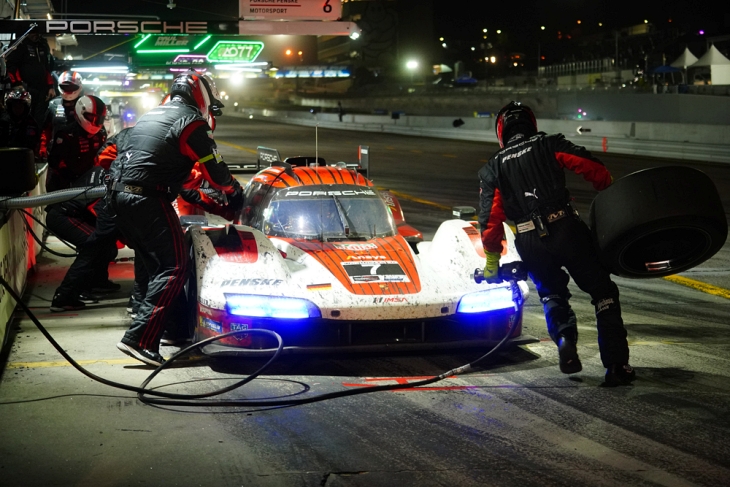
And the opportunity was there for more to end the year: Cameron had an opportunity to win Petit Le Mans for the first time, but he and his co-drivers Nasr and Campbell came away with a third-place finish after some minor issues in the evening hours – including a faulty fuel flow meter and problems with the front brakes.
“Some of these issues were hurting us in terms of performance,” said Cameron. “We had a brake issue at the end. I don’t know where that came from, but we were really wearing the left front rotor at an incredible rate – and weren’t sure if we were going to have to change it. Ultimately, we were a little bit lacking in terms of speed there at the end.”
The #7 joined the #6 of Jaminet, Tandy, and Kevin Estre (one of the drivers primed to win the World Endurance Hypercar Championship for Porsche Penske) on the podium as they finished third and second.
“On the one hand, it’s okay because we got what we came here for. But on the other hand… it’s always a little bittersweet to be out of the fight for the race win,” Cameron lamented.
A year like this was always what was expected from the day Porsche announced its commitment to the new LMDh regulations in December 2020, to the day it was announced that Team Penske would rekindle its successful partnership with Porsche from years past.
The first part of 2023 on both fronts of the Porsche Penske attack didn’t live up to the hype – it seemed as if 17,000 testing miles in the previous year weren’t enough to match Cadillac and Acura who had been in the DPi category prior to the launch of the new GTP.
Even the 963’s first win at Long Beach felt like a fluke – before victories at Road America and Indianapolis began to tell a story of a platform that was rounding into form and an alliance that was finally starting to operate at the standards that Porsche and Penske set for themselves.
“I’d say it was a reality check,” Cameron reflects, “when you’re running on your own and things like this – and you don’t really know where you stand.
“The development period was difficult, obviously, being the first guys running some of the HV components. There were some issues that were out of our control – but we were, as a group, willing to take that risk, thinking we were going to be, maybe, ahead.
“Turns out, we weren’t ahead, unfortunately. But the group has done a really great job to rectify those things. To make the strides to get to the front, where everybody believes this programme should be.”
Anecdotally, many of Porsche’s most successful racing machines didn’t start realizing their full potential until their second year of racing – the 908, 917, and 919 Hybrid are all textbook examples throughout the company’s racing history.
And now, you can add the 963 to that list of examples of the Porsche ‘sophomore shine.’
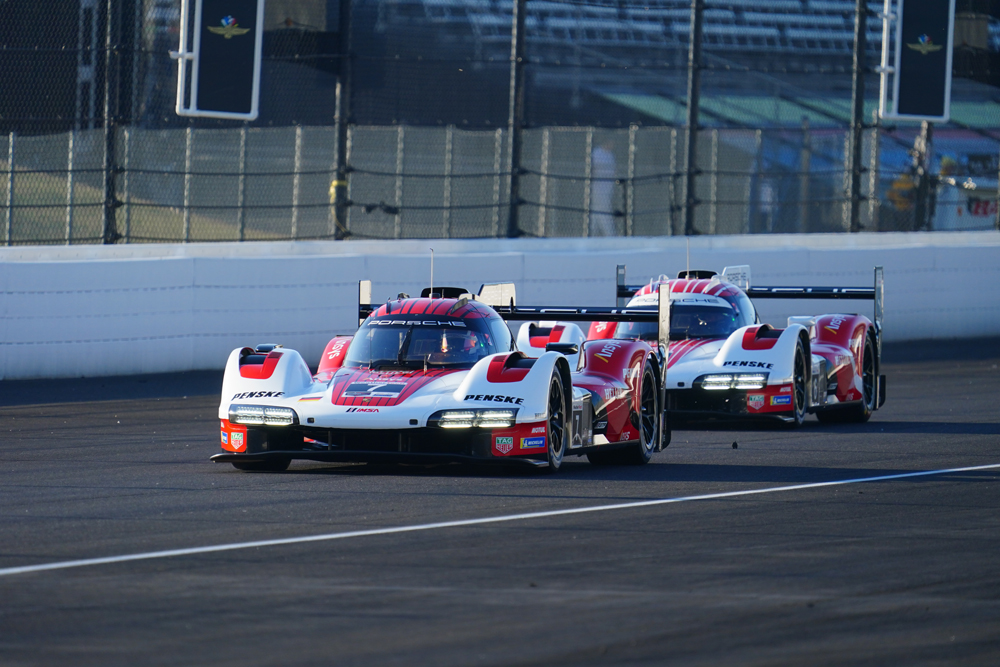
“I think there were a lot of expectations on this project, which we probably missed last year. To make that jump and be in the position to finish 1-2 with the two cars and to win everything is really spectacular,” Cameron said.
It’s only fitting that Cameron and Nasr, who joined Porsche and Penske together ahead of the team’s year-long testing and development programme two years ago, got to team up for this historic achievement.
To Nasr, who found a home in IMSA after two years in Formula One, a championship like this is exactly what he envisioned when he left Cadillac after winning his first two IMSA titles in 2018 and 2021.
“It means everything,” Nasr said of winning his first championship in the Porsche 963.
“When I joined this programme, (I) remember they’re asking me, ‘So why do you want to join the programme?’ I said, ‘Well, I want to create history with you guys. I mean, look at all the statements you made – I want to continue history!’

“2022 was the development (year). 2023 was a difficult season. Come ’24, we completely changed the pace of the programme. And finally getting everything done, winning all the championships possible – that’s exactly what I’m here for. Representing such two big names in the sport like Porsche and Penske, for me as a driver and as a person, it’s a unique moment for sure to cherish.
“As soon as we got Daytona, I feel like that dictated the pace of the season. I could see everybody’s desire, the fire to work harder and dedicate more, and get the car better. I couldn’t think of a better way of it progressing. The whole year has been incredible.
“When I look back, we ticked all the boxes. And when it came to race day, we were there to deliver. We were there to fight for the win many weekends, and here we are. It feels amazing to get a third championship.”
Images © Juergen Tap / Porsche, Jack Webster / Dailysportscar.com