Bosch, Ferrari and Alpine were among the key manufacturers in attendance at the Hydrogen For Life conference in London last week. There, they participated in discussions on the future of hydrogen technology in the automotive and motorsport sectors, debating the challenges, benefits and opportunities that it presents.
There’s a common belief that as motorsport transitions to a more sustainable future, wholesale change will be required in a number of areas. Manufacturers, suppliers, circuits, teams, drivers and rule-makers will all need to play a part in ensuring that the sector as a whole meets ambitious sustainability targets, continues to provide a platform for innovation and delivers excitement on track that attracts the eyes of the public.
There is a tall, steep mountain to climb in the decades to come, though there appears to be a growing sense of belief that it is not insurmountable.
At the conference, the three aforementioned organisations took to the stage to discuss their thoughts on hydrogen as a future solution for motorsport and high-performance motoring.
Crucially for these pages, sportscar racing – and specifically the FIA WEC – was mentioned throughout as the natural home for the development of high-performance hydrogen technology, with the future regulation set for 2028 fast approaching.
And in line with the FIA’s energy transition road map – which is prioritising solutions for hydrogen stored as a liquid rather than gas – Bosch, Ferrari and Alpine all reiterated that it appears to be the most suitable path for motorsport in the future as things stand today.
The jury is still out, for example, on whether or not standard passenger road cars fitted with hydrogen combustion engines will ever become the norm, as battery EVs look set to take the majority share in the marketplace.
However, as a solution, hydrogen combustion looks set to become a particularly relevant option for heavy goods and potentially high-performance vehicles. For some applications, it boasts several key benefits over BEV solutions, including potentially longer vehicle range, faster recharging times, the ability to retrofit petrol and diesel engines currently in use and, crucially, perhaps for motorsport, traditional engine notes.
What’s lacking at present in the UK, continental Europe and beyond, is the infrastructure to support a transition for businesses in the short term and a policy-led strategy from key governments. Attention is required, and fast, to give the budding industry that is pioneering hydrogen tech a clearer pathway forward. But there are signs that confidence is building and investment is on the way.
“We are at an interesting moment right now,” Paolo Favino, the head of automotive innovation at the Department of Business and Trade, commented on stage at the event.
“As we prepare to launch an industrial strategy, we are shaping industrial policy here in the UK so we can manufacture the technology here and get it moving.”
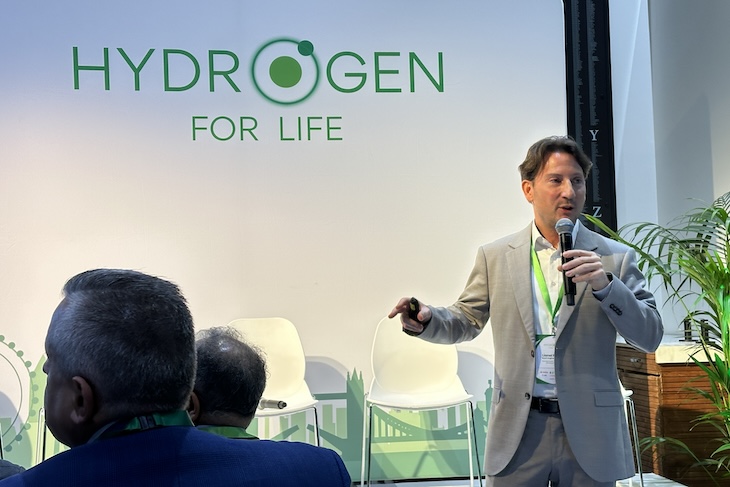
Lionel Martin, Bosch Engineering’s H2 engines and storage product manager, delivered one of the first keynote speeches of the day.
His focus was on the company’s joint project with Ligier Automotive to develop the JS2 RH2, its high-performance “race-ready” demonstrator powered by a 3.0-l V6 gasoline engine converted to a hydrogen combustion unit, which houses three onboard gas tanks.
The project has come on in leaps and bounds since the car was first revealed at the Circuit de La Sarthe ahead of the Centenary edition of the Le Mans 24 Hours last year.
In testing over the past 18 months, the JS2 RH2 – with no major issues – has completed more than 5,000 kilometres and has achieved its targets of producing more than 600 horsepower and a range of 20-25 minutes on track.

“I truly believe that the progress we have made with this car is not only to have fun on the race track, it is to develop better solutions for all kinds of vehicles that run with hydrogen,” he said.
“We had clear targets. A big part was that we wanted to demonstrate that you can easily convert gasoline engines to hydrogen engines. And we truly believe we can increase the power by nearly 20 per cent by optimising the engine hardware.
“Motorsport is committed to carbon neutrality by 2030 and the ACO is motivated to push hydrogen solutions. So are we. In 2028 at Le Mans, we want to be there.”
Speaking with DSC after the keynote, Martin provided more clarity on Bosch’s ambitions in hydrogen competition. He also revealed that development has been parked on the current JS2 RH2 for now, with Bosch looking at developing a solution utilising liquid hydrogen to bring it in line with the FIA’s vision.
“Liquid hydrogen is a future topic for motorsport so we are working on that. We have done a concept study with an OEM,” he said.
“We have developed this prototype (JSR RH2) as the first milestone towards future motorsport. Today we haven’t planned any updates for the car, we are planning for updates to the engine.”
With a presence at Le Mans in 2028 a stated target, does Bosch envision competing with its own car, or remaining a key technology partner for manufacturers?
“We are already a partner for teams and OEMs in the WEC. So our aim is to be there in the first race for hydrogen with our engine control and storage systems,” Martin added.
“Today we are very confident with our engine technology. The key is storage. So it’s good we have the decision on liquid hydrogen, but it’s a massive challenge for everybody, for onboard systems, to logistics, to everything really. But we have always pushed new technologies and met challenges.”
“With a hydrogen engine, you will be able to get enough power to compete for overall wins,” he continued when asked if he felt it was a realistic target for hydrogen-powered cars to compete at similar performance levels to current Hypercars by 2030.
“It’s a question of technical definitions, mainly the maximum engine power, hybridisation yes or no, so the overall powertrain performance. It all has to be defined by the FIA and ACO so that each technology can compete with each other.
“At the start, hydrogen is something for professional motorsport. We need to be realistic with its introduction, which is why the World Endurance Championship is the best choice right now.”
Before participating in a panel discussion in the afternoon, Ferrari and Alpine Racing also took the opportunity to speak publicly about hydrogen power.
Massimo Medda, Ferrari’s powertrain innovation manager, revealed that in recent years the Italian brand has been exploring hydrogen technology, with a focus on internal combustion for use in future projects.

“Hydrogen is a key player to substitute fossil fuels. The question is whether this tech can apply to passenger cars, or if it will only be useful for heavy industry,” he said.
“We could use fuel cell or internal combustion. But Hydrogen combustion makes sense for us because, as we have discovered, it delivers similar power, torque and high revving capabilities to conventional ICEs and complies with emission regulations.
“And our founder Enzo Ferrari, believed that the internal combustion engine was the soul of our cars, we want to keep this soul alive and keep this dream alive. So that’s our focus.
“We have been looking at it for a few years together with Bosch and other colleagues,” he continued. “The results have been very promising. But if we want to win this challenge we cannot do it alone. An extensive distribution grid must be developed for passenger cars and heavy-duty transport. We need support from legislation.”
“Liquid storage is not an option for road cars due to the risk of boil off, but it could be adopted for racing. [For passenger cars] we need to find an alternative solution to reduce the tank mass and increase efficiency.
“Probably the best competition, the best category to introduce H2 into racing, is the WEC, because there are already a lot of pit stops and driver changes, so the time needed for refuelling is manageable, unlike Formula One.”
This adds to Antonello Coletta’s remarks at FinaliMondiali back in October. There the brand’s endurance and GT boss was asked by reporters whether or not Ferrari was interested in signing up to the Hydrogen category in the WEC in the future.
He confirmed that it was involved in the FIA technical working group, which is believed to include a number of major manufacturers, including Toyota and Hyundai.
“This is certainly a technology that we believe can have uses in the future,” he said. “Some manufacturers have already decided to be on that side of it. When the new rules for prototypes were first being drafted, we didn’t think we would do it.
“Now we are among the manufacturers studying it to assess a presence. That doesn’t mean we will do it. But even though they feel like a long way away, they are not that far in the future.
“Nothing is discarded when there could be change on the horizon.”
Alpine Racing’s chief hydrogen engineer Pierre-Jean Tardy echoed Medda’s thoughts when he spoke about the Alpenglow Hy6 project, which was demonstrated in public at the Le Mans 24 Hours this year (the earlier Hy4 is shown below).
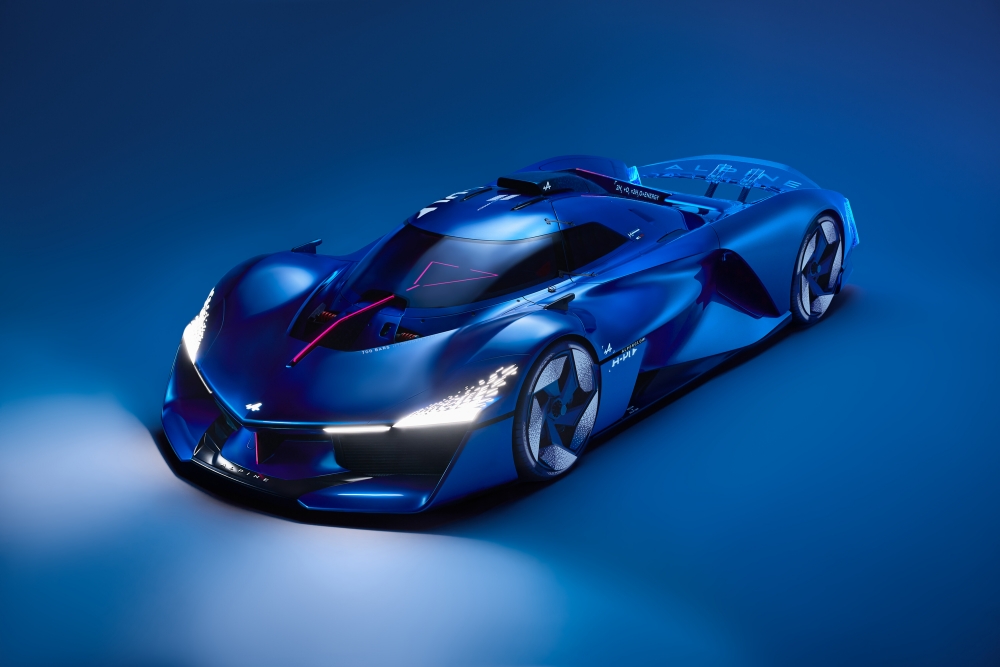
For that car, Alpine has developed a bespoke twin-turbo V6 engine with a high-efficiency combustion chamber design using key learnings from its Formula One programme.
After its exploratory work in recent years, he noted that Alpine holds a similar opinion as Ferrari on Hydrogen combustion technology.
“Hydrogen combustion has lots of advantages compared to hydrogen fuel cell. Liquid hydrogen too, can be fuelled a lot quicker than gaseous hydrogen-powered cars. So if we go racing, it will be with liquid hydrogen,” he said.
What does hydrogen’s future in motorsport look like? That was one of many key, pertinent questions raised during the day at The Oval.
Crucially, some of the most influential organisations and manufacturers are committed to finding out. And with so much work going on in the background to pioneer this technology, we may not have to wait too much longer…