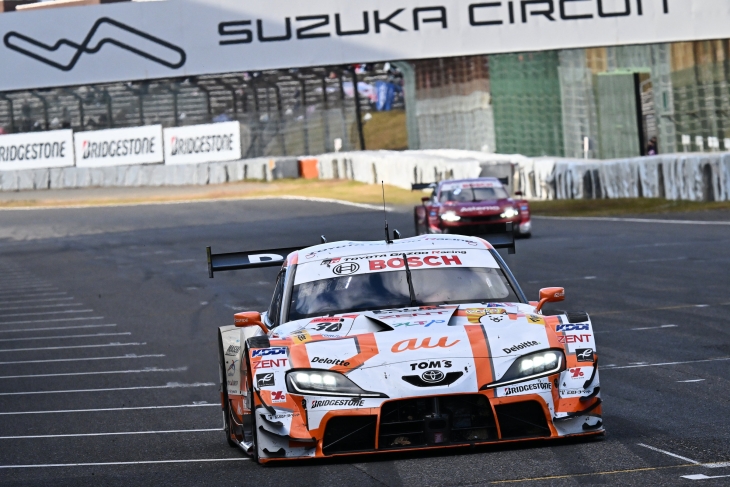
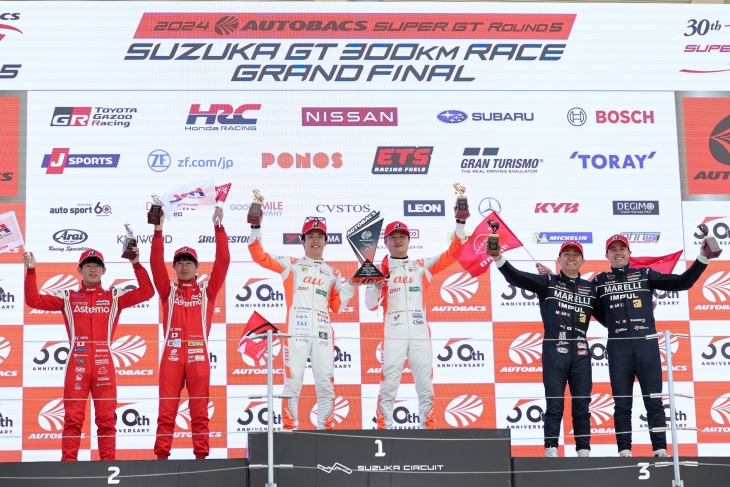
It was a championship-winning season with an exclamation mark. TGR Team au TOM’S, Sho Tsuboi, and Kenta Yamashita completed their 2024 Autobacs SUPER GT Series title-winning campaign with a victory in the season-ending Suzuka GT 300km Race Grand Final at historic Suzuka Circuit.
Suzuka was the host venue of SUPER GT’s first December decider in series history, originally scheduled as the fifth round of the 2024 season but delayed due to the deadly Typhoon Shanshan which struck Japan at the end of August.
On Saturday, Tsuboi and Yamashita clinched the GT500 Drivers’ Championship by putting the #36 au TOM’S Toyota GR Supra on pole position. But on a cool autumn day at motorsport’s most famous figure-eight, they were determined to finish the year firing on all cylinders.
Sunday’s race was shortened by one lap as an extra formation lap was needed due to the cold surface temperatures.

But once the race got going, three-time GT500 Champion Tsuboi got the hole shot into turns one and two, followed by the #17 Astemo Honda Civic Type R-GT of Koudai Tsukakoshi in second, and Tadasuke Makino in the #100 Stanley Civic in third. Teppei Natori lined up third on the grid but got swarmed in the opening corners and dropped all the way down to 14th on the opening lap, allowing Hiroki Otsu in the #16 ARTA Mugen Civic to move up to third.
But in the first few laps, the story was the final race of SUPER GT’s only four-time GT500 Champion, Ronnie Quintarelli. Quintarelli started 11th in the #23 Motul Autech Nissan Z. But with a three-wide lunge up the inside of Giuliano Alesi and Hiroaki Ishiura’s Toyotas, Quintarelli was able to get up to the back bumper of team-mate Mitsunori Takaboshi in the #3 Niterra Motul Z. Takaboshi and Quintarelli fought hard before the #3 car settled in ahead of its counterpart, eventually moving up to fifth place by Lap nine.
Quintarelli made a brave pass up the inside of 130R to overtake the #19 WedsSport Advan GR Supra of Yuji Kunimoto for seventh place, and then on Lap 14, he made a textbook pass around the outside of the Hitachi Astemo Chicane to take sixth place from the #14 Eneos X Prime GR Supra of Nirei Fukuzumi. Takaboshi in the Niterra Z was also making some impressive moves, including a three-wide pass at the exit of 130R to get past Otsu for fourth place, using a GT300 car as a buffer to get by.
On Lap 10, Tsukakoshi collided with the #87 Metalive S Lamborghini GT3 of Natsu Sakaguchi in the Degner Curves. Sakaguchi’s race was over and the Full Course Yellow was deployed to recover the stranded Lamborghini. Tsukakoshi dropped from second to fifth, though he avoided a further penalty for the collision. Tsuboi, meanwhile, maintained a four-second lead over Makino after the FCY was withdrawn.
After 17 laps, the first of the front-running GT500 cars began to make their way to pit lane, including the #100 Stanley Civic that came in for fuel, tyres, and a driver change to Naoki Yamamoto. Another car that came in on the same lap was the #12 Marelli Impul Z, which made its way from 15th to ninth thanks to Bertrand Baguette’s driving in the opening stint.
One lap later, the leading #36 au GR Supra came in for its pit stop, and Tsuboi handed off the controls to his two-time Champion co-driver Yamashita. The #3 Niterra Z followed them in from second as Atsushi Miyake replaced Takaboshi. And then in came the #23 Motul Z for its pit stop. Katsumasa Chiyo got in, and for the final time in his 20-year GT500 career, Ronnie Quintarelli stepped out of the car.
After 21 laps, all GT500 cars had made their routine pit stops, and Yamashita was leading aboard the #36 au GR Supra, followed by Miyake in the #3 Niterra Z, and Kakunoshin Ohta in the #17 Astemo Civic. But Yamashita’s lead was not comfortable – Miyake was within a second of the leading Toyota and putting serious pressure on the champion-elect’s car, lap after lap.
Then, Miyake saw his opportunity to make a move on Lap 29 – with a great run out of the Chicane, the #3 Niterra Z tucked into the #36’s slipstream down the front stretch. Miyake tried the classic outside-line overtake into turn one, and drew ahead – but clipped too much of the outside kerb to keep the car from veering wide in turn two, and Yamashita was able to retain the lead.
Two laps later, the #48 Datsumou/K’s Frontier Nissan GT3 ground to a halt in the Degner Curves with a mechanical problem, bringing out a second FCY. This intervention took a bit longer than expected once the stricken car was pushed off course, and it allowed Ohta to cleverly make up ground at 80 km/h by hugging the inside line at every corner. Yamashita and Miyake were right behind a slower GT300 car – specifically the #11 Gainer Tanax Nissan Fairlady Z – once the FCY was pulled as the leaders came through Degner II. Yamashita rolled smoothly into the throttle, but Miyake, on cold tyres, spun on his own, handing second place to Ohta.

Yamashita maintained a narrow lead in the closing laps, but Ohta, fresh off his first LMDh test at Daytona, was determined to capture his first GT500 victory. With four laps to go, traffic allowed him to close in, and he fired off to the inside of the Chicane to make his move for the lead. But he couldn’t keep all four wheels on track, and Yamashita once again escaped with the lead.
While the final margin of victory was only 1.513 seconds, the #36 au TOM’S GR Supra of Tsuboi and Yamashita led all but two laps to take the win, completing another near-perfect season in GT500 for the orange and white machine.
Tsuboi had his worries during his first stint. “There was a slight feeling of a lack of pace,” he said. “I was able to build a lead at the beginning but after that the others closed in on me and it became a difficult race. In the second half, Yamashita-san’s stint became long and very tough, as he was constantly being challenged from behind.
“Still, we were not content with just having won the championship and he went on to get the pole-to-finish win with all of us cheering him on with all our heart. So, this was really a great race today.”
Yamashita was cool under pressure despite almost running off course due to fluid on track. “It was a more difficult race than I expected it to be, so I am really worn out now,” he remarked. “At one point I slipped, probably because of oil on the track, and it surprised me. It was fortunate that I didn’t come to a stop.
“We had already clinched the championship, but I thought it would look bad if we got passed at the end. And although there were some dangerous moments, I’m glad I was able to hold out till the end.”

Both drivers were motivated to end the season with a victory – and what a win it was. On top of the milestones they achieved by clinching the championship, Tsuboi and Yamashita both earned their seventh career GT500 wins. This equals the career total of, among others, Toyota WEC legends Kazuki Nakajima and Ryo Hirakawa.
For TOM’S, it was their fifth win of the season between both cars – the most wins by any team in a GT500 season in the history of the category – and a second consecutive three-win season for the #36 car alone, following up a hat trick in 2023 for Tsuboi and Ritomo Miyata.
Toyota, meanwhile, matched its 2019 standard with six wins in eight races, one short of Nissan’s record for the most GT500 wins by a manufacturer set in 2008. Bridgestone, for the first time since 2004, swept the season in GT500 as a tyre manufacturer, all while the “group of three” cars on Yokohama and Dunlop tyres locked out the bottom three positions in the class.
Astemo Real Racing’s Tsukakoshi and Ohta finished second, matching Ohta’s best career GT500 finish though coming up just short of his first SUPER GT win.
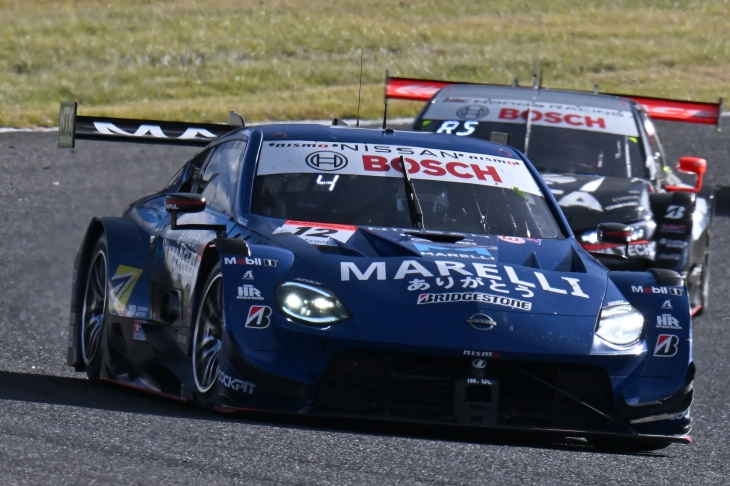
Meanwhile, thanks to a rapid-fire pit stop from Team Impul’s crew, the #12 Marelli Z of Kazuki Hiramine cycled up to fifth place after pit stops. Taking advantage of Miyake’s spin to move into fourth, Hiramine then passed the #100 Stanley Civic of Yamamoto to take third place.
Hiramine and Baguette fittingly gained 12 positions on their way to the final podium position, in the final race for Team Impul with Marelli as its title sponsor after 43 years. Wearing a special decal on the bonnet reading “Marelli Arigatou”, it likely might have been the final moment of glory for a blue Impul Nissan in Japanese motorsport, a bittersweet occasion for generations of fans around the world. We’ll just have to wait and see what look Impul’s new title sponsor presents in 2025.
The #100 Stanley Civic of Yamamoto and Makino finished fourth, six-tenths ahead of the #16 ARTA Mugen Civic of Otsu and Ren Sato in fifth, and another six-tenths ahead of the #14 Eneos GR Supra of Fukuzumi and Kazuya Oshima.
With these results, Yamamoto and Makino confirmed second place in the championship, while seventh place at Suzuka for the #3 Niterra Z of Takaboshi and Miyake was enough for them to move up to third in the final championship standings.
Ronnie Quintarelli finished eighth in his final race, alongside Chiyo in the #23 Motul Z, while the #38 KeePer Cerumo GR Supra (Hiroaki Ishiura/Toshiki Oyu) and the #39 Denso Kobelco SARD GR Supra (Yuhi Sekiguchi/Yuichi Nakayama) rounded out the top ten. The #39 car recovered from an incident in the pre-race Warm-Up session to come away with a tenth-place finish.
As alluded to, Bridgestone cars swept positions 1—12, the best of the rest was the #64 Modulo Civic (Takuya Izawa/Riki Okusa) in a lowly 13th. For reference, that was one place behind the #8 ARTA Mugen Civic (Tomoki Nojiri/Nobuharu Matsushita) which had to serve a penalty stop early in the race for an unapproved engine change.

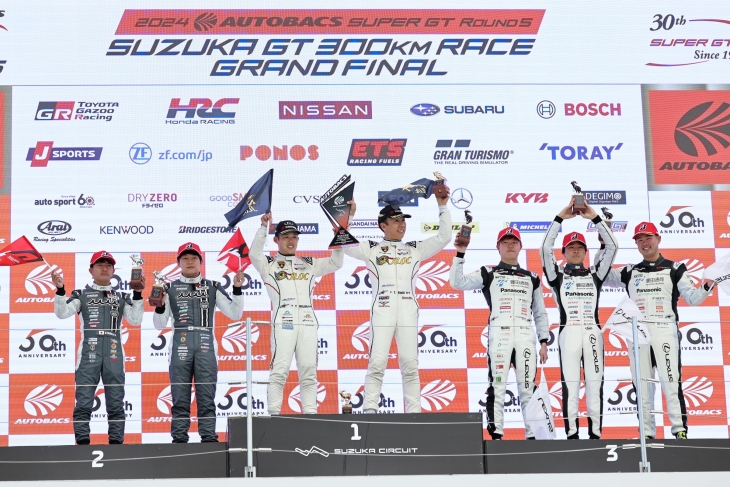
While the GT500 Championships were already determined, there was still a score to settle in GT300. Three teams had a mathematical chance at the championship, but with a come-from-behind victory, the Japan Lamborghini Owners’ Club – known to racing fans as JLOC – finally won its first SUPER GT championship after 31 seasons, as Takashi Kogure and Yuya Motojima drove the #88 Venteny Lamborghini Huracán GT3 EVO2 to its third win in a row, and fourth win of the season.
Kogure and Motojima, after winning pole position, entered the final race of the season trailing the #65 LEON Pyramid Mercedes-AMG GT3 of Naoya Gamou and Takuro Shinohara by eight points. The #2 muta Racing Toyota GR86 of Yuui Tsutsumi and Hibiki Taira was also mathematically eligible to win the championship, but needed a victory and a lot of help to even have a chance.
Motojima started on pole, Taira would start from the second row in third, while Shinohara had a lot of work to do to move up from tenth place on the grid.

The polesitting #88 Lamborghini led from pole, from the #61 Subaru BRZ R&D Sport of Takuto Iguchi, and Taira in the #2 muta GR86. Shinohara slid out of the top ten momentarily after being overtaken by the #777 D’station Aston Martin Vantage GT3 of Tomonobu Fujii, but quickly began to regain positions.
It was a disappointing day for the #56 Realize/Nissan Mechanic Challenge GT-R (Daiki Sasaki/João Paulo de Oliveira) which went to the garage with a suspected engine issue, spoiling Sasaki’s 100th SUPER GT race and ending a potential podium run. On top of that, there was the #87 Metalive Lamborghini’s accident which for a split-second stopped the hearts of JLOC supporters, along with an investigation into a potential start procedure violation for the #88 of Motojima.
Once Motojima was let off with a warning, he could bear down and get to work, extending his lead to around four seconds over the battle for second between Iguchi and Taira.
A defining moment in the race came after 15 laps, when Shinohara brought the #65 LEON Pyramid AMG in for a pit stop. In a bid to gain track position, K2 R&D LEON Racing took fuel only along with its driver change from Shinohara to Gamou. The #31 apr Lexus LC500h of Jin Nakamura used a similar strategy, coming in one lap later.
On Lap 18, the #88 Venteny Lamborghini made its pit stop, taking only two rear tyres along with fuel and the driver change from Motojima to Kogure. Taira cycled to the lead, while Kogure slotted in between the #31 apr LC500h of Kazuto Kotaka and the #65 LEON Pyramid AMG of Gamou. And on lap 25, Taira brought the #2 muta GR86 in for its stop – another fuel-only stop. Tsutsumi left the pits and retained the lead.
With the results as they stood, LEON Racing’s strategy would have won them the championship.
But after the second FCY, the #88 Venteny Lamborghini began closing in rapidly on the #31 Lexus. A bullet in a straight line, Kogure caught and passed Kotaka for second, and then began chipping away at Tsutsumi’s five-second lead. And there was urgency to do so – because even this position change would not have been enough for JLOC to take the title. Kogure began cutting into Tsutsumi’s lead rapidly with a massive advantage through the high-speed third and fourth sectors.
With 11 laps to go, Kogure was right on Tsutsumi’s tail, trying to pass around the outside but not carrying enough speed to make the move. But the next time around, Kogure would not be denied. A perfect exit from the Chicane gave Kogure the momentum he needed for a perfect slipstream pass up the inside of Tsutsumi, and the #88 Lamborghini was in the lead, back in a championship-winning position!
Kogure began driving away, and Gamou was stuck in fourth, now needing to gain two places to retake the championship for LEON Racing – but he’d run out of time.

JLOC, the team that had never finished better than fifth in the Teams’ Championship before the season, the team synonymous to Western sports car fans with ambitious failure in the late-2000s yet equally synonymous as one of SUPER GT’s ever-present teams since its inaugural season, had finally won its first SUPER GT title. Fittingly, it came at the same venue where JLOC got its first GT300 win in 2006.
“I am really happy,” exclaimed Kogure. “I feel truly grateful to everyone, from JLOC Chairman (Isao) Noritake to everyone on the team, to the people at Yokohama Tyres and to Motojima-san for building us a lead in the first half.
“Am I the third one to win a championship in both classes? I am grateful for this too,” he wondered – and he was. Kogure joined Masataka Yanagida and Kazuya Oshima as only the third dual-class champion, coming on board at JLOC after his Honda factory contract ended after 2018.
“When I quit the GT500 class I thought that my life as a racer was over, but Chairman Noritake gave me another chance and I am really grateful now to have won another championship,” he said.

“I don’t know what to say. I’m at a loss for words,” added Motojima – who first broke into SUPER GT with Team Taisan in 2016, but found his true home in the series with JLOC in a deal that began with a part-time contract the following year. “Ever since Chairman Noritake made me this offer, there were hard times when I thought I couldn’t win anymore, but he would tell me, ‘It’s OK, believe in yourself.’”
Motojima waited until the final race of last season for his first victory, and now has a championship to his name.
“From the second half of last year, it seems that began to have an effect, in the team’s 30th year at that. And nothing could make me happier than the fact that we finally won the championship. I am full of gratitude to Chairman Noritake, to all the people at JLOC and to Kogure-san. That is all that I can say.”
And JLOC did it in style – putting together the greatest season in 26 years. Kogure and Motojima’s fourth win was the first time any team and driver combo, in either category, won this many races since the unbelievable 1998 title-winning season from Team Taisan and Tsuchiya Engineering’s Keiichi Suzuki and Shingo Tachi, who won five races. And of course, for Lamborghini, this was their first championship as a manufacturer, represented almost exclusively through JLOC with the Countach, Diablo, Murcielago, Gallardo, and Huracán over the years.

Tsutsumi and Taira drove the #2 muta GR86 to a second-place finish, doing all they could to secure a championship but falling ten laps short of the win they needed to even have a chance.
And rounding out the podium was the #31 apr LC500h of Kotaka and Nakamura (accompanied by third driver Yuki Nemoto, who did not drive), the first podium of the year for the duo. Just two months before his 19th birthday, Nakamura became the youngest GT300 podium scorer since Ritomo Miyata got his first in 2018 – and how fitting, when considering the smart money in the paddock is on Nakamura following a similar path to Miyata.

The #65 LEON Pyramid AMG of Gamou and Shinohara finished fourth, as they fell four points short of the championship in the end. They made the right strategy call to make their way to the front, and left Suzuka with no regrets despite the near-miss.
But they did have to hold off the #6 Uni-Robo Bluegrass Ferrari 296 GT3 (Yoshiaki Katayama/Roberto Merhi) at the end, which finished less than two-tenths behind in fifth.
The #777 D’station Vantage of Fujii and Charlie Fagg finished sixth, capping off the best season for an Aston Martin GT300 team since 2012, while the #61 Subaru BRZ of Iguchi and Hideki Yamauchi finished seventh to finish what had been a miserable year for the duo.
In eighth place was the #11 Gainer Z (Ryuichiro Tomita/Keishi Ishikawa/Kazuki Oki※) despite shedding its rear cowling down the run into 130R, it didn’t destroy their race. The #96 K-tunes Lexus RC F GT3 (Morio Nitta/Shinichi Takagi) and the #4 Goodsmile Hatsune Miku AMG (Nobuteru Taniguchi/Tatsuya Kataoka) completed the top ten.
On the final lap of its final race, the #18 UPGarage Honda NSX GT3 (Takashi Kobayashi/Syun Koide/Yusuke Mitsui) retired, classified 24th in what will all but certainly be the final GT300 race for the NSX GT3 that took two wins in 2023, and won the GT300 Championship in 2019 via ARTA.
It was the last race for Muneharu Ito’s Arnage Racing team, at least in its current form. Igor Fraga and Yuga Furutani finished 21st in their #50 Anest Iwata Racing RC F GT3, and while Anest Iwata wishes to continue racing in GT300, it will not be in partnership with Arnage Racing. Ito, the former TOM’S engineer who has run the team since 2013, said on his social media accounts that “Arnage successfully took the first step towards the second phase,” showcasing a garage also carrying R’Qs Motor Sports’ Mercedes, and the Craft-Bamboo Racing Super Taikyu machine which the team prepares.
And while Team Mach is working to secure a new Mother Chassis vehicle and enough parts for its GTA V8 engine, the 12th-place finish for the #5 Mach Syaken Air Buster MC86 Mach Go (Yusuke Shiotsu/Kiyoto Fujinami) could have been the last GT300 Mother Chassis race, ten years from its launch.
The curtain closes on the 30th anniversary season of the Autobacs SUPER GT Series, and it’ll be four months until the fever returns for the start of the 2025 season.
Images © GTA