We’re looking back at some of the biggest races of 2024 with a travel diary series from DSC’s Australian correspondent Michael Zalavari. Here is the final instalment, documenting his visit to the Spa 24 Hours.
Missed out on previous parts? Catch up with the following links. PART 1 | PART 2 | PART 3 | PART 4
*****
My travels post Le Mans had taken me through Belgium, and I found my way to the town of Spa at the beginning of race week, well ahead of track action. The beautiful town on the Ardennes was the perfect place to focus on rest, and recuperation, ahead of my last challenge in my month of motorsport coverage.
Come Wednesday afternoon, I enjoyed a slow morning before clearing out into the main plaza, to wait for the arrival of Graham and, for his first-ever event as media, Ewan Wane.
It was going to be an interesting weekend for me, taking on the senior role for the first time, as well as guiding Ewan through his first event (hopefully of many). I was looking forward to a new challenge, while simultaneously feeling nervous at the prospect of the added responsibilities!
We loaded into the media centre, and while Graham immediately went off, catching up with every second person around the room, Ewan and I got settled in and started working on a plan for the weekend.
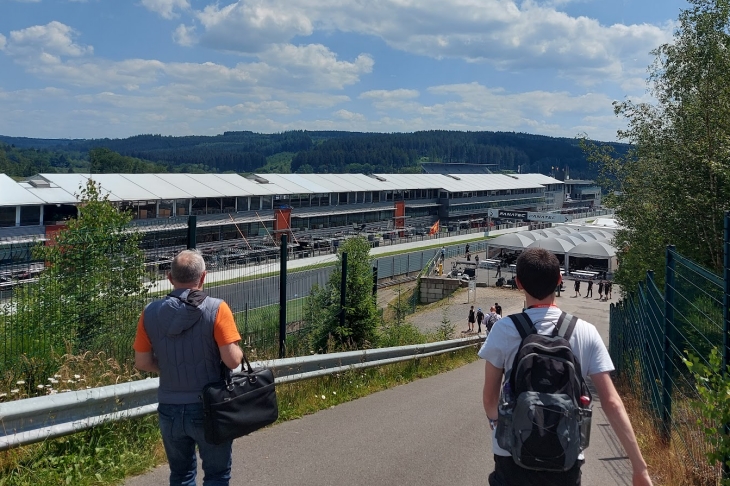
For Ewan, the focus would be the ‘bread and butter’ of weekend coverage – session reports. The goal was to get him up to speed with the DSC reporting style, and have him do most of the on-track reporting through practice and qualifying, under the watch of myself and GG.
For me, I’d be focusing on feature content and paddock notes, basically trying to chase down the stories from the paddock as they were happening. It was a new role for me – normally I’m the one Focussed’s on the track while everyone else chases the paddock – and I was already trying to plan stories and interviews as we settled in.
*****
We were shortly joined by Jasmin, the comms manager from Kessel Racing, who was supporting DSC’s coverage of the Spa 24 Hours. She presented us a task right away: Come up with a story to explain the crutches and moonboot that had appeared since I last saw her at Le Mans that was more interesting than ‘I fell over while hiking.’ After sharing a few ideas, “mountain lion” was the preferred answer, and the tone was set for a fun weekend of working alongside the team.
Kessel’s support of DSC at the Spa 24 was part of a longer sequence of stories and features which would include a visit to the Kessel headquarters for Graham and David Lord later in the year. For this week, they would provide us additional access to the team, while in return, DSC would prepare feature content on the team’s efforts during the weekend. The first part of that deal was already imminent; The Spa 24 Centenary Parade was just about to start, and we needed to be on our way to the town, or else we’d miss out!
From my understanding, these arrangements are not uncommon in the world of sportscar media and offer teams a good chance at sharing their stories and getting in front of the eyes of fans on a different platform, but it was the first time I would be involved in one. Something I expected to be difficult and contrived turned out to be easy and enjoyable, as Jasmin joined us (or rather, we joined Jasmin!) in trying to track down the #8 blue-chrome Kessel Ferrari, which had already gotten lost on the parade!
The parade itself was a great day in town, with the chance to have plenty of low-key chats with a variety of drivers and team members in amongst the chaos, to show Ewan around, and answer some of his questions. The one thing I kept repeating to him was to enjoy it – I remember being so stressed at my first event that I forgot to enjoy it!

Wrapping up at the parade brought us back to the track and into Kessel’s hospitality for dinner. I had already worked out that good hospitality was key in having an enjoyable weekend, and Kessel’s hospitality suite sent a clear signal that I’d be eating well this week.
At the Nürburgring, I’d been lucky enough to sample Porsche’s hospitality on the fourth floor of the pit building, then United Autosport’s variety of cuisines at Le Mans had been great in a really challenging week. At Kessel, the food was sublime too, an art form; one side, a full Italian-style platter of cheeses and salads; the other, a variety of pasta, meats, and seafood; down the centre, trays of desserts. I could get used to this…
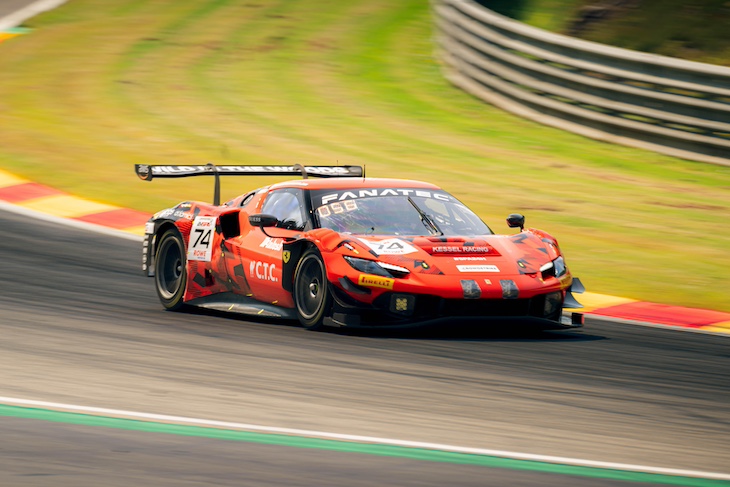
As a special treat too, Ewan had the chance to sit in and watch qualifying in the Kessel Racing garage and ask the drivers and engineers about dealing with qualifying at the 24 Hours of Spa, and we were invited onto the grid with the team ahead of the race. During the race, we were invited to document its mandatory technical pit stop as well. The access given by the team made us more informed about the goings-on behind the scenes and gave a very personal view into the complexities of a 24-hour race.
*****
Working the paddock at the Spa 24 is a challenge because it spans both the GP pits, as well as the full length of the Endurance Pit – all the way down to Eau Rouge! Trying to chase teams that had issues in Super Pole was more of a chore, because they were all at the bottom of the pit lane. You certainly get a lot of miles in the legs in the Spa 24 paddock.
The elevation change in the paddock was nothing compared to the track itself. With no broadcast of FP1, Graham’s gracious ‘oh go on then’ gave Ewan and me free rein to take in every view we could get to in the two-hour session. Charging down the hill, we made our way to Eau Rouge, before hiking back up to the top of Raidillon, just as the session went green.
It’s a cliche that’s been said a million times before, but you cannot appreciate just how incredible the elevation is until you’re there – just like Skyline at Bathurst, or anywhere at the Nordschleife.
We cut through the tunnel at Bruxelles to a view I’ve always wanted to see: Standing at the top of Jacky Ickx corner, with the run to Pouhon directly in front of us, being able to see the Esses through the trees to our left, and then in the distance, Blanchimont, the Bus Stop, and pit straight. Wow, and placed right in front of my eyes.

But as much as I was enjoying the view, I could never enjoy it as much as some of the fans. At Bruxelles, we came across two lads who had strung up hammocks between the trees, with a clear view of the cars whipping their way around the dropping right-hand hairpin. I’m sure they could have stayed there for the 24 Hours straight without leaving their spot, in absolute comfort. The dream.
Almost as special was being able to walk along the track after warm-up on Friday, in the dark. The track was open from Pit Entry to the top of Raidillon, giving the stream of spectators (and two DSC reporters!) an amazing chance to get onto the race track.
There were people writing on the track, having a small picnic on the grass, and sitting in the grid slots pretending to take off, in a special hour before midnight.
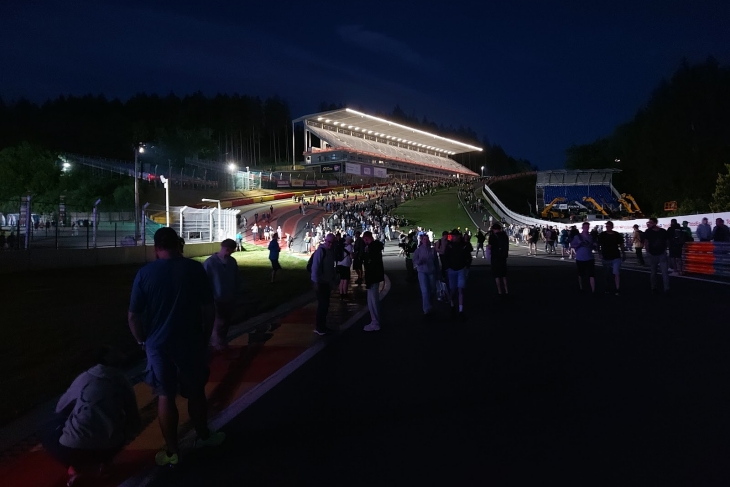
I hadn’t had a chance to get on the racing surface in any meaningful way yet, so to get the chance to run up one of the most incredible pieces of the road was something truly awesome.
*****
Getting back to the media centre after FP1 presented us with a challenge. With no broadcast of the session, how do we describe the experience of being trackside with those cars all going around? While we were out, we witnessed a few issues, including a puncture and a crash up Eau Rouge, so there was insight that we had that the reader at home wouldn’t have access to. I decided to write up those incidents while giving Ewan a chance to write about the experience of being trackside. And for his first assignment, that was a tough one.
After we’d finished the report, we had a quick chat, and I quickly realised that I’d assigned the jobs the wrong way around, and effectively thrown the poor lad too far in the deep end for his first go. It was a re-calibration moment for me, and a reminder of just how much experience it took me before I was comfortable filling a brief like that.
Working with Ewan for the weekend was great for me for two main reasons. Firstly, it was awesome to have additional support to allow me to chase a few different stories without having to worry about session reports. Once we had a broadcast and timing, Ewan was on the ball and able to follow a session and pull together a good story without too much support. And he was a sponge too – seeking feedback and quickly implementing our comments into his next report. It was awesome to see his willingness to adjust better his writing, and the immediate effect it was having.
Secondly, Ewan gave me perspective. Spa was my third event in a month after five years of coverage, and I had lost sight of improvements in my confidence in writing and interviewing in that time. Having Ewan tell me that I’d made approaching drivers at the Parade look easy was something that made me pause and reflect.
That impostor syndrome I felt in the room at Bathurst while at the WRT roundtable was completely absent as I sat at the same roundtable at Spa, quizzing Rossi once again about his future driving plans, and asking Raffaele Marciello about the track surface in front of 15 other journalists. It had become easier.
*****
Something I didn’t appreciate until afterwards was just how different the atmosphere was at each of the three 24-hour races I attended. The Nürburgring 24 felt like a race had broken out at a camping festival; the masses of people on the grid, next to the track, in the campgrounds, in the mud and rain. Le Mans on the other hand was the Grand Prix d’Endurance; everything was meticulous in its preparation, from Pesage to the paddock and even the fan zone, all immaculate.
Something I didn’t appreciate until afterwards was just how different the atmosphere was at each of the three 24-hour races
The Spa 24 felt more like a showcase. A real celebration of GT racing, with previous class winners, GT1 cars, and a variety of GT machinery on display and in support categories. It was also a showcase in the paddock, with marketing displays on every level of the multi-layered structures, promoting teams, brands, and cars. A of the SRO, displaying the success of GT3 as a platform, with repeated references to the massive grid of cars amongst the different marques for the SRO’s blue riband event.
It’s a very different race to report on too. The restrictions in strategy as defined by the regulations mean that for a lot of the first part of the race, all you can realistically do is report on who falls out of the running. With so many cars, all prescribed the same stint length, and the same pit stop time, it is rare that anyone can break free of the normal race flow and do something different out of the ordinary on the strategy front.

There’s also a feeling of dread. 66 cars of relatively equal speed crammed onto a track as hazardous as Spa, with varying driver abilities, is a pressure cooker waiting to explode. The Spa 24 Hours has seen some monumental incidents in its time, and unfortunately, the experienced people in the media room were waiting for the next one to be added to that list.
Thankfully, for the opening hours of the race on Saturday, we managed to escape without the big one. There was one minor incident (which did put a car out of the race) but for the most part, everyone was well-behaved, and the field began to disperse across the track, untightening the knot in my stomach. After the third hour, Ewan and I lodged our report to Graham, and headed over for dinner. The race had just gone to green, and we were watching the restart on the screens in Kessel’s hospitality.
Just as we served ourselves, ‘the big one’ happened. Contact on the old pit straight saw Christian Hook’s Ferrari stranded and stationary on the approach to Eau Rouge, where he was collected by the Porsche of Adrian D’Silva at full speed.
Dinner was going to have to wait.
*****
Ewan was now covering the race while I worked to unpack the incident, following the same structure I’ve used when working as a corner marshal; What happened before, during, and after? At that stage, we hadn’t heard whether Hook, D’Silva and Baerts were okay, so I had to tread carefully.
The initial incident was an innocuous squeeze, but for the Ferrari being turned across the front of the Aston Martin into the pit wall. That left Hook stranded on the old pit straight, on the approach to Eau Rouge, and 15 seconds of double waved yellows that should have resulted in cars significantly slowing.
Here’s the incident that resulted in the Safety Car period.
The #12 Aston Martin (Baert) and #333 Ferrari (Hook) collide on the exit of La Source – the latter is then hit by the #61 Porsche (D’Silva).
ALL DRIVERS OK.#Spa24H #FanatecGT | #GTWorldChEU pic.twitter.com/PTqpu00H74
— GT World Challenge Europe Powered by AWS (@GTWorldChEu) June 29, 2024
While I stayed away from making a judgement call on that fact in my report, there was plenty of discussion around the table and the media centre on the appropriate course of action in response to so many cars passing by the incident at close to racing speed.
Just as I was finishing, an announcement in the media centre confirmed that Hook, Baerts and D’Silva were all okay. A collective sigh of relief rang out around the room.
It’s incredible the amount of emotional energy writing about an incident can take sometimes. By the time I’d finished, with the relief of the good news still very fresh, I felt entirely drained. This was then compounded by a further string of incidents taking us all the way through to the quarter race mark, and the next DSC report.
The onset of rain and resulting safety car gave us a chance at respite, and the decision was made to head back to the accommodation and try for a decent sleep, with a burger on the way to make up for missing dinner. For the third race in a row, I’d been rained on in the middle of the night – so much for a European Summer!
*****
Weeks of built-up fatigue hit me as my alarm went off on Sunday morning, and all three of us trudged our way back to the circuit to find the race already back underway. Coffee and breakfast in the Kessel garage lifted our spirits slightly, but I was fading quickly. The combination of the new role, while managing and teaching Ewan, off the back of six weeks of travel and my third 24-hour race in a month had left me running on nothing more than adrenaline and caffeine.
Graham noticed this too, and took it upon himself to keep me going as the race approached its finale. Very explicit instructions to “Get outside and don’t come back until you feel alive” after the 20-hour report had me crossing back to Kessel for a third coffee before 1 pm, and a task to write once I’d gotten back.
Occasionally, you can tell who is going to win the race well out from the finish. At Bathurst, it was Manthey EMA that was dominant all race; at Nürburgring, it was looking like Audi or BMW were making the right choices. At Spa, AF Corse was clearly going to win. The team had made all the correct decisions on tyres and strategy and the drivers had the pace in the car whenever it needed it.
With three hours left, Alessandro Pier Guidi drove away from the field, and it was going to be a lock that Ferrari would take home the Centenary edition of the Spa 24 Hour to go with the Centenary Le Mans 24 Hour the year before. So I got to work, preparing an article detailing all of the achievements, and the significance of a double-centenary win in arguably the two most important sportscar races.

And then all hell broke loose. Pier Guidi couldn’t get into the pits. The #19 Lamborghini, many laps down, had come to a stop in the pit entrance, blocking the lane. It was pandemonium. Out of nowhere, Aston Martin was in the lead.
Out goes all that work then…
*****
After that, the rest of the day was a blur. I remember four things post-race from Spa: the sheer sense of relief after hitting send on my final race report; the chat with Ewan while Graham spoke to the winners, asking them for some comments in Danish to send to our colleague Jens Jensen; the excellent Frites and Frikadel on the way back to the accommodation; and finally, my head hitting the pillow before 8pm. I’m sure more happened (and I’m sure there are photos too), but I had absolutely nothing left to give.
In the month of June, I spent 22 days either travelling to, working at, or travelling from race events
In the month of June, I spent 22 days either travelling to, working at, or travelling from race events. The gaps included three days between Nürburgring and Le Mans, and a week between Le Mans and Spa-Francorchamps, in which I effectively holed up in hotel rooms to catch up on sleep and recover from the brutality that is covering a 24-hour race. It took a toll on drivers, and on teams too – each driver I asked had said that recovery had become so difficult with each event so close to each other.
This year (2025) the Nürburgring 24 Hours will be sandwiched between Le Mans and Spa. For a team, driver, or reporter planning to do all three events, it will mean effectively four weeks straight away from home; from Pesage to the end of the Spa 24. There has already been plenty of commentary saying it will be logistically difficult and for some teams impossible, to transport, bump in, and bump out in time for the next event.
Based on my experience, it would take a herculean effort to be present at all four weeks – Le Mans Test Day, the Le Mans 24 Hours, Nürburgring 24 Hours, and Spa 24 Hours. Managing rest, recovery, and even keeping spirits high are all challenges at any major race event, even just as a fan; four weeks in a row of working, as a member of a team or media, is going to be unsustainable at best.

But, on the other hand, my experiences this year were incredible. To have the chance to report on three of the biggest sportscar races, back-to-back-to-back, with the backing of DailySportsCar was truly a privilege, and I’m so proud to have been given the opportunity, and so lucky to have worked with such good people.
My laptop now has stickers of the Nürburgring, Le Mans and Spa track maps, and I have a new respect for the reporters and photographers who do this travel on a regular basis. I ticked off three bucket list items in one go, and had an absolute blast doing so.
*****
A huge thanks must go to everyone who made this adventure possible, including the teams that supported us, the colleagues in the media centre, and the DSC host family at Arnage. The DSC Crew – RJ O’Connell, Martin Little, David Greenhalgh, Andrew ‘Skippy’ Hall, David Lord, and Peter ‘Pedro’ May, working with you all was a privilege, and I was lucky to be able to lean on all of you for support, ideas, and laughter. And to Ewan Wane, I can’t wait to see you at your next event!
To DSC deputy editor Stephen Kilbey, thank you for putting up with me on the long car rides, thank you for encouraging me, and most of all, thank you for challenging me, and backing that up with great advice. I learned so much from you in such a short time.
The biggest thanks must go to DSC Editor Graham Goodwin. Thank you for giving me the chance to turn this ridiculous dream into a reality.