Today, it’s showtime – as one of professional motorsport’s greatest comeback stories truly begins. And thankfully, Robert Wickens hasn’t had to do all of this on his own. Bosch and Pratt Miller were the companies most invested in developing a system that would allow the former INDYCAR Rookie of the Year to get behind the wheel of a GT3 car, seven years after his life-changing accident at Pocono Raceway.
Wickens’ co-driver for the Acura Grand Prix of Long Beach, Corvette Racing factory driver Tommy Milner, helped ensure that Bosch’s newest generation of hand-controlled throttle and braking was good to go before Wickens even set foot in the car for the first time.
After all, if anyone is qualified to ensure that an ambitious project within the Corvette Racing umbrella is good to go, would it not be the man who has headed up the task of testing and developing both the Z06 GT3.R and the previous Corvette C8.R behind the wheel, before they ever raced in anger?
It began in between Milner’s regular assignment at Corvette Racing by Pratt Miller Motorsports, after the Roar Before The 24 but before the 63rd Rolex 24 At Daytona, when the first shakedown at The FIRM (Florida International Rally and Motorsports Park) in Starke, Florida proved to be a positive – and very eye-opening – experience for the two-time IMSA Champion, and winner at Daytona, Sebring, and Le Mans.
“It was about as smooth a test that I’ve ever had,” Milner told DSC. “Everything worked. There was obviously a plan from Bosch and from Pratt Miller who, together, they designed all the different bits and pieces to integrate into the Corvette well. And everything worked as expected.”
For the test to work, Milner had to put himself in the shoes of the man the car was built for and get used to not only steering and shifting, but applying the throttle and brake with his hands instead of his feet.
It was one thing for Milner to shake the car down and confirm if all the systems were working as intended – but the next day he’d have to start driving for performance. “I told them, I’m not sure that I’m going to be able to do performance running – this feels very unnatural, what I’ve done so far,” he recalls of the first performance test of the accessible Corvette. “They said, ‘Well, that’s fine, we’ll just try.'”
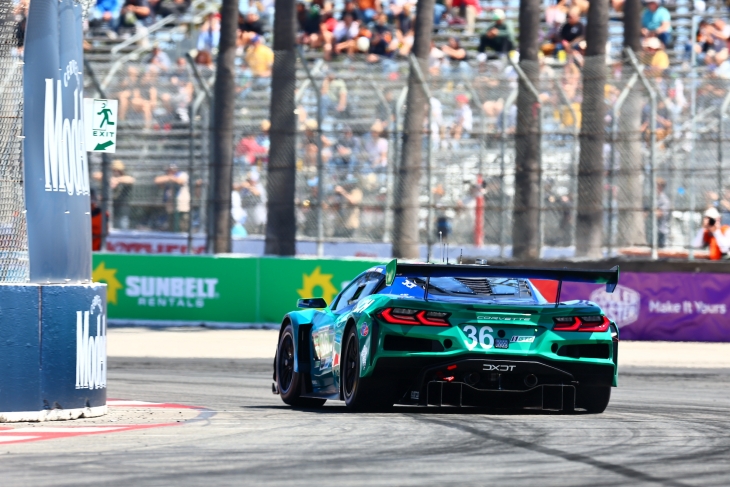
Milner’s apprehensions melted away after only a few laps that morning, running on a damp track with wet tyres.
“I was shocked at how quickly your body can start forgetting about your feet, and then your legs – what you’re used to – and just focus on driving with the hand controls,” he said. “We just stayed on wet tyres just to be safe. But I was within a second of what I was doing with all the normal controls, and it felt very natural, in some ways, to actually drive that way.
“Obviously the big thing is feel, right – how do you feel? With what the car is doing, braking-wise, because now you’re pulling a paddle as opposed to getting feedback from your feet.”
WATCH: Robert Wickens Explains New Hand Control System >>
Having to shed those instinctual responses and learn a different way to drive is, of course, a temporary necessity for Milner. It’s why the car that he and Wickens share can be switched over to a traditional pedal box for feet with just the press of a button on a separate panel inside the cockpit of this specially homologated Corvette Z06 GT3.R.
But this is what Wickens is used to. Ever since 19 August 2018 at Pocono Raceway – the accident, the plateau in his recovery from a spinal cord injury, realising the limitations of his mobility – and yet, defying the odds to get back behind the wheel of a race car and not only make up the numbers but to win races and championships in the Michelin Pilot Challenge TCR category.
“There are situations where, for me it’s awkward, but maybe not as much for Robert. There’s a very tight hairpin at The FIRM where you have to crank all the way over, and you have to, obviously, use your hands that use the throttle on the wheel. That took me a while to get comfortable. But again, I was surprised – the way that the systems are set up, there’s two throttles, two paddles on the back of the steering wheel for the brakes.
“So if your hand moves in a position where it’s awkward to grab the throttle still, you can compensate with the other one. I mean, all of that started to make sense as you drive it and use it. And obviously for someone like Robert, that’s what he has been used to. That’s how he has to drive now. He’ll be more in tune with that stuff.”
The ergonomics of driving with one’s hands have been tried and tested by Wickens over his entire second career in racing, beginning when he stepped into a car that was originally built for fellow paraplegic racer Michael Johnson, with a much less sophisticated hand control system, just to see if he could still do it.
It continued on, culminating in the introduction of Bosch’s newest hand controls that originally made their debut as Wickens neared the end of his full-time TCR run at Bryan Herta Autosport. With no recollections of any major drama during tests at The FIRM and Sebring, it’s clear that Corvette Z06 GT3.R constructor Pratt Miller has done a good job making sure the hand controls have been integrated into a car that is finding success around the world in 2025.
The level of sophistication and ease with which Wickens and Milner (and whoever DXDT Racing appoints to share the car with Wickens in the other IMSA WeatherTech sprint events) can share the car is such a leap forward, reminiscent of what the legendary Alex Zanardi helped bring forward when he made his racing return after losing his legs in a 2001 accident.
“Obviously, this is a performance world, and so having the ability to make those adjustments is super important,” Milner says.
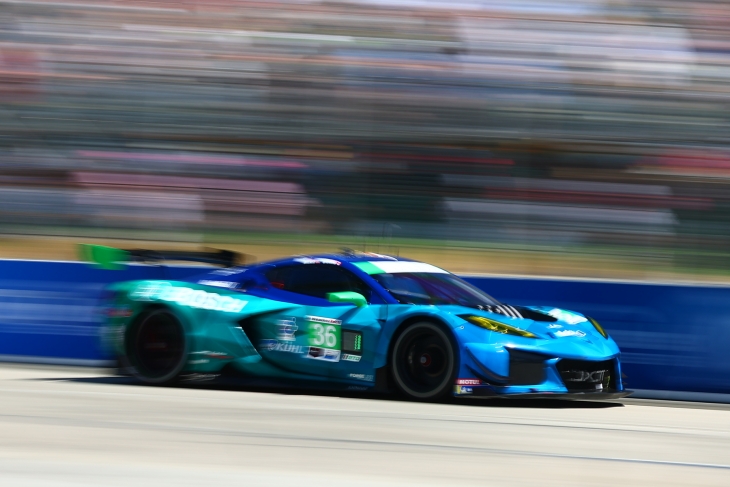
Fast forward to yesterday, after the first practice session, Wickens spoke to the media at Long Beach. He was a bit downbeat at the time due to some trouble on an installation lap, which cost him a lot of time in a short 60-minute session.
Milner, who has worked closely with Wickens over the last three months, talking profoundly and extensively as peers to share their extensive knowledge, heaped praise upon what his co-driver had already achieved.
“I know his standards for himself are super high, but to come here for the first time to Long Beach in a long time, driving basically a car new to himself and be a second off the pace in about 10 minutes of practice is quite impressive,” Milner said of his co-driver.
“He’s talking from the position of who he is. He wants to be the fastest. And that’s why, for me, I’m excited to be here this weekend with him and his journey.
“But also just having a teammate as competitive as Robbie is awesome, rewarding and exciting for me. It’s been easy talking to him about driving this Corvette because it’s like talking to any other teammate that I’ve ever had in my career.”
The rest of Friday had its struggles – a stoppage in the afternoon practice and contact for Wickens during qualifying that limited his potential – but also the uplifting high of him setting the fastest time during the second practice session, hours after he and Milner spoke to the press.
This afternoon, Robert Wickens will begin a journey that’s been seven years in the making. Then there will be a pit stop, Wickens will be assisted out of the car – and Corvette legend Tommy Milner, as he has done so many times before, will do his best to make sure that this first chapter ends as well as it possibly can.
Images © GM